Text to imageSpace & architectureStyle guide
Small Window Seat · Deep Window-Reveal Planes
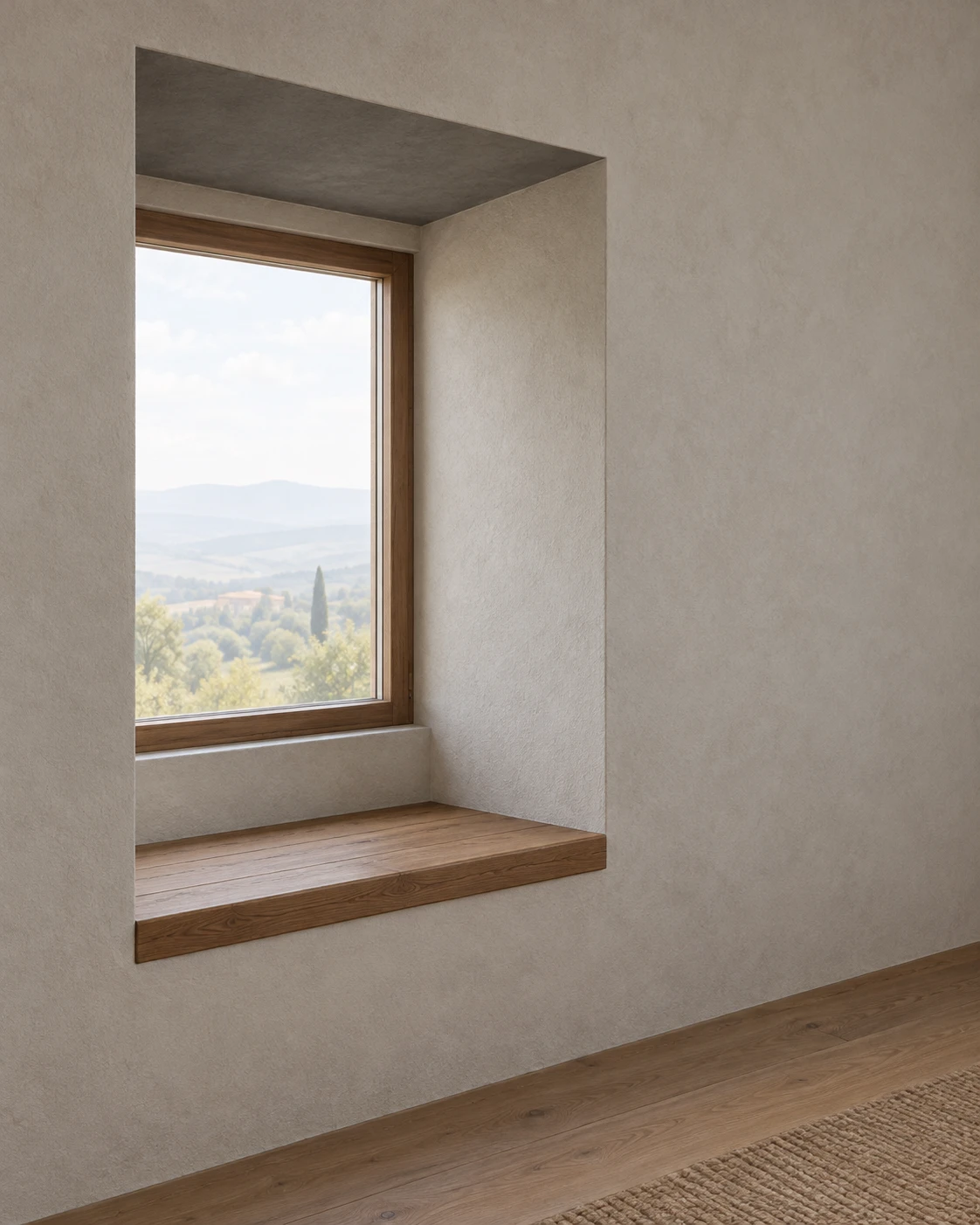
Separate the side and top planes of a deep window reveal with distinct values to show wall thickness and the depth of a window seat.
Small Window Seat · Deep Window-Reveal Planes
- Shape & line
- Construct the opening with straight rectangular edges, and connect the front wall opening to the recessed window with visible depth edges. Make the image-right jamb a broad quadrilateral and the head reveal a shallower overhead plane; keep their shared corners aligned.
- Color & light
- Bring soft daylight through the rear window and keep the outdoor view pale. Give the image-right jamb a light warm-gray value, the downward-facing head reveal a distinctly darker gray, and the front wall an intermediate value, preserving readable boundaries between all three planes.
- Texture & material
- Render the plaster with restrained matte grain that continues across each plane without obscuring its value. Give the wooden seat a few broad grain streaks following its length, and use a soft dark seam where its rear edge meets the reveal to show the fitted junction.
- Composition
- Place the opening slightly left of image center and leave a generous strip of front wall on image-right. Keep the seat fully visible beneath the window, and let the depth edges lead toward the recessed frame while the surrounding room remains visually quiet.
Priority
Prioritize the visible depth and value separation of the window-reveal planes.
What to avoid & what to check
Avoid flattening the window into a surface rectangle or flooding every reveal plane with equal brightness.
Check that the right jamb, overhead reveal, and front wall read as three connected planes around a recessed window.
Exact prompt for this example
SUBJECT
One small interior window seat built into a thick plaster wall, with one rectangular window recessed behind two deep side jambs and a deep head reveal. A single plain wooden seat spans the bottom of the opening, directly below the window.

COMPOSITION
View the opening obliquely from inside the room, positioned to the image-left of its center, so the image-right jamb and the underside of the head reveal are clearly visible. Include the entire opening, the seat, a short strip of floor, and enough surrounding wall to read the recess.

STYLE GUIDE
1. Shape & line
Construct the opening with straight rectangular edges, and connect the front wall opening to the recessed window with visible depth edges. Make the image-right jamb a broad quadrilateral and the head reveal a shallower overhead plane; keep their shared corners aligned.

2. Color & light
Bring soft daylight through the rear window and keep the outdoor view pale. Give the image-right jamb a light warm-gray value, the downward-facing head reveal a distinctly darker gray, and the front wall an intermediate value, preserving readable boundaries between all three planes.

3. Texture & material
Render the plaster with restrained matte grain that continues across each plane without obscuring its value. Give the wooden seat a few broad grain streaks following its length, and use a soft dark seam where its rear edge meets the reveal to show the fitted junction.

4. Composition
Place the opening slightly left of image center and leave a generous strip of front wall on image-right. Keep the seat fully visible beneath the window, and let the depth edges lead toward the recessed frame while the surrounding room remains visually quiet.

PRIORITY
Preserve the requested identity, count, action, composition and output settings. Apply the style rules within those constraints; a style reference must not replace the subject or layout. Within the style: Prioritize the visible depth and value separation of the window-reveal planes.

AVOID
Avoid flattening the window into a surface rectangle or flooding every reveal plane with equal brightness.

OUTPUT
One architectural interior illustration in a 4:5 portrait aspect ratio, with no lettering, labels, dimensions, or watermark.

SELF-CHECK
Check that the right jamb, overhead reveal, and front wall read as three connected planes around a recessed window.
Model information comes from image provenance. The same prompt may produce a different result.