Text to imageCharacterStyle guide
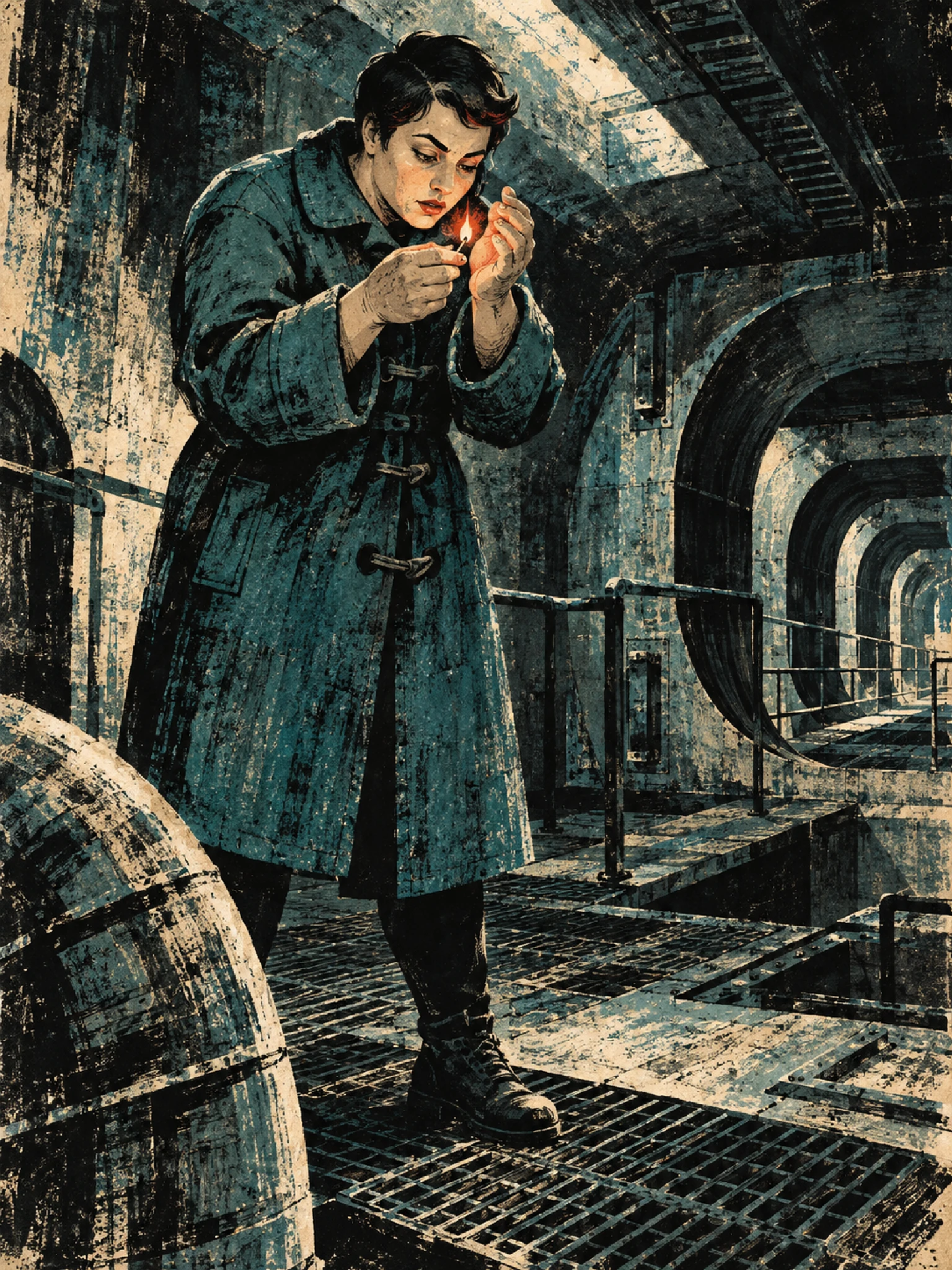
Shielding a Match in the Vent Hall
Among deeply ribbed ventilation ducts, a woman shelters a small match flame between her hands. Rough ink contours and shifted print layers connect the cavernous setting with her delicate gesture.
Remix this referenceShielding a Match in the Vent Hall
- Form language
- Build forms from blunt interlocking masses, allowing smaller shapes to simplify or vary within the same cut-and-brushed vocabulary.
- Contour
- Alternate loaded brush edges with dry, broken contours; let selected boundaries disappear into adjoining ink masses.
- Mark-making
- Combine broad roller skips with quick dragged strokes and occasional scraped openings; vary their pressure and spacing naturally.
- Surface rendering
- Use translucent print overlaps, slight registration slips and uneven ink transfer; build tonal changes through broken layers.
Priority
Keep the experimental ink-and-print poster treatment visibly tactile and irregular.
What to avoid & what to check
Exact prompt for this example
MODULE OWNERSHIP
subject: Subject count, type, stable proportions and landmarks, resting face geometry, hair shape, physical materials, garment construction and permanent marks. No emotion, movement, color assignment or rendering recipe.
expression: Facial soft-tissue displacement and pupil direction, muscle coordination, regional intensity, asymmetry and onset/peak/release. No head/body pose, stable appearance, skin color or rendering.
gesture: Head/neck/body/limb orientation, joint movement, support, contact and pose-caused occlusion using existing anatomy. No eye/pupil movement, emotion, identity, props inventory or camera.
props: Prop count, type, construction, physical material and scale relative to the subject. Holding/contact belongs to gesture, position to composition, color to palette.
scene: Environment elements, terrain, backdrop/floor presence and structural detail. No canvas positions, camera, lighting, assigned colors or render texture.
camera: Projection, focal-length impression, camera elevation/yaw/roll, viewing distance and crop. No actor pose, world placement, lighting or canvas aspect ratio.
composition: Normalized 0-100% canvas positions, scale in frame, depth/overlap, focal hierarchy and margins. No joint pose, camera projection, rendering, subject/prop inventory or emotion.
palette: Color anchors, hue/saturation/value ranges, colors assigned to parts and approximate color coverage. No illumination direction, shading algorithm, physical material or layout.
lighting: Light-source direction/softness/intensity, ambient illumination, physical shadow direction/length and highlight position. Absence of directional illumination is allowed. No shading technique, palette or material changes.
style: Reusable form abstraction, contour weight/taper/edge quality, medium and mark scale/density/direction, surface rendering and tonal transition technique. No fixed subject proportions, anatomy, identity, expression, pose, palette, light-source direction, camera or layout.
output: Image count, aspect ratio, size, file/alpha requirements and global lettering/logo/watermark restrictions. No background scenery, crop, style, identity or pose.

SUBJECT
inventory: One original adult woman, actor A, with a sturdy build and large hands.
geometry: Broad shoulders, a compact waist, substantial calves and a small tapered head create a recognizable silhouette.
resting-face: A blunt nose, wide-set eyes, full lower lip and shallow chin cleft define her resting face.
appearance: A cropped cap of hair has one swept notch; her wool work coat has a rounded collar, toggle closures and broad cuffs.

PRIORITY


AVOID


CHECK


EXPRESSION — ACTOR A
brows: Inner brows draw together slightly, with one brow marginally lower.
lids: Upper lids lower slightly while the lower lids tighten.
cheeks: Cheeks stay quiet, with faint tension beside the mouth.
nose: Nostrils remain relaxed without a visible flare.
mouth: Lips part narrowly at the center; the corners stay level.
jaw: The jaw releases just enough to support the small lip opening.
gaze: Both pupils settle on the match flame.
coordination: Brow and lid tension lead; the lower face remains restrained.
timing: Hold the apex of quiet concentration.

PRIORITY


AVOID


CHECK


GESTURE
head: Her neck bends gently forward and her chin lowers toward her hands.
torso: The torso inclines over the hands, with one shoulder advanced to form a shelter.
limbs: Bent elbows form an open bowl; staggered feet support the forward lean.
contact: Right fingertips pinch the match; the left palm curves beside it, leaving the flame and face visible.

PRIORITY


AVOID


CHECK


PROPS
inventory: One short match, small enough to sit between two fingertips.
construction: A slender wooden stick ends in a compact, partly charred match head.

PRIORITY


AVOID


CHECK


SCENE
inventory: A disused ventilation hall contains ribbed ducts, grated walkways and recessed access hatches.
structure: Nested duct openings connect through a low maintenance passage; the ceiling has a narrow slit.

PRIORITY


AVOID


CHECK


CAMERA
projection: Use natural perspective with a moderately wide, roughly 40 mm lens impression.
viewpoint: View from chest height at a shallow three-quarter angle, with a level horizon.
crop: Show the complete figure from a distance that keeps the hands and facial acting readable.

PRIORITY


AVOID


CHECK


COMPOSITION
placement: Place A around 38% of the canvas width, with the figure about 80% of the frame height; the match sits just left of center.
depth: A cropped foreground duct overlaps the coat hem; successive openings recede beyond the figure toward the right.
spacing: Make the flame the first accent, then the face and hands; leave breathing room around this cluster.

PRIORITY


AVOID


CHECK


PALETTE
colors: Use soot black, mineral teal, warm paper cream and a concentrated vermilion accent.
assignment: Give the coat teal, hair and recesses black, skin cream, and the flame a cream core with vermilion edges.
balance: Black and teal dominate; cream opens the image, while vermilion remains scarce and vivid.

PRIORITY


AVOID


CHECK


LIGHTING
sources: Soft daylight enters through the ceiling slit from high left; the match adds a small local light beneath the face.
shadows: Broad shadows fall to the right, with deeper shelter beneath the collar and between duct ribs.
highlights: Daylight catches upper shoulders; the flame picks out fingertips, lower lip and the underside of the nose.

PRIORITY


AVOID


CHECK


STYLE GUIDE
form-language: Build forms from blunt interlocking masses, allowing smaller shapes to simplify or vary within the same cut-and-brushed vocabulary.
contour: Alternate loaded brush edges with dry, broken contours; let selected boundaries disappear into adjoining ink masses.
mark-making: Combine broad roller skips with quick dragged strokes and occasional scraped openings; vary their pressure and spacing naturally.
surface-rendering: Use translucent print overlaps, slight registration slips and uneven ink transfer; build tonal changes through broken layers.

PRIORITY
Keep the experimental ink-and-print poster treatment visibly tactile and irregular.

AVOID


CHECK


OUTPUT
format: One finished image, portrait 3:4, 1536 × 2048 pixels, opaque PNG; no lettering, logos or watermarks.
restrictions: One finished image, portrait 3:4, 1536 × 2048 pixels, opaque PNG; no lettering, logos or watermarks.

PRIORITY


AVOID


CHECK


FINAL INTEGRATION
expression + gesture + composition: Let the facial performance and hand gesture read together within the focal cluster.
lighting + style: Preserve the light relationships through the broken print layers.
Model information comes from image provenance. The same prompt may produce a different result.