Text to imageCafe & brandStyle guide
Cooper Turning a Barrel
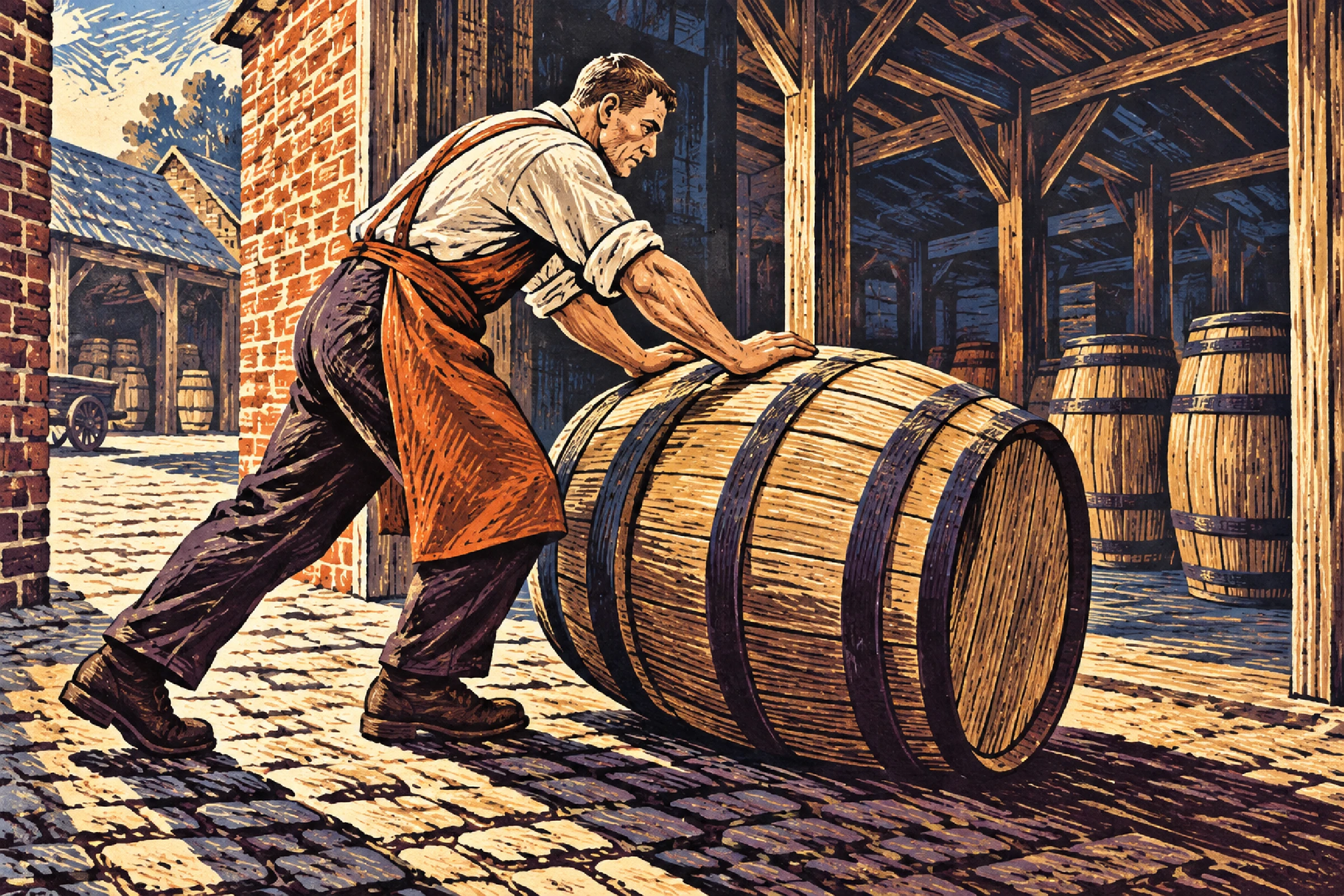
A bold linocut brand illustration of a cooper rolling a barrel into an open workshop. Repeated barrel curves and a deep working setting convey the energy of skilled making.
Remix this referenceCooper Turning a Barrel
- Form language
- Compress forms into interlocking wedges and sweeping arcs; let incidental shapes vary within that robust vocabulary.
- Contour
- Use bold relief-print edges with slight gouge bites and occasional broken boundaries instead of uniform outlines.
- Mark-making
- Carve rhythmic fans of short cuts, alternating broad scoops with narrow slivers and allowing the intervals to breathe.
- Surface rendering
- Build tone from dense ink masses opening into carved paper channels; retain uneven ink transfer and selective overprint.
Priority
The image must visibly read as bold linocut with carved rhythmic marks.
What to avoid & what to check
Exact prompt for this example
MODULE OWNERSHIP
subject: Subject count, type, stable proportions and landmarks, resting face geometry, hair shape, physical materials, garment construction and permanent marks. No emotion, movement, color assignment or rendering recipe.
expression: Facial soft-tissue displacement and pupil direction, muscle coordination, regional intensity, asymmetry and onset/peak/release. No head/body pose, stable appearance, skin color or rendering.
gesture: Head/neck/body/limb orientation, joint movement, support, contact and pose-caused occlusion using existing anatomy. No eye/pupil movement, emotion, identity, props inventory or camera.
props: Prop count, type, construction, physical material and scale relative to the subject. Holding/contact belongs to gesture, position to composition, color to palette.
scene: Environment elements, terrain, backdrop/floor presence and structural detail. No canvas positions, camera, lighting, assigned colors or render texture.
camera: Projection, focal-length impression, camera elevation/yaw/roll, viewing distance and crop. No actor pose, world placement, lighting or canvas aspect ratio.
composition: Normalized 0-100% canvas positions, scale in frame, depth/overlap, focal hierarchy and margins. No joint pose, camera projection, rendering, subject/prop inventory or emotion.
palette: Color anchors, hue/saturation/value ranges, colors assigned to parts and approximate color coverage. No illumination direction, shading algorithm, physical material or layout.
lighting: Light-source direction/softness/intensity, ambient illumination, physical shadow direction/length and highlight position. Absence of directional illumination is allowed. No shading technique, palette or material changes.
style: Reusable form abstraction, contour weight/taper/edge quality, medium and mark scale/density/direction, surface rendering and tonal transition technique. No fixed subject proportions, anatomy, identity, expression, pose, palette, light-source direction, camera or layout.
output: Image count, aspect ratio, size, file/alpha requirements and global lettering/logo/watermark restrictions. No background scenery, crop, style, identity or pose.

SUBJECT
inventory: A is one adult human cooper.
geometry: Broad shoulders, a broad back, a sturdy waist and large hands give the figure a grounded working build.
resting-face: A broad cheekbone, straight brow and blunt nose establish a simple, substantial facial profile.
appearance: Close-cropped hair, a cotton shirt with rolled cuffs, and a heavy canvas bib apron with broad straps.

PRIORITY


AVOID


CHECK


EXPRESSION — ACTOR A
brows: The visible brow draws slightly inward and down.
lids: The visible upper lid lowers slightly; the lower lid firms.
cheeks: The visible cheek tightens gently without a smile lift.
nose: The visible nostril opens slightly; the bridge stays unwrinkled.
mouth: Lips meet in a light press, with the visible corner level.
jaw: The jaw firms mildly without a hard clench.
gaze: The visible pupil aims toward the threshold.
coordination: Brow and lid tension lead; the mouth remains comparatively relaxed.
timing: Hold a steady apex of concentration; far-side features remain unprescribed.

PRIORITY


AVOID


CHECK


GESTURE
head: The neck follows the forward lean, with the head facing along the barrel's path.
torso: A leans forward from the hips with the back extending toward the shoulders.
limbs: One leg advances while the trailing leg pushes; both arms reach forward with yielding elbows.
contact: Both palms press the upper curve of the working barrel as it rolls on its curved side.

PRIORITY


AVOID


CHECK


PROPS
inventory: One working barrel and three stored barrels, each roughly waist-high beside A.
construction: All barrels have bulging oak staves, inset circular heads and broad iron hoops.

PRIORITY


AVOID


CHECK


SCENE
inventory: A brick cooperage yard opens into a timber workshop with deep storage bays and a cobbled floor.
structure: A broad threshold, repeated posts and exposed roof trusses connect the yard to the workshop interior.

PRIORITY


AVOID


CHECK


CAMERA
projection: Moderately wide perspective with gentle architectural convergence.
viewpoint: Waist-high from A's left side and slightly behind, revealing a near profile; no camera roll.
crop: Include the whole worker and working barrel; let peripheral architecture continue beyond the frame.

PRIORITY


AVOID


CHECK


COMPOSITION
placement: The worker occupies the left middle and the working barrel the lower right; their joined diagonal leads inward.
depth: The working barrel is the main focal mass; stored barrels overlap in the receding bays behind it. The threshold lies beyond the working barrel.
spacing: Keep a generous opening above the arms, balanced by masonry along one foreground edge.

PRIORITY


AVOID


CHECK


PALETTE
colors: Deep aubergine, warm flax, burnt orange and a restrained dusty blue.
assignment: Aubergine anchors structure and hoops; flax carries wood, skin and shirt; orange marks the apron; blue the interior.
balance: Flax and aubergine dominate, with orange as a compact accent and blue used sparingly.

PRIORITY


AVOID


CHECK


LIGHTING
sources: Broad daylight enters from the open upper left, with gentle ambient light inside the shed.
shadows: Soft, substantial shadows extend toward the right and gather beneath the barrels.
highlights: Broad highlights catch the upper barrel curves and the worker's left shoulder.

PRIORITY


AVOID


CHECK


STYLE GUIDE
form-language: Compress forms into interlocking wedges and sweeping arcs; let incidental shapes vary within that robust vocabulary.
contour: Use bold relief-print edges with slight gouge bites and occasional broken boundaries instead of uniform outlines.
mark-making: Carve rhythmic fans of short cuts, alternating broad scoops with narrow slivers and allowing the intervals to breathe.
surface-rendering: Build tone from dense ink masses opening into carved paper channels; retain uneven ink transfer and selective overprint.

PRIORITY
The image must visibly read as bold linocut with carved rhythmic marks.

AVOID


CHECK


OUTPUT
format: One image, landscape 3:2, 2400 × 1600 pixels, opaque PNG.
restrictions: No lettering, logos or watermarks.

PRIORITY


AVOID


CHECK


FINAL INTEGRATION
gesture + composition + style: Let bodily action, visual flow and carved rhythm cooperate to convey forward momentum.
Model information comes from image provenance. The same prompt may produce a different result.