Text to imageCharacterStyle guide
Night Mail Sorter · Task-Shaped Costume Design
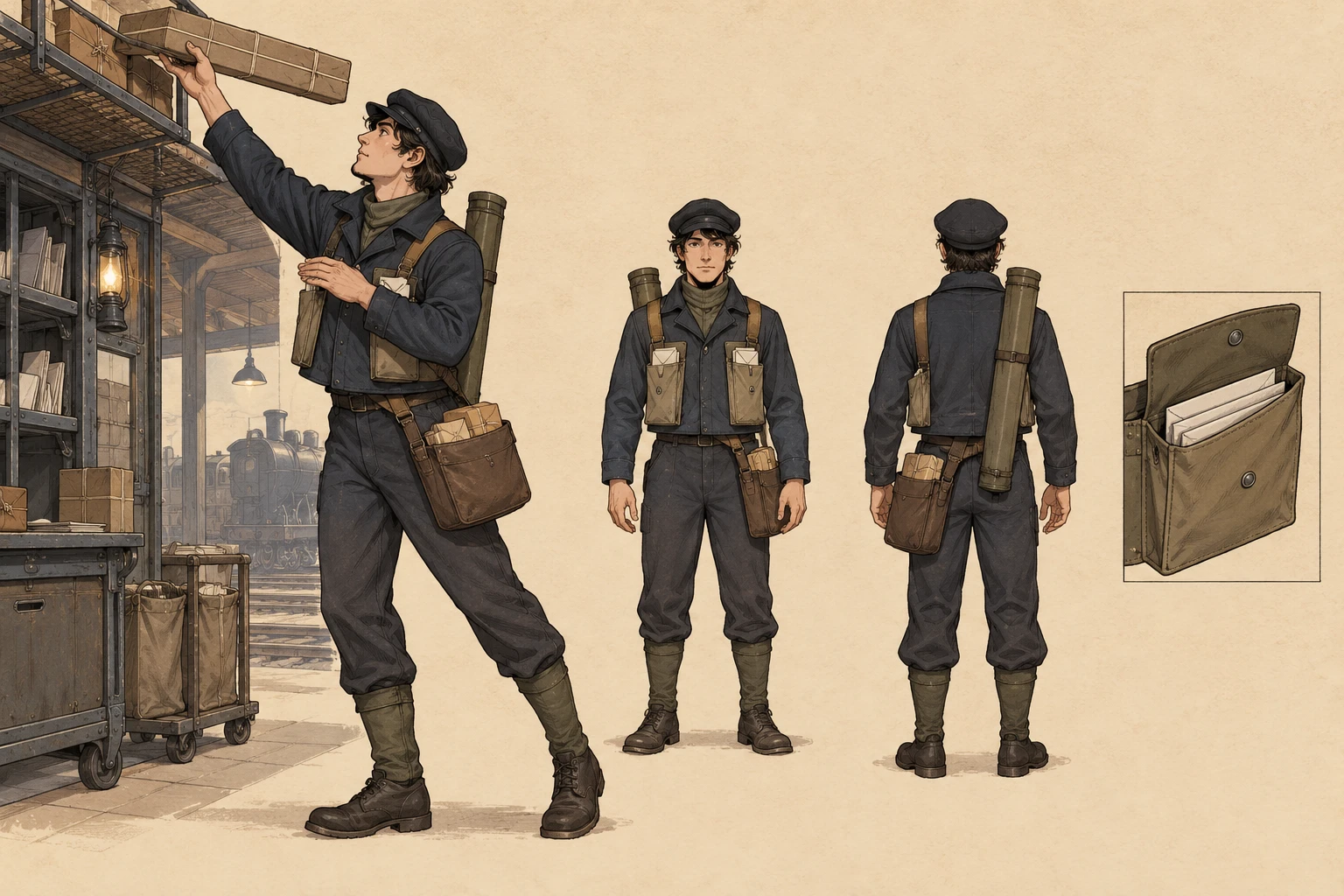
A solo character whose sorting motions and mail sizes determine the costume silhouette and storage layout.
Remix this referenceNight Mail Sorter · Task-Shaped Costume Design
- Shape & line
- Build a recognizable work silhouette from short jacket, narrow dispatch tube, flat envelope pockets and weighted hip pouch.
- Color & light
- Use restrained matte colors on warm paper, with clear shadow separation at the raised shoulder and waist.
- Texture & material
- Keep inked linework, believable cloth tension and concise seam detail, avoiding glossy realism.
- Composition
- Make the task pose dominant, with consistent smaller front and rear views and a clearly detached open-pocket inset.
Priority
Preserve the distinctive construction and medium first, readable spatial hierarchy second, subtle surface details third.
What to avoid & what to check
Avoid extra subjects, inconsistent repeated geometry, hidden key details, crowded overlaps, unwanted text and watermarks.
Check each style rule against the finished image: visible shape construction, color and light, material treatment, and composition. Preserve the exact subject count and scene requirements.
Exact prompt for this example
SUBJECT
Create an original full-body character design sheet for one night mail sorter who works in a compact railway depot. Show a large three-quarter action pose placing a long parcel into an overhead rack, plus small front and rear views of the same person. Build the costume around that task: a short jacket that clears the raised arm, a narrow vertical tube for rolled dispatches, flat envelope pockets that do not snag, and a weighted hip pouch for parcels. Let these storage forms create an unmistakable silhouette even when filled in as a single dark shape. Show one pocket open in a small detail inset to explain its construction. Use inked linework and restrained matte color on warm paper, with clear anatomy and believable fabric tension at the shoulder and waist. Keep the sheet spacious and readable. No lettering, labels, logos, or watermarks.

COMPOSITION
Large action pose placing a long parcel overhead, smaller front and rear views of the same mail sorter, plus one small open-pocket inset on warm paper. Scale the largest pose down enough to keep the entire body from raised fingers to BOTH soles completely inside the sheet, with at least 10 percent clear paper below both feet. The overhead rack also remains inside the frame. Show exactly one large full-body action pose, two smaller full-body front/rear views and one pocket close-up.

STYLE GUIDE
1. Shape & line
Build a recognizable work silhouette from short jacket, narrow dispatch tube, flat envelope pockets and weighted hip pouch.

2. Color & light
Use restrained matte colors on warm paper, with clear shadow separation at the raised shoulder and waist.

3. Texture & material
Keep inked linework, believable cloth tension and concise seam detail, avoiding glossy realism.

4. Composition
Make the task pose dominant, with consistent smaller front and rear views and a clearly detached open-pocket inset.

PRIORITY
Preserve the requested identity, count, action, composition and output settings. Apply the style rules within those constraints; a style reference must not replace the subject or layout. Within the style: Preserve the distinctive construction and medium first, readable spatial hierarchy second, subtle surface details third.

AVOID
Avoid extra subjects, inconsistent repeated geometry, hidden key details, crowded overlaps, unwanted text and watermarks.

OUTPUT
One finished landscape image, aspect ratio 3:2. No lettering, captions, dimensions, unrelated logos, watermark, border or interface. Fully opaque background across the entire rectangular canvas. No transparent pixels, no feathered cutout boundary and no unrequested vignette.

SELF-CHECK
Check each style rule against the finished image: visible shape construction, color and light, material treatment, and composition. Preserve the exact subject count and scene requirements.
Model information comes from image provenance. The same prompt may produce a different result.