Text to imageCafe & brandStyle guide
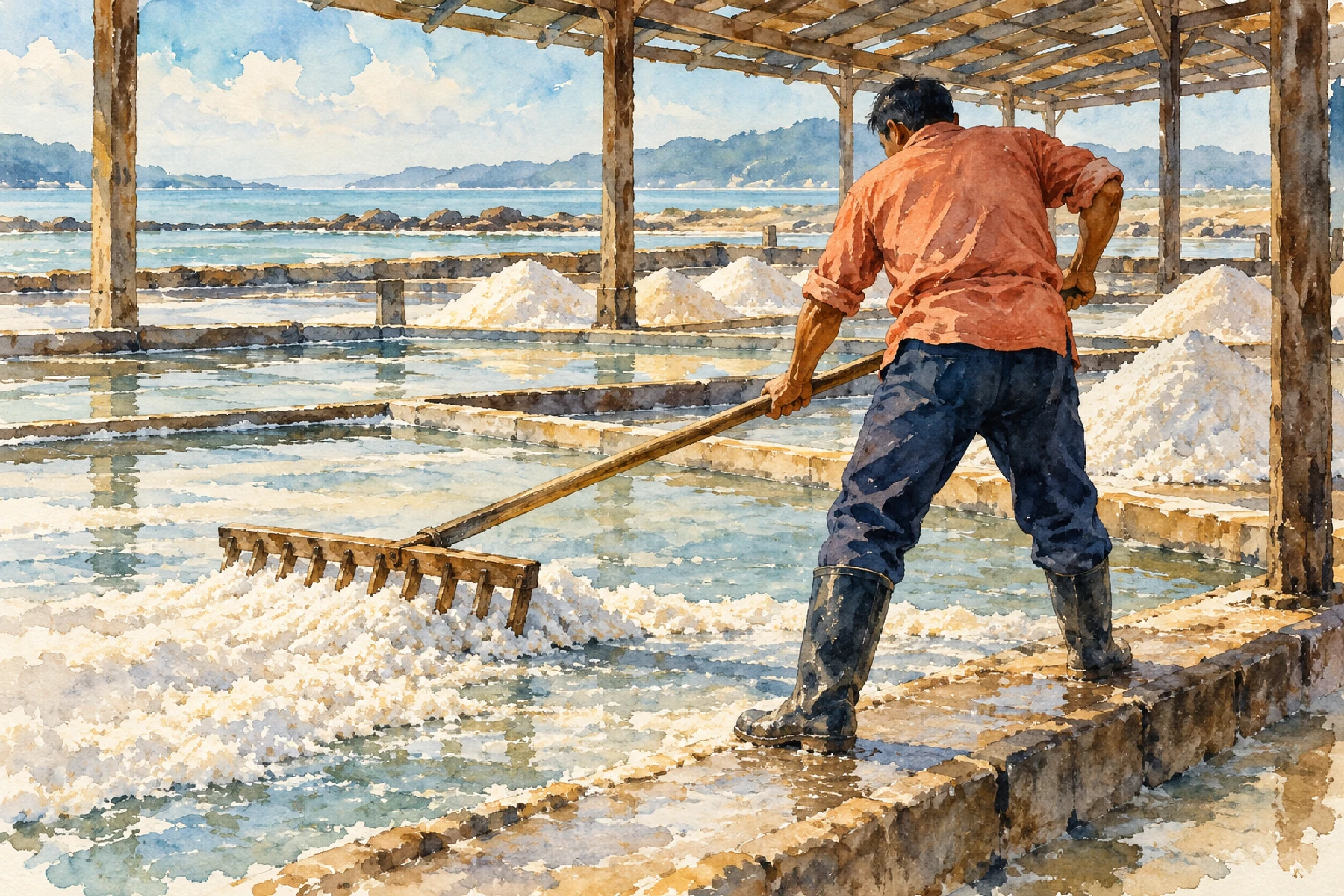
Raking Salt Beneath the Shed
A coastal salt-house brand illustration: a worker draws salt inward with a wooden rake, surrounded by layered crystallizing pans and glimpses of sea in blooming watercolor.
Remix this referenceRaking Salt Beneath the Shed
- Form language
- Reduce complex forms to uneven interlocking masses, retaining a few decisive notches and bends; secondary shapes may vary naturally.
- Contour
- Let watercolor boundaries alternate between sharp pigment rims, feathered bleeds and missing edges; avoid a continuous enclosing outline.
- Mark-making
- Use broad wet brush sweeps interrupted by skipping dry-brush strokes; vary pressure and stroke length without regular repetition.
- Surface rendering
- Build transparent overlapping washes with visible blooms, pooled margins and paper reserves; let watery tonal transitions remain uneven.
Priority
Expressive watercolor blooms and broken edges must remain visibly integral to the finished image.
What to avoid & what to check
Exact prompt for this example
MODULE OWNERSHIP
subject: Subject count, type, stable proportions and landmarks, resting face geometry, hair shape, physical materials, garment construction and permanent marks. No emotion, movement, color assignment or rendering recipe.
expression: Facial soft-tissue displacement and pupil direction, muscle coordination, regional intensity, asymmetry and onset/peak/release. No head/body pose, stable appearance, skin color or rendering.
gesture: Head/neck/body/limb orientation, joint movement, support, contact and pose-caused occlusion using existing anatomy. No eye/pupil movement, emotion, identity, props inventory or camera.
props: Prop count, type, construction, physical material and scale relative to the subject. Holding/contact belongs to gesture, position to composition, color to palette.
scene: Environment elements, terrain, backdrop/floor presence and structural detail. No canvas positions, camera, lighting, assigned colors or render texture.
camera: Projection, focal-length impression, camera elevation/yaw/roll, viewing distance and crop. No actor pose, world placement, lighting or canvas aspect ratio.
composition: Normalized 0-100% canvas positions, scale in frame, depth/overlap, focal hierarchy and margins. No joint pose, camera projection, rendering, subject/prop inventory or emotion.
palette: Color anchors, hue/saturation/value ranges, colors assigned to parts and approximate color coverage. No illumination direction, shading algorithm, physical material or layout.
lighting: Light-source direction/softness/intensity, ambient illumination, physical shadow direction/length and highlight position. Absence of directional illumination is allowed. No shading technique, palette or material changes.
style: Reusable form abstraction, contour weight/taper/edge quality, medium and mark scale/density/direction, surface rendering and tonal transition technique. No fixed subject proportions, anatomy, identity, expression, pose, palette, light-source direction, camera or layout.
output: Image count, aspect ratio, size, file/alpha requirements and global lettering/logo/watermark restrictions. No background scenery, crop, style, identity or pose.

SUBJECT
inventory: A is the only person: an adult coastal salt worker.
geometry: A has a sturdy adult build with broad shoulders and ordinary human proportions.
resting-face: Resting facial geometry is left unspecified.
appearance: Short cropped hair, a loose cotton shirt with rolled cuffs, straight trousers and rubber work boots.

PRIORITY


AVOID


CHECK


EXPRESSION — ACTOR A
brows: Brow displacement remains unspecified.
lids: Lid opening and tension remain unspecified.
cheeks: Cheek lift and compression remain unspecified.
nose: Nose wrinkling and nostril action remain unspecified.
mouth: Lip shape and mouth action remain unspecified.
jaw: Jaw opening and muscular tension remain unspecified.
gaze: Pupil direction remains unspecified.
coordination: Facial muscle coordination and asymmetry remain unspecified.
timing: The neutral apex prescribes no facial change, onset or release.

PRIORITY


AVOID


CHECK


GESTURE
head: A's head follows the torso away from the viewer, with the neck inclined toward the working surface.
torso: A counterleans from the hips as the rake is drawn inward, giving the pull a clear bodily weight.
limbs: Both elbows bend to draw the shaft toward one hip; the legs form a wide, softly bent stance.
contact: Both hands grip the shaft, both boots bear weight on the walkway, and the rake teeth engage the salt.

PRIORITY


AVOID


CHECK


PROPS
inventory: One wooden salt rake, approximately as tall as A, with a broad toothed head.
construction: A worn timber shaft joins a transverse wooden head with blunt, widely spaced teeth.

PRIORITY


AVOID


CHECK


SCENE
inventory: An open coastal salt shed contains shallow crystallizing pans, narrow walkways and heaps of harvested salt.
structure: Timber posts support an open-sided roof; low pan walls step toward a tidal shoreline beyond the shed.

PRIORITY


AVOID


CHECK


CAMERA
projection: Natural perspective with a moderately wide lens impression and restrained near-field enlargement.
viewpoint: Look slightly downward into the shed from behind A at a three-quarter rear angle; the face stays unseen.
crop: Show the complete worker and rake while cropping the nearest pan edges, parts of the roof and one edge post.

PRIORITY


AVOID


CHECK


COMPOSITION
placement: A anchors the right third near 65% canvas width; the rake extends diagonally into the open left half.
depth: Overlapping pan rims lead through A's working space to the distant shore; a post frames one edge.
spacing: The hand–shaft junction leads the hierarchy, followed by the gathered salt; broad brine areas provide breathing room.

PRIORITY


AVOID


CHECK


PALETTE
colors: Use chalk ivory, muted sea teal, deep indigo, weathered ochre and a small burnt-coral accent.
assignment: Salt is ivory, brine and sea teal, timber and rake ochre, trousers and boots indigo, and the shirt coral.
balance: Pale ivory and subdued teal dominate; indigo supplies sparse dark anchors and coral remains a limited accent.

PRIORITY


AVOID


CHECK


LIGHTING
sources: Broad daylight enters through the open left side, softened by coastal haze and ambient sky light.
shadows: Soft shadows extend rightward beneath the roof, with firmer contact shadows beneath boots and pan walls.
highlights: Gentle highlights catch left-facing salt ridges and the upper edge of the rake shaft.

PRIORITY


AVOID


CHECK


STYLE GUIDE
form-language: Reduce complex forms to uneven interlocking masses, retaining a few decisive notches and bends; secondary shapes may vary naturally.
contour: Let watercolor boundaries alternate between sharp pigment rims, feathered bleeds and missing edges; avoid a continuous enclosing outline.
mark-making: Use broad wet brush sweeps interrupted by skipping dry-brush strokes; vary pressure and stroke length without regular repetition.
surface-rendering: Build transparent overlapping washes with visible blooms, pooled margins and paper reserves; let watery tonal transitions remain uneven.

PRIORITY
Expressive watercolor blooms and broken edges must remain visibly integral to the finished image.

AVOID


CHECK


OUTPUT
format: One landscape image, 3:2 aspect ratio, 1800 × 1200 pixels, opaque PNG.
restrictions: No lettering, logos or watermarks.

PRIORITY


AVOID


CHECK


FINAL INTEGRATION
gesture + composition + style: Keep the working action legible through the overlapping setting while allowing wash irregularity to connect adjacent forms.
Model information comes from image provenance. The same prompt may produce a different result.