Text to imageCharacterStyle guide
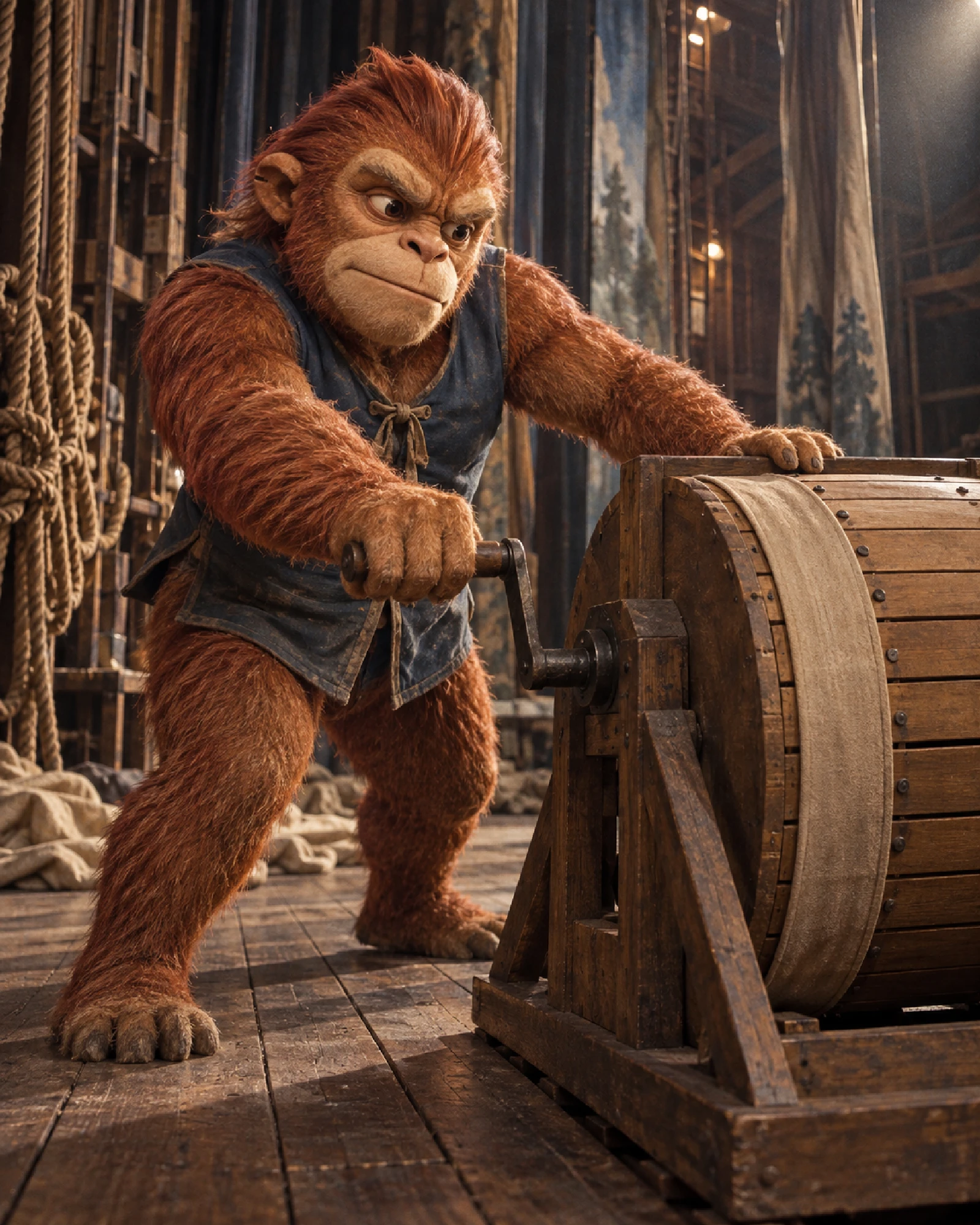
A Creature Cranking the Wind Drum
A velvet-furred creature works a hand-cranked wind-sound drum backstage. An analog color photograph catches its concentrated face and committed gesture among layered theater equipment.
Remix this referenceA Creature Cranking the Wind Drum
- Form language
- Keep photographic volumes tactile and slightly irregular, with broad masses clearly readable and incidental detail allowed to vary naturally.
- Contour
- Use unoutlined edges with tiny fibrous interruptions, alternating gently feathered boundaries and crisp local breaks.
- Mark-making
- Fine, uneven color-negative grain remains visible through middle values; occasional print specks vary without a repeated texture pattern.
- Surface rendering
- Use compressed print-like midtones, soft highlight roll-off and faint halation, preserving surface detail within broad tonal transitions.
Priority
The finished image must read as an analog color photograph with expressive tonal depth and visible negative grain.
What to avoid & what to check
Exact prompt for this example
MODULE OWNERSHIP
subject: Subject count, type, stable proportions and landmarks, resting face geometry, hair shape, physical materials, garment construction and permanent marks. No emotion, movement, color assignment or rendering recipe.
expression: Facial soft-tissue displacement and pupil direction, muscle coordination, regional intensity, asymmetry and onset/peak/release. No head/body pose, stable appearance, skin color or rendering.
gesture: Head/neck/body/limb orientation, joint movement, support, contact and pose-caused occlusion using existing anatomy. No eye/pupil movement, emotion, identity, props inventory or camera.
props: Prop count, type, construction, physical material and scale relative to the subject. Holding/contact belongs to gesture, position to composition, color to palette.
scene: Environment elements, terrain, backdrop/floor presence and structural detail. No canvas positions, camera, lighting, assigned colors or render texture.
camera: Projection, focal-length impression, camera elevation/yaw/roll, viewing distance and crop. No actor pose, world placement, lighting or canvas aspect ratio.
composition: Normalized 0-100% canvas positions, scale in frame, depth/overlap, focal hierarchy and margins. No joint pose, camera projection, rendering, subject/prop inventory or emotion.
palette: Color anchors, hue/saturation/value ranges, colors assigned to parts and approximate color coverage. No illumination direction, shading algorithm, physical material or layout.
lighting: Light-source direction/softness/intensity, ambient illumination, physical shadow direction/length and highlight position. Absence of directional illumination is allowed. No shading technique, palette or material changes.
style: Reusable form abstraction, contour weight/taper/edge quality, medium and mark scale/density/direction, surface rendering and tonal transition technique. No fixed subject proportions, anatomy, identity, expression, pose, palette, light-source direction, camera or layout.
output: Image count, aspect ratio, size, file/alpha requirements and global lettering/logo/watermark restrictions. No background scenery, crop, style, identity or pose.

SUBJECT
inventory: Actor A is one original adult humanoid creature; no other figures appear.
geometry: A broad trunk, low shoulders, long forearms and short sturdy legs support a shovel-shaped chin and a swept-back crest.
resting-face: Round eyes sit beneath fleshy brow pads; a broad flat nose and flexible muzzle end in a clearly defined lip line.
appearance: Short velvet fur gives way to bare muzzle skin; a canvas work vest has cloth ties, and one rounded ear has a permanent notch.

PRIORITY


AVOID


CHECK


EXPRESSION — ACTOR A
brows: Brow pads pull inward and slightly down, with unequal compression.
lids: Lower lids tighten while upper lids leave the pupils clearly visible.
cheeks: Cheeks bunch subtly beside the mouth without inflating.
nose: The nose base tightens slightly; the bridge stays smooth.
mouth: Lips press together, with one corner drawn slightly higher.
jaw: The jaw sets gently forward without exposing the teeth.
gaze: Both pupils track the crank handle through the lower side of the eyes.
coordination: The compressed brow and firm mouth work together; mouth asymmetry keeps the effort personal.
timing: Capture the apex of sustained effort before the face relaxes.

PRIORITY


AVOID


CHECK


GESTURE
head: A inclines the head toward the working hand, keeping the chin clear of the leading shoulder.
torso: The torso leans diagonally into the crank, with one shoulder leading and the waist visibly yielding.
limbs: One bent arm drives the crank while the other extends to brace the frame; staggered feet support the forward weight.
contact: One hand closes around the handle, the other presses the frame, and both soles remain grounded.

PRIORITY


AVOID


CHECK


PROPS
inventory: One hand-cranked theatrical wind-sound machine, with a drum approximately as broad as A's torso.
construction: A slatted timber drum sits in a sturdy wooden frame, with a canvas friction band and an integrated metal crank.

PRIORITY


AVOID


CHECK


SCENE
inventory: A theater wing contains hanging scenic cloths, rope runs, timber rails and a worn plank floor.
structure: Narrow passages between scenic supports open into a tall fly space, with folded cloth pooled along the floor.

PRIORITY


AVOID


CHECK


CAMERA
projection: Use natural photographic perspective with a normal-lens impression and shallow focus centered on the face and working hand.
viewpoint: Observe from slightly below chest height in a three-quarter view, with no camera roll.
crop: Use a close environmental full-figure view, retaining the feet and crank while cropping peripheral stage equipment.

PRIORITY


AVOID


CHECK


COMPOSITION
placement: A occupies the left-middle area and the drum fills the lower right; the face and one hand form the primary visual pair.
depth: A near rope partially overlaps an outer edge, the figure and machine share the middle layer, and cloth corridors recede behind.
spacing: Leave a breathing pocket around the face and working hand; let denser peripheral overlaps make the backstage space feel inhabited.

PRIORITY


AVOID


CHECK


PALETTE
colors: Use muted copper, apricot, petrol blue, honey ocher and smoky umber, with restrained overall saturation.
assignment: A has copper fur, an apricot muzzle and charcoal facial accents; the vest is petrol blue and the drum honey ocher.
balance: Smoky umber surroundings dominate, allowing the copper face and blue vest to remain distinct without bright primary colors.

PRIORITY


AVOID


CHECK


LIGHTING
sources: A broad stage-side source enters from the upper right, with weak ambient fill reaching the opposite side.
shadows: Soft-edged shadows fall leftward across the floor; deeper recesses retain enough illumination to reveal their structure.
highlights: Highlights gather on the right brow, upper finger surfaces and the drum's upper rim.

PRIORITY


AVOID


CHECK


STYLE GUIDE
form-language: Keep photographic volumes tactile and slightly irregular, with broad masses clearly readable and incidental detail allowed to vary naturally.
contour: Use unoutlined edges with tiny fibrous interruptions, alternating gently feathered boundaries and crisp local breaks.
mark-making: Fine, uneven color-negative grain remains visible through middle values; occasional print specks vary without a repeated texture pattern.
surface-rendering: Use compressed print-like midtones, soft highlight roll-off and faint halation, preserving surface detail within broad tonal transitions.

PRIORITY
The finished image must read as an analog color photograph with expressive tonal depth and visible negative grain.

AVOID


CHECK


OUTPUT
format: Deliver one finished image at 1600 × 2000 pixels, 4:5 aspect ratio, as an opaque RGB PNG.
restrictions: No lettering, logos or watermarks.

PRIORITY


AVOID


CHECK


FINAL INTEGRATION
expression + gesture: Facial effort and bodily commitment should feel like the same sustained action.
camera + composition + style: Optical depth, layered staging and print character should cooperate to make the invented character feel physically present.
Model information comes from image provenance. The same prompt may produce a different result.