Text to imageProductStyle guide
A Folding Field Desk by the Marsh
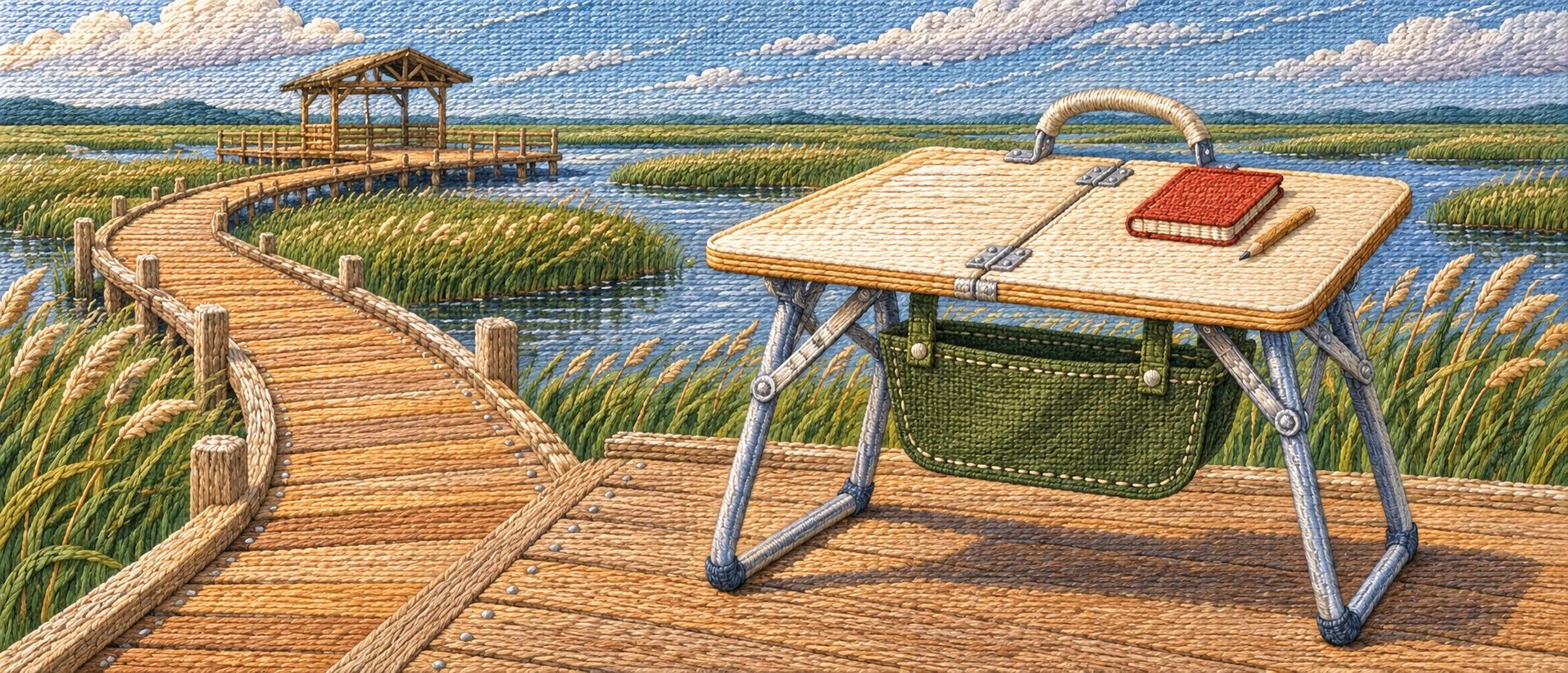
A portable field desk stands beside a winding marsh boardwalk. Raised thread and open ground weave create a panorama that carries the eye from the writing surface to a distant observation shelter.
Remix this referenceA Folding Field Desk by the Marsh
- Form language
- Translate forms into broad interlocking fabric-like shapes, simplifying small structures while preserving distinctive junctions and openings.
- Contour
- Use couched cords for selected raised boundaries and broken running stitches for lighter edges; vary tension and continuity naturally.
- Mark-making
- Build directional long-and-short stitches beside looser seed stitches; allow visible changes in stitch length rather than a uniform mesh.
- Surface rendering
- Layer padded embroidery over woven ground, leaving breathing patches of fabric; overlapping thread bundles create stepped tonal transitions.
Priority
The image must read as an embroidered textile illustration with tangible thread relief.
What to avoid & what to check
Exact prompt for this example
MODULE OWNERSHIP
subject: Subject count, type, stable proportions and landmarks, resting face geometry, hair shape, physical materials, garment construction and permanent marks. No emotion, movement, color assignment or rendering recipe.
expression: Facial soft-tissue displacement and pupil direction, muscle coordination, regional intensity, asymmetry and onset/peak/release. No head/body pose, stable appearance, skin color or rendering.
gesture: Head/neck/body/limb orientation, joint movement, support, contact and pose-caused occlusion using existing anatomy. No eye/pupil movement, emotion, identity, props inventory or camera.
props: Prop count, type, construction, physical material and scale relative to the subject. Holding/contact belongs to gesture, position to composition, color to palette.
scene: Environment elements, terrain, backdrop/floor presence and structural detail. No canvas positions, camera, lighting, assigned colors or render texture.
camera: Projection, focal-length impression, camera elevation/yaw/roll, viewing distance and crop. No actor pose, world placement, lighting or canvas aspect ratio.
composition: Normalized 0-100% canvas positions, scale in frame, depth/overlap, focal hierarchy and margins. No joint pose, camera projection, rendering, subject/prop inventory or emotion.
palette: Color anchors, hue/saturation/value ranges, colors assigned to parts and approximate color coverage. No illumination direction, shading algorithm, physical material or layout.
lighting: Light-source direction/softness/intensity, ambient illumination, physical shadow direction/length and highlight position. Absence of directional illumination is allowed. No shading technique, palette or material changes.
style: Reusable form abstraction, contour weight/taper/edge quality, medium and mark scale/density/direction, surface rendering and tonal transition technique. No fixed subject proportions, anatomy, identity, expression, pose, palette, light-source direction, camera or layout.
output: Image count, aspect ratio, size, file/alpha requirements and global lettering/logo/watermark restrictions. No background scenery, crop, style, identity or pose.

SUBJECT
inventory: One original portable field desk, a compact carrying case that opens into a freestanding writing station.
geometry: A hinged rectangular desktop joins paired folding trestles, a rounded carry handle and an underslung storage pocket.
resting-face: No face or facial landmarks.
appearance: Birch plywood panels, bent aluminum tubing and a cotton-canvas pocket; exposed hinges make the folding construction understandable.

PRIORITY


AVOID


CHECK


PROPS
inventory: One closed pocket notebook and one short pencil, both small enough to leave most of the desktop usable.
construction: The notebook has a clothbound board cover and paper block; the pencil is sharpened cedar with a graphite core.

PRIORITY


AVOID


CHECK


SCENE
inventory: A coastal reed marsh with a wooden boardwalk, tidal channels, a small observation shelter and an open sky.
structure: The boardwalk bends around reed islands and widens into a stopping platform; simple posts and roof beams define the shelter.

PRIORITY


AVOID


CHECK


CAMERA
projection: A broad perspective view with restrained convergence and readable product construction.
viewpoint: Look slightly downward from a three-quarter viewpoint high enough to see the writing surface and the marsh route beyond.
crop: Use a panoramic environmental view that includes the complete desk and a continuous stretch of boardwalk.

PRIORITY


AVOID


CHECK


COMPOSITION
placement: The desk anchors the right foreground; the boardwalk enters at lower left and curves behind it toward the distant shelter.
depth: The desktop is the primary focal plane, with the notebook near its back edge; successive reed banks lead into the distance.
spacing: Marsh expanses surround the desk; keep open water between its silhouette and distant reeds, with generous sky above the route.

PRIORITY


AVOID


CHECK


PALETTE
colors: Flax cream, ochre, bottle green and slate blue, with a small vermilion accent.
assignment: Cream marks the desktop, slate the frame and channels, green the pocket and reeds, ochre the boardwalk, and vermilion the notebook.
balance: Quiet greens and blues occupy broad areas; keep the desk lighter and reserve the strongest saturation for the small notebook.

PRIORITY


AVOID


CHECK


LIGHTING
sources: Soft daylight arrives from the upper left, with enough ambient fill to keep the underside readable.
shadows: The desk casts a short diffuse shadow toward the lower right.
highlights: Subtle highlights follow upper frame edges.

PRIORITY


AVOID


CHECK


STYLE GUIDE
form-language: Translate forms into broad interlocking fabric-like shapes, simplifying small structures while preserving distinctive junctions and openings.
contour: Use couched cords for selected raised boundaries and broken running stitches for lighter edges; vary tension and continuity naturally.
mark-making: Build directional long-and-short stitches beside looser seed stitches; allow visible changes in stitch length rather than a uniform mesh.
surface-rendering: Layer padded embroidery over woven ground, leaving breathing patches of fabric; overlapping thread bundles create stepped tonal transitions.

PRIORITY
The image must read as an embroidered textile illustration with tangible thread relief.

AVOID


CHECK


OUTPUT
format: One finished image, 21:9 aspect ratio, 2520 × 1080 pixels, opaque PNG.
restrictions: No lettering, logos or watermarks.

PRIORITY


AVOID


CHECK


FINAL INTEGRATION
subject + style: The embroidered interpretation should preserve the product's recognizable construction while allowing handmade variation.
scene + composition + camera: The environmental route provides a visual journey while keeping the product easy to inspect.
style + lighting: Raised thread catches the upper-left light along stitch crests and casts small shadows toward the lower right.
Model information comes from image provenance. The same prompt may produce a different result.