Text to imageAnimationStyle guide
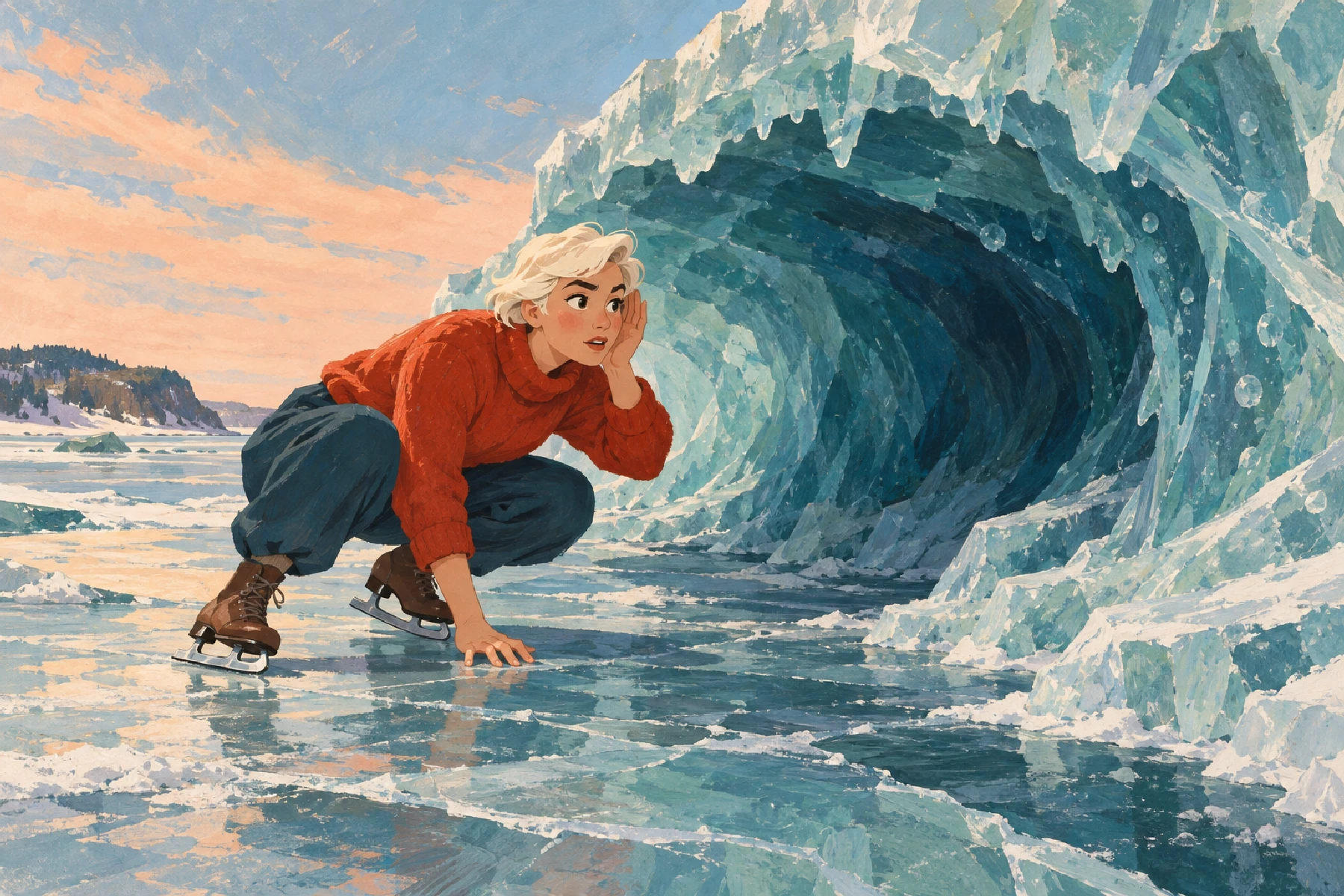
A Skater Listening to a Frozen Wave
On a beach where a great wave has frozen in place, a skater listens into its hollow. A small gesture of curiosity meets an immense curling silhouette in broad, opaque gouache passages.
Remix this referenceA Skater Listening to a Frozen Wave
- Form language
- Reduce forms to broad planar masses, balancing simple curved sweeps with angular facets; allow secondary shapes to vary naturally.
- Contour
- Separate shapes through opaque painted boundaries; alternate firm cuts with slightly broken edges instead of continuous outlines.
- Mark-making
- Leave broad brush traces within planes and occasional dry-brush skips at edges, with irregular pressure and economical small accents.
- Surface rendering
- Build matte opaque gouache passages over shallow paper tooth, using a few stepped tonal levels and occasional soft scumbled transitions.
Priority
Rendering medium: 2D opaque-gouache animated-film concept illustration; formal rendering reference: Walt Disney Studios · 1950s · Peter Pan concept art (1953)
What to avoid & what to check
Exact prompt for this example
MODULE OWNERSHIP
subject: Subject count, type, stable proportions and landmarks, resting face geometry, hair shape, physical materials, garment construction and permanent marks. No emotion, movement, color assignment or rendering recipe.
expression: Facial soft-tissue displacement and pupil direction, muscle coordination, regional intensity, asymmetry and onset/peak/release. No head/body pose, stable appearance, skin color or rendering.
gesture: Head/neck/body/limb orientation, joint movement, support, contact and pose-caused occlusion using existing anatomy. No eye/pupil movement, emotion, identity, props inventory or camera.
props: Prop count, type, construction, physical material and scale relative to the subject. Holding/contact belongs to gesture, position to composition, color to palette.
scene: Environment elements, terrain, backdrop/floor presence and structural detail. No canvas positions, camera, lighting, assigned colors or render texture.
camera: Projection, focal-length impression, camera elevation/yaw/roll, viewing distance and crop. No actor pose, world placement, lighting or canvas aspect ratio.
composition: Normalized 0-100% canvas positions, scale in frame, depth/overlap, focal hierarchy and margins. No joint pose, camera projection, rendering, subject/prop inventory or emotion.
palette: Color anchors, hue/saturation/value ranges, colors assigned to parts and approximate color coverage. No illumination direction, shading algorithm, physical material or layout.
lighting: Light-source direction/softness/intensity, ambient illumination, physical shadow direction/length and highlight position. Absence of directional illumination is allowed. No shading technique, palette or material changes.
style: Reusable form abstraction, contour weight/taper/edge quality, medium and mark scale/density/direction, surface rendering and tonal transition technique. No fixed subject proportions, anatomy, identity, expression, pose, palette, light-source direction, camera or layout.
output: Image count, aspect ratio, size, file/alpha requirements and global lettering/logo/watermark restrictions. No background scenery, crop, style, identity or pose.

SUBJECT
inventory: One original adult woman, a recreational skater; no other figures.
geometry: A sturdy build with a compact torso, substantial hands and a broad, slightly tapered face.
resting-face: Broad eyebrows, almond-shaped eye openings, a wedge-shaped nose and a wide mouth with a fuller lower lip.
appearance: Short crescent-shaped hair, a wool pullover with a thick rolled collar, roomy trousers and lace-up boots with skate blades.

PRIORITY


AVOID


CHECK


EXPRESSION — ACTOR A
brows: One eyebrow lifts slightly higher than the other.
lids: Upper lids lift gently; lower lids remain loose.
cheeks: Cheeks stay mostly relaxed, with a faint lift on one side.
nose: The nose remains unwrinkled and nostrils unflared.
mouth: Lips part narrowly, with one corner barely raised.
jaw: The jaw releases just enough to support the parted lips.
gaze: Pupils turn toward the hollow beneath the ice curl.
coordination: The questioning brow leads; the mouth responds more quietly.
timing: Catch the onset of recognition before curiosity becomes a smile.

PRIORITY


AVOID


CHECK


GESTURE
head: Tilt the head toward the hollow, bringing one ear forward without burying the face.
torso: Fold the torso forward in a low, balanced crouch.
limbs: Bend both knees; cup one hand behind the ear and extend the other toward the ice.
contact: The extended fingertips rest against the ice; both skate blades support her on the frozen shallows.

PRIORITY


AVOID


CHECK


PROPS
inventory: No separate props.
construction: No prop construction applies.

PRIORITY


AVOID


CHECK


SCENE
inventory: A frozen shoreline, an immense breaking wave arrested in ice, shallow shore ice and a distant low headland.
structure: The wave forms a hollow overhang with a scalloped lip; a few trapped bubbles and fissures suggest its former motion.

PRIORITY


AVOID


CHECK


CAMERA
projection: A gently wide perspective with restrained depth distortion.
viewpoint: View obliquely along the shore from approximately the crouching woman's eye level, with a level horizon.
crop: A medium-wide view includes the full skater and lets the wave continue beyond the right edge.

PRIORITY


AVOID


CHECK


COMPOSITION
placement: Place the skater near 30% canvas width and the ice hollow near 65%; the figure occupies about a third of the image height.
depth: The listening face and nearby hand lead attention into the larger curl; the headland remains a small distant interval.
spacing: Keep a spacious upper-left sky field and a clear opening around the face; let the right edge feel heavily cropped.

PRIORITY


AVOID


CHECK


PALETTE
colors: Anchor the image in deep petrol blue, pale mint, dusty peach and a small vermilion accent.
assignment: Use mint for the ice, petrol blue for its hollow and trousers, peach for sky and skin, vermilion for the pullover, and ivory for hair.
balance: Cool hues occupy most of the image; the pullover supplies the strongest saturation within otherwise muted colors.

PRIORITY


AVOID


CHECK


LIGHTING
sources: Broad, soft daylight enters from the upper left, with gentle ambient illumination inside the hollow.
shadows: The overhang casts a broad shadow beneath itself; the skater's short shadow falls toward the lower right.
highlights: Reserve restrained highlights for the upper ice lip, shoulder and ear-facing hand.

PRIORITY


AVOID


CHECK


STYLE GUIDE
form-language: Reduce forms to broad planar masses, balancing simple curved sweeps with angular facets; allow secondary shapes to vary naturally.
contour: Separate shapes through opaque painted boundaries; alternate firm cuts with slightly broken edges instead of continuous outlines.
mark-making: Leave broad brush traces within planes and occasional dry-brush skips at edges, with irregular pressure and economical small accents.
surface-rendering: Build matte opaque gouache passages over shallow paper tooth, using a few stepped tonal levels and occasional soft scumbled transitions.

PRIORITY
Rendering medium: 2D opaque-gouache animated-film concept illustration; formal rendering reference: Walt Disney Studios · 1950s · Peter Pan concept art (1953)

AVOID


CHECK


OUTPUT
format: One finished image, landscape 3:2, 1800 × 1200 pixels, opaque PNG.
restrictions: No lettering, logos, signatures or watermarks.

PRIORITY


AVOID


CHECK


FINAL INTEGRATION
expression + gesture + composition: Let facial acting and the listening gesture remain legible within the larger environmental arrangement.
style + lighting + palette: Translate the illumination and color relationships through the painted vocabulary without losing their distinct roles.
Art direction
디즈니 / Walt Disney Studios · 1950s · 피터 팬 콘셉트 아트(1953) / Peter Pan concept art (1953) ↗- Render forms as broad planar masses with simplified curved and angular facets
- Separate forms primarily through opaque painted boundaries rather than continuous outlines
- Broad brush traces within planes and small dry-brush interruptions at their edges
- Matte opaque gouache planes, shallow paper texture and a small set of tonal levels
Model information comes from image provenance. The same prompt may produce a different result.