Text to imageCharacterStyle guide
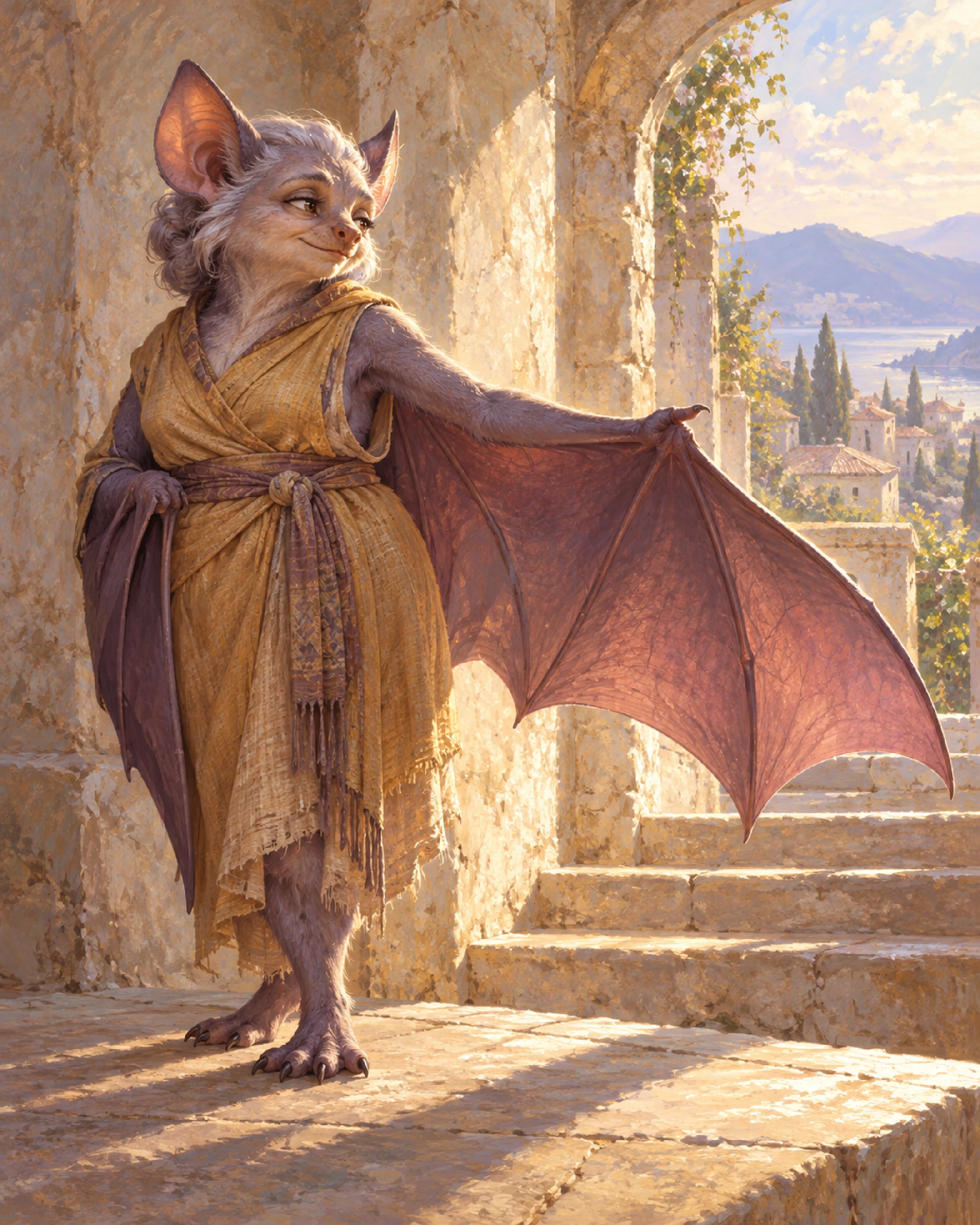
Bat Woman Warming Her Wing
An elderly bat woman opens one wing into morning sunshine on a stair landing. Luminous painted tones and generous space surround a modest moment of rest.
Remix this referenceBat Woman Warming Her Wing
- Form language
- Simplify forms into supple connected masses, alternating broad quiet shapes with a few delicate structural accents.
- Contour
- Use brush-shaped edges that sharpen briefly and dissolve into neighboring tones; reserve thin contours for select junctions.
- Mark-making
- Let broad curved strokes carry the painting, with sparse dragged bristles and irregular small dabs; incidental marks may vary naturally.
- Surface rendering
- Build luminous continuous tones through translucent paint veils, softly fused transitions, and occasional opaque scumbles over the underpainting.
Priority
Preserve luminous tonal continuity while allowing visible, uneven painterly handling.
What to avoid & what to check
Exact prompt for this example
MODULE OWNERSHIP
subject: Subject count, type, stable proportions and landmarks, resting face geometry, hair shape, physical materials, garment construction and permanent marks. No emotion, movement, color assignment or rendering recipe.
expression: Facial soft-tissue displacement and pupil direction, muscle coordination, regional intensity, asymmetry and onset/peak/release. No head/body pose, stable appearance, skin color or rendering.
gesture: Head/neck/body/limb orientation, joint movement, support, contact and pose-caused occlusion using existing anatomy. No eye/pupil movement, emotion, identity, props inventory or camera.
props: Prop count, type, construction, physical material and scale relative to the subject. Holding/contact belongs to gesture, position to composition, color to palette.
scene: Environment elements, terrain, backdrop/floor presence and structural detail. No canvas positions, camera, lighting, assigned colors or render texture.
camera: Projection, focal-length impression, camera elevation/yaw/roll, viewing distance and crop. No actor pose, world placement, lighting or canvas aspect ratio.
composition: Normalized 0-100% canvas positions, scale in frame, depth/overlap, focal hierarchy and margins. No joint pose, camera projection, rendering, subject/prop inventory or emotion.
palette: Color anchors, hue/saturation/value ranges, colors assigned to parts and approximate color coverage. No illumination direction, shading algorithm, physical material or layout.
lighting: Light-source direction/softness/intensity, ambient illumination, physical shadow direction/length and highlight position. Absence of directional illumination is allowed. No shading technique, palette or material changes.
style: Reusable form abstraction, contour weight/taper/edge quality, medium and mark scale/density/direction, surface rendering and tonal transition technique. No fixed subject proportions, anatomy, identity, expression, pose, palette, light-source direction, camera or layout.
output: Image count, aspect ratio, size, file/alpha requirements and global lettering/logo/watermark restrictions. No background scenery, crop, style, identity or pose.

SUBJECT
inventory: One original elderly anthropomorphic bat woman, actor A.
geometry: A compact torso, broad ears, two wing arms with small free thumbs, and two sturdy hind feet establish her silhouette.
resting-face: A short muzzle, broad nose, softly hooded eyes, and a shallow mouth line give her face an aged, substantial structure.
appearance: Fine fur forms a swept-back crown; leathery wing membranes accompany a woven wrap tunic with deep side openings.

PRIORITY


AVOID


CHECK


EXPRESSION — ACTOR A
brows: Brow tension releases into nearly level, gently separated arches.
lids: Upper lids settle softly; lower lids remain loose.
cheeks: Cheeks lift faintly, with a slightly fuller lift on her left.
nose: The nose remains unwrinkled and the nostrils relaxed.
mouth: Closed lips soften into a small, uneven upward curve.
jaw: The jaw unclenches without opening the mouth.
gaze: Pupils rest toward the outer portion of her extended wing.
coordination: The softened lids and slight mouth lift work together without a broad grin.
timing: Catch the release after a quiet exhale, as facial tension has just subsided.

PRIORITY


AVOID


CHECK


GESTURE
head: Her neck inclines slightly toward the open wing, with her chin gently lowered.
torso: Her torso turns partly toward the opening while her shoulders settle downward.
limbs: One wing arm opens in a low, generous fan; the other folds loosely against her side.
contact: Both hind feet rest on the landing, the rear foot carrying most of her weight.

PRIORITY


AVOID


CHECK


PROPS
inventory: No separate props.
construction: No prop construction applies.

PRIORITY


AVOID


CHECK


SCENE
inventory: A masonry stair landing, a tall arched opening, a short stair flight, and open air beyond.
structure: Thick plastered walls reveal worn stone at the threshold; shallow steps descend from the landing.

PRIORITY


AVOID


CHECK


CAMERA
projection: Natural perspective with a normal-lens impression and restrained depth compression.
viewpoint: View from chest height at a gentle three-quarter angle, with no roll.
crop: A full-figure view includes both feet and the entire extended wing.

PRIORITY


AVOID


CHECK


COMPOSITION
placement: Place A left of center at roughly two-thirds frame height, with the open wing reaching across the lower right.
depth: The face leads attention into the nearer wing; the arch overlaps the distant exterior as a quiet secondary layer.
spacing: Keep generous breathing room above and to the right, with unequal gaps between the figure and architectural edges.

PRIORITY


AVOID


CHECK


PALETTE
colors: Use mulberry, smoky lavender, muted ochre, pale apricot, and warm chalk, with restrained saturation.
assignment: Assign mulberry to membranes, lavender to fur, ochre to the tunic, and chalk with apricot accents to the surroundings.
balance: Let pale neutrals occupy the largest area; the deeper wing colors provide the main chromatic weight.

PRIORITY


AVOID


CHECK


LIGHTING
sources: Broad morning sunlight enters from the upper right through the opening, supported by soft ambient fill.
shadows: A long, softly edged cast shadow travels left across the landing; folded areas retain gentle shade.
highlights: Light catches the upper ear rims, muzzle ridge, and open wing edge; thin membranes transmit a soft glow.

PRIORITY


AVOID


CHECK


STYLE GUIDE
form-language: Simplify forms into supple connected masses, alternating broad quiet shapes with a few delicate structural accents.
contour: Use brush-shaped edges that sharpen briefly and dissolve into neighboring tones; reserve thin contours for select junctions.
mark-making: Let broad curved strokes carry the painting, with sparse dragged bristles and irregular small dabs; incidental marks may vary naturally.
surface-rendering: Build luminous continuous tones through translucent paint veils, softly fused transitions, and occasional opaque scumbles over the underpainting.

PRIORITY
Preserve luminous tonal continuity while allowing visible, uneven painterly handling.

AVOID


CHECK


OUTPUT
format: One finished image, 4:5 portrait format, 2048 × 2560 pixels, opaque PNG.
restrictions: No lettering, logos, signatures, or watermarks.

PRIORITY


AVOID


CHECK


FINAL INTEGRATION
expression + gesture: Facial release and bodily ease should read as one uninterrupted pause.
palette + lighting + style: Let color relationships, illumination, and layered paint cooperate to make the luminous effect feel embedded in the image.
Model information comes from image provenance. The same prompt may produce a different result.