Text to imageSpace & architectureStyle guide
A Practice Room Behind a Folded Wall
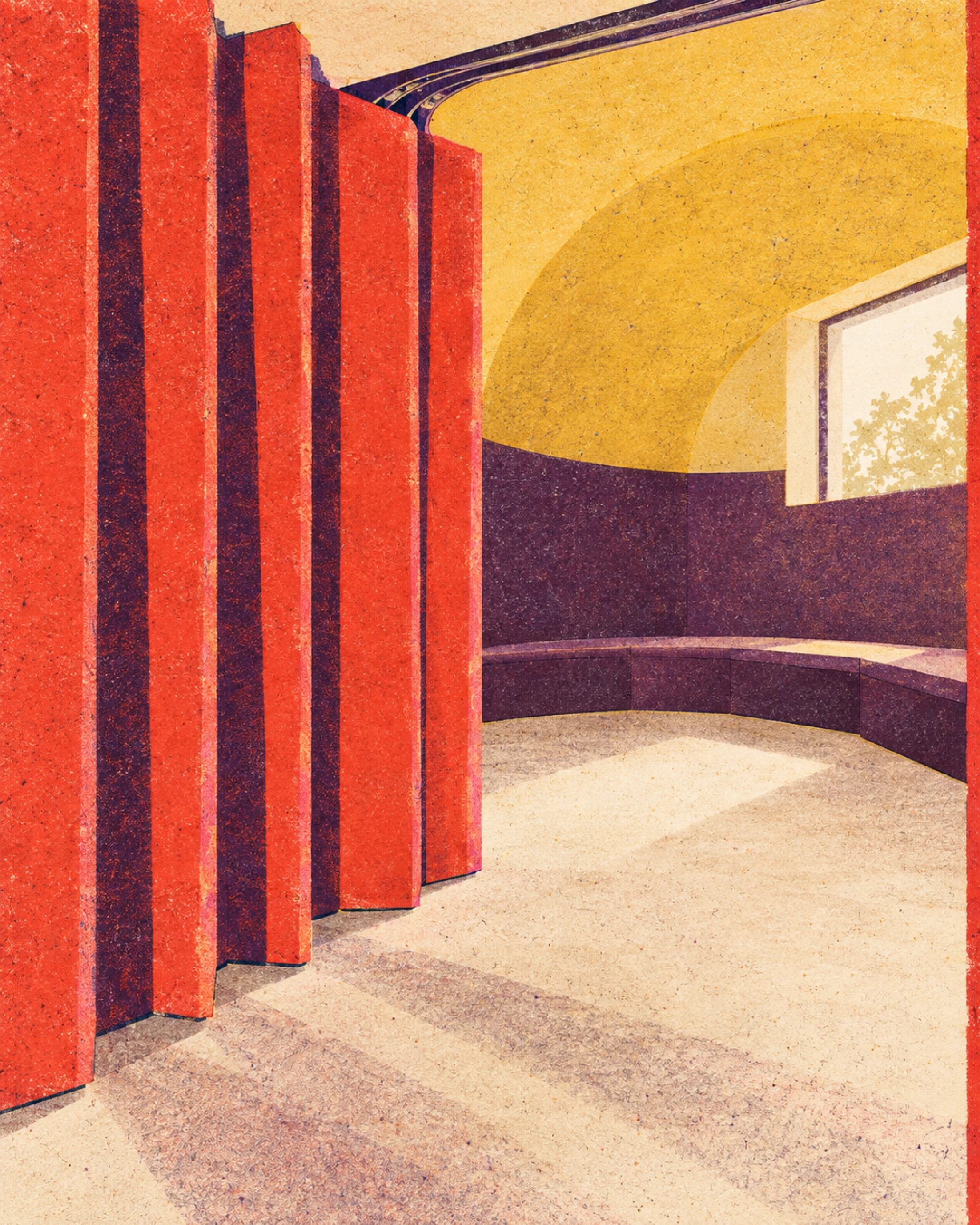
A folded acoustic wall reveals a small practice room. Closely cropped pleats and overlapping riso inks give the compact interior a playful architectural rhythm.
Remix this referenceA Practice Room Behind a Folded Wall
- Form language
- Use slightly irregular cut-stencil polygons and generous curves; allow minor shapes to vary coherently.
- Contour
- Let meeting ink shapes establish most edges; use occasional blunt, uneven line fragments instead of a continuous outline.
- Mark-making
- Use porous riso grain with naturally uneven ink pickup and playful registration offsets at selected overlapping edges.
- Surface rendering
- Create tonal steps through translucent overprinting and coarse broken screens, retaining paper speckles inside substantial ink fields and leaving some areas unprinted.
Priority
Make the riso process visible through grain, translucent overprints, and selective registration slips.
What to avoid & what to check
Exact prompt for this example
MODULE OWNERSHIP
subject: Subject count, type, stable proportions and landmarks, resting face geometry, hair shape, physical materials, garment construction and permanent marks. No emotion, movement, color assignment or rendering recipe.
expression: Facial soft-tissue displacement and pupil direction, muscle coordination, regional intensity, asymmetry and onset/peak/release. No head/body pose, stable appearance, skin color or rendering.
gesture: Head/neck/body/limb orientation, joint movement, support, contact and pose-caused occlusion using existing anatomy. No eye/pupil movement, emotion, identity, props inventory or camera.
props: Prop count, type, construction, physical material and scale relative to the subject. Holding/contact belongs to gesture, position to composition, color to palette.
scene: Environment elements, terrain, backdrop/floor presence and structural detail. No canvas positions, camera, lighting, assigned colors or render texture.
camera: Projection, focal-length impression, camera elevation/yaw/roll, viewing distance and crop. No actor pose, world placement, lighting or canvas aspect ratio.
composition: Normalized 0-100% canvas positions, scale in frame, depth/overlap, focal hierarchy and margins. No joint pose, camera projection, rendering, subject/prop inventory or emotion.
palette: Color anchors, hue/saturation/value ranges, colors assigned to parts and approximate color coverage. No illumination direction, shading algorithm, physical material or layout.
lighting: Light-source direction/softness/intensity, ambient illumination, physical shadow direction/length and highlight position. Absence of directional illumination is allowed. No shading technique, palette or material changes.
style: Reusable form abstraction, contour weight/taper/edge quality, medium and mark scale/density/direction, surface rendering and tonal transition technique. No fixed subject proportions, anatomy, identity, expression, pose, palette, light-source direction, camera or layout.
output: Image count, aspect ratio, size, file/alpha requirements and global lettering/logo/watermark restrictions. No background scenery, crop, style, identity or pose.

SUBJECT
inventory: No people, animals, or independent focal objects; the architectural interior belongs to scene.
geometry: No independent subject proportions or landmarks apply.
resting-face: No faces are present.
appearance: No independent subject materials, garments, or permanent marks apply.

PRIORITY


AVOID


CHECK


PROPS
inventory: No separate props.
construction: No prop construction applies.

PRIORITY


AVOID


CHECK


SCENE
inventory: A compact practice room, a partly retracted acoustic partition, a built-in bench, a high window, and continuous flooring.
structure: Thick fabric-faced panels concertina beneath a ceiling track; beyond them, a shallow barrel vault meets a curved bench wall.

PRIORITY


AVOID


CHECK


CAMERA
projection: A restrained wide-angle perspective preserves the room's depth without exaggerated edge stretching.
viewpoint: Look diagonally through the opening from standing eye height, with a slight downward pitch and no roll.
crop: Use an intimate architectural crop that cuts through the nearest folded panels and includes part of the floor.

PRIORITY


AVOID


CHECK


COMPOSITION
placement: Folded panels crowd the left edge; the revealed chamber occupies the right, with its window near the upper-right margin.
depth: Overlapping pleats form a near screen; the opening leads past the bench to the rear wall and vaulted ceiling.
spacing: Make the irregular opening the focal shape; contrast compressed folds with an uncluttered floor and broad interior planes.

PRIORITY


AVOID


CHECK


PALETTE
colors: Tomato red, aubergine, butter yellow, and warm cream, with lively but limited saturation.
assignment: Red belongs to partition faces, aubergine to recesses and the bench, yellow to the vault, and cream to the floor and window.
balance: Red and cream carry the largest areas; aubergine provides concentrated dark intervals and yellow remains a lighter accent.

PRIORITY


AVOID


CHECK


LIGHTING
sources: Soft daylight enters through the high rear-right window, supported by gentle ambient illumination.
shadows: Fold recesses remain shaded; broad, soft-edged shadows extend toward the front left across the floor.
highlights: Window-facing panel ridges and the upper bench edge receive broad, subdued highlights.

PRIORITY


AVOID


CHECK


STYLE GUIDE
form-language: Use slightly irregular cut-stencil polygons and generous curves; allow minor shapes to vary coherently.
contour: Let meeting ink shapes establish most edges; use occasional blunt, uneven line fragments instead of a continuous outline.
mark-making: Use porous riso grain with naturally uneven ink pickup and playful registration offsets at selected overlapping edges.
surface-rendering: Create tonal steps through translucent overprinting and coarse broken screens, retaining paper speckles inside substantial ink fields and leaving some areas unprinted.

PRIORITY
Make the riso process visible through grain, translucent overprints, and selective registration slips.

AVOID


CHECK


OUTPUT
format: One finished image, 4:5 portrait aspect ratio, 2000 × 2500 pixels, opaque PNG.
restrictions: No lettering, logos, signatures, or watermarks.

PRIORITY


AVOID


CHECK
Model information comes from image provenance. The same prompt may produce a different result.