Text to imageSpace & architectureStyle guide
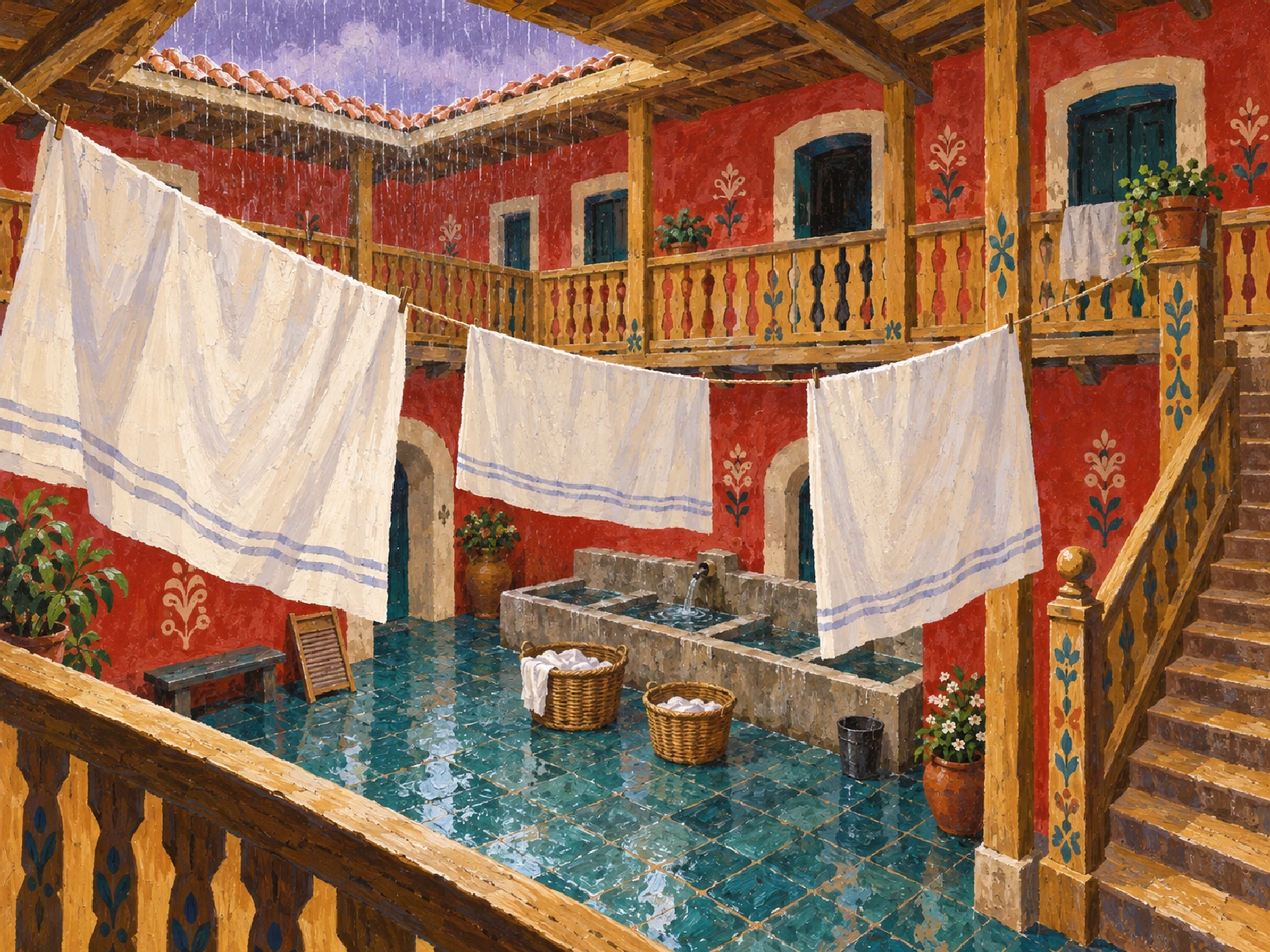
Rain in the Courtyard Washhouse
A shower enters a communal washhouse through its open roof. Overlapping sheets reveal the wet court and upper drying gallery, brought to life by decorative, deliberately untutored folk painting.
Remix this referenceRain in the Courtyard Washhouse
- Form language
- Use naive folk painting: simplify forms into gently uneven silhouettes and repeated ornamental shapes, allowing local exaggeration within a coherent handmade language.
- Contour
- Draw friendly, slightly wavering brush outlines with rounded turns and occasional gaps; vary their weight through natural brush pressure.
- Mark-making
- Scatter short dashes, loose dots, and scalloped repetitions across broad forms; keep motifs irregular enough to show individual brush touches.
- Surface rendering
- Lay opaque paint in overlapping strokes with visible drag and thin patches; use stepped tonal bands softened by occasional dry-brush passages.
Priority
Keep decorative simplification and visibly individual brushwork central to the naive folk painting.
What to avoid & what to check
Exact prompt for this example
MODULE OWNERSHIP
subject: Subject count, type, stable proportions and landmarks, resting face geometry, hair shape, physical materials, garment construction and permanent marks. No emotion, movement, color assignment or rendering recipe.
expression: Facial soft-tissue displacement and pupil direction, muscle coordination, regional intensity, asymmetry and onset/peak/release. No head/body pose, stable appearance, skin color or rendering.
gesture: Head/neck/body/limb orientation, joint movement, support, contact and pose-caused occlusion using existing anatomy. No eye/pupil movement, emotion, identity, props inventory or camera.
props: Prop count, type, construction, physical material and scale relative to the subject. Holding/contact belongs to gesture, position to composition, color to palette.
scene: Environment elements, terrain, backdrop/floor presence and structural detail. No canvas positions, camera, lighting, assigned colors or render texture.
camera: Projection, focal-length impression, camera elevation/yaw/roll, viewing distance and crop. No actor pose, world placement, lighting or canvas aspect ratio.
composition: Normalized 0-100% canvas positions, scale in frame, depth/overlap, focal hierarchy and margins. No joint pose, camera projection, rendering, subject/prop inventory or emotion.
palette: Color anchors, hue/saturation/value ranges, colors assigned to parts and approximate color coverage. No illumination direction, shading algorithm, physical material or layout.
lighting: Light-source direction/softness/intensity, ambient illumination, physical shadow direction/length and highlight position. Absence of directional illumination is allowed. No shading technique, palette or material changes.
style: Reusable form abstraction, contour weight/taper/edge quality, medium and mark scale/density/direction, surface rendering and tonal transition technique. No fixed subject proportions, anatomy, identity, expression, pose, palette, light-source direction, camera or layout.
output: Image count, aspect ratio, size, file/alpha requirements and global lettering/logo/watermark restrictions. No background scenery, crop, style, identity or pose.

SUBJECT
inventory: No standalone character subject.
geometry: No separate subject geometry applies; the architecture is defined in scene.
resting-face: No faces or facial geometry apply.
appearance: No standalone subject appearance applies.

PRIORITY


AVOID


CHECK


PROPS
inventory: Three bed sheets, two laundry baskets, and one washboard; their scale fits ordinary communal washing.
construction: Linen sheets have broad loose folds and simple hems; baskets are woven wicker, and the washboard is ribbed wood.

PRIORITY


AVOID


CHECK


SCENE
inventory: A two-level washhouse encloses a small rain-wet court, with masonry wash troughs, drying rails, and an open roof hatch.
structure: A narrow stair joins the tiled court to a timber gallery; a brief shower passes through the hatch beside exposed rafters.

PRIORITY


AVOID


CHECK


CAMERA
projection: Use gently compressed perspective with a normal-lens impression; keep the architecture readable without extreme convergence.
viewpoint: Look diagonally into the court from the upper gallery, slightly downward, with an unrolled view.
crop: Include the court, stair connection, and roof opening; let the nearest gallery rail continue beyond the frame.

PRIORITY


AVOID


CHECK


COMPOSITION
placement: Place the roof opening high left, the wet court below center, and the stair along the right; sheets cross the intervening space.
depth: Overlap the nearest sheet with a gallery rail, a second with the stair, and a third with the far wall; baskets sit deeper in the court.
spacing: The opening between the sheets is the focal passage; irregular gaps reveal enough architecture to sustain a lively spatial rhythm.

PRIORITY


AVOID


CHECK


PALETTE
colors: Use tomato red, deep teal, milk white, straw ochre, and muted violet, with warm saturated accents against quieter fields.
assignment: Assign red to walls, teal to floor tiles, white to sheets, ochre to timber and baskets, and violet to visible sky.
balance: Warm wall fields and cool floor fields carry most color; pale sheets interrupt them, with smaller ochre and violet accents.

PRIORITY


AVOID


CHECK


LIGHTING
sources: Soft overcast daylight arrives from the upper left through the roof opening, with generous ambient light beneath the gallery.
shadows: Broad, faint shadows extend toward the lower right; stronger sheltered shade remains beneath the gallery and stair.
highlights: Upper folds receive soft highlights, and exposed wet tiles catch scattered broad reflections of the roof opening.

PRIORITY


AVOID


CHECK


STYLE GUIDE
form-language: Use naive folk painting: simplify forms into gently uneven silhouettes and repeated ornamental shapes, allowing local exaggeration within a coherent handmade language.
contour: Draw friendly, slightly wavering brush outlines with rounded turns and occasional gaps; vary their weight through natural brush pressure.
mark-making: Scatter short dashes, loose dots, and scalloped repetitions across broad forms; keep motifs irregular enough to show individual brush touches.
surface-rendering: Lay opaque paint in overlapping strokes with visible drag and thin patches; use stepped tonal bands softened by occasional dry-brush passages.

PRIORITY
Keep decorative simplification and visibly individual brushwork central to the naive folk painting.

AVOID


CHECK


OUTPUT
format: Deliver one finished 4:3 landscape image, 1600 × 1200 pixels, as an opaque PNG.
restrictions: No lettering, logos, signatures, or watermarks.

PRIORITY


AVOID


CHECK


FINAL INTEGRATION
scene + composition + style: Let ornamental simplification enrich the overlaps while preserving the architectural connections that make the interior understandable.
Model information comes from image provenance. The same prompt may produce a different result.