Text to imageSpace & architectureStyle guide
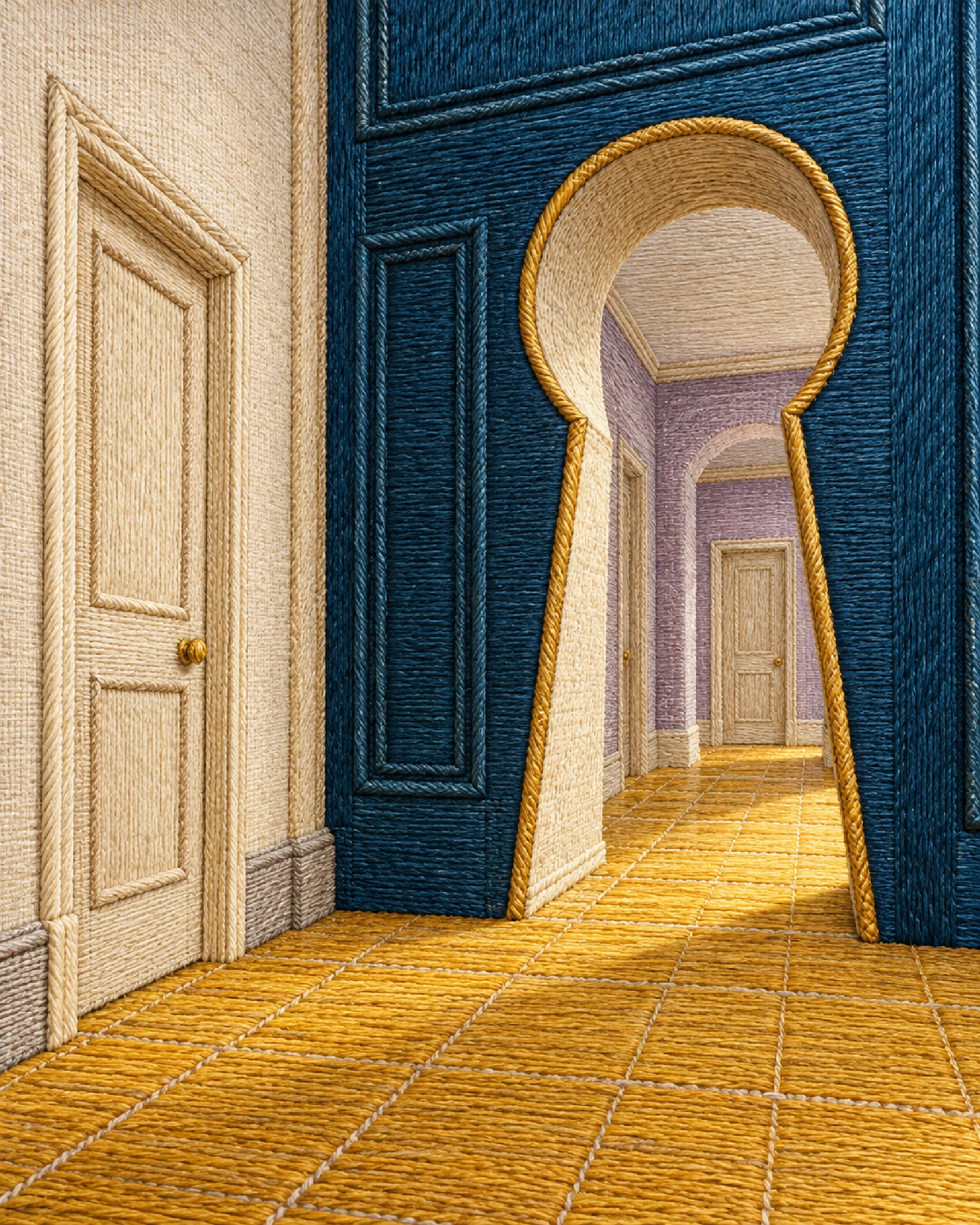
A Giant Keyhole Beyond the Hall
A familiar apartment vestibule leads through an enormous keyhole-shaped passage. Ordinary doors reveal its strange scale, while raised threads and overlapping stitches turn the interior into a textile relief.
Remix this referenceA Giant Keyhole Beyond the Hall
- Form language
- Reduce architecture to broad textile planes and rounded joins, preserving openings and changes of plane without drafting every fitting.
- Contour
- Use slightly uneven couched cords for substantial edges and fine running stitches for receding boundaries; allow occasional interruptions.
- Mark-making
- Lay satin stitches in changing bands across broad planes, with longer floor stitches and small handworked variations at their joins.
- Surface rendering
- Build palpable thread relief over visible woven cloth; blend tones by interleaving adjacent thread colors rather than smoothing away the stitches.
Priority
The finished illustration must visibly read as raised embroidery, with thread bodies, stitch overlaps, and exposed cloth.
What to avoid & what to check
Exact prompt for this example
MODULE OWNERSHIP
subject: Subject count, type, stable proportions and landmarks, resting face geometry, hair shape, physical materials, garment construction and permanent marks. No emotion, movement, color assignment or rendering recipe.
expression: Facial soft-tissue displacement and pupil direction, muscle coordination, regional intensity, asymmetry and onset/peak/release. No head/body pose, stable appearance, skin color or rendering.
gesture: Head/neck/body/limb orientation, joint movement, support, contact and pose-caused occlusion using existing anatomy. No eye/pupil movement, emotion, identity, props inventory or camera.
props: Prop count, type, construction, physical material and scale relative to the subject. Holding/contact belongs to gesture, position to composition, color to palette.
scene: Environment elements, terrain, backdrop/floor presence and structural detail. No canvas positions, camera, lighting, assigned colors or render texture.
camera: Projection, focal-length impression, camera elevation/yaw/roll, viewing distance and crop. No actor pose, world placement, lighting or canvas aspect ratio.
composition: Normalized 0-100% canvas positions, scale in frame, depth/overlap, focal hierarchy and margins. No joint pose, camera projection, rendering, subject/prop inventory or emotion.
palette: Color anchors, hue/saturation/value ranges, colors assigned to parts and approximate color coverage. No illumination direction, shading algorithm, physical material or layout.
lighting: Light-source direction/softness/intensity, ambient illumination, physical shadow direction/length and highlight position. Absence of directional illumination is allowed. No shading technique, palette or material changes.
style: Reusable form abstraction, contour weight/taper/edge quality, medium and mark scale/density/direction, surface rendering and tonal transition technique. No fixed subject proportions, anatomy, identity, expression, pose, palette, light-source direction, camera or layout.
output: Image count, aspect ratio, size, file/alpha requirements and global lettering/logo/watermark restrictions. No background scenery, crop, style, identity or pose.

SUBJECT
inventory: No people or animals.
geometry: No independent figure or object geometry applies; architectural proportions belong to the scene.
resting-face: No faces are present.
appearance: No character appearance, garments, or permanent marks apply.

PRIORITY


AVOID


CHECK


PROPS
inventory: No separate props.
construction: No prop construction applies.

PRIORITY


AVOID


CHECK


SCENE
inventory: A double-height apartment vestibule, an oversized timber door, ordinary apartment doors, skirting boards, and a tiled floor.
structure: The giant door contains an open keyhole passage with a round crown and tapered stem reaching the floor; a normal corridor continues beyond.

PRIORITY


AVOID


CHECK


CAMERA
projection: Moderately wide rectilinear perspective with straight architectural verticals.
viewpoint: View from ordinary standing eye height near the left wall, looking diagonally through the vestibule.
crop: Include the floor connection and full keyhole opening, while cropping the giant door's outer top and right edges.

PRIORITY


AVOID


CHECK


COMPOSITION
placement: The giant door occupies the right-hand majority; its opening sits right of center, balanced by an ordinary doorway at left.
depth: The keyhole is the main focus; successive thresholds overlap within it, leading to a small distant door.
spacing: Leave an uninterrupted foreground floor passage; keep the aperture interior spacious enough to read as inhabitable architecture.

PRIORITY


AVOID


CHECK


PALETTE
colors: Deep petrol blue, warm oyster, muted saffron, and dusty lavender; reserve the darkest values for narrow recesses.
assignment: Petrol blue belongs to the giant door, oyster to the walls, saffron to the floor, and lavender to the farther corridor.
balance: Let the large blue field meet generous pale areas; saffron provides a smaller warm interval and lavender a quiet recess.

PRIORITY


AVOID


CHECK


LIGHTING
sources: Broad, soft daylight arrives from upper right, supported by gentle ambient illumination throughout the interior.
shadows: The deep threshold casts a soft shadow down-left; raised threads produce short shadows in the same direction.
highlights: Restrained highlights catch upper-right thread ridges; the passage beyond remains gently illuminated.

PRIORITY


AVOID


CHECK


STYLE GUIDE
form-language: Reduce architecture to broad textile planes and rounded joins, preserving openings and changes of plane without drafting every fitting.
contour: Use slightly uneven couched cords for substantial edges and fine running stitches for receding boundaries; allow occasional interruptions.
mark-making: Lay satin stitches in changing bands across broad planes, with longer floor stitches and small handworked variations at their joins.
surface-rendering: Build palpable thread relief over visible woven cloth; blend tones by interleaving adjacent thread colors rather than smoothing away the stitches.

PRIORITY
The finished illustration must visibly read as raised embroidery, with thread bodies, stitch overlaps, and exposed cloth.

AVOID


CHECK


OUTPUT
format: One finished image, 4:5 portrait, 1600 × 2000 pixels, opaque PNG.
restrictions: No lettering, logos, signatures, or watermarks.

PRIORITY


AVOID


CHECK
Model information comes from image provenance. The same prompt may produce a different result.