Text to imageCharacterStyle guide
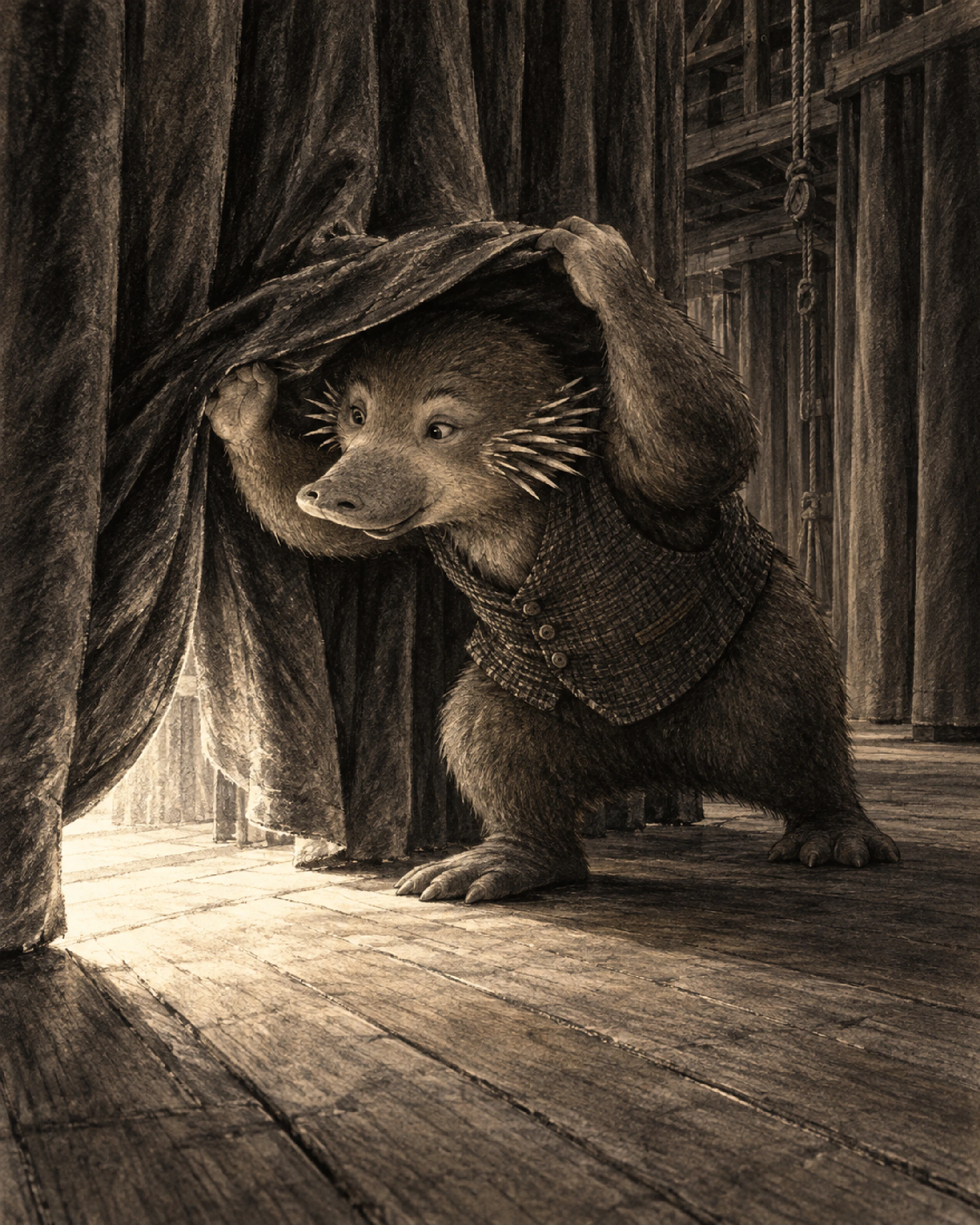
Quill-Cheeked Usher Raising the Curtain
A small quill-cheeked usher lifts a heavy theatre curtain and peers beneath it. Rubbed charcoal and erased light reveal the gesture within layers of backstage space.
Remix this referenceQuill-Cheeked Usher Raising the Curtain
- Form language
- Use observational mass drawing: broad compressed volumes first, with selective structural corrections left visible.
- Contour
- Let edges alternate between firm compressed-charcoal accents and rubbed, disappearing boundaries; avoid enclosing every form.
- Mark-making
- Drag charcoal on its side for broad strokes, then add searching tip marks and hand-smudged passages with natural variation.
- Surface rendering
- Rub layered charcoal into the paper tooth and lift charcoal with a kneaded eraser to reveal lighter paper tones; preserve dusty halftones and imperfect corrections.
Priority
Make observational charcoal visibly tactile through smudged masses and light erased back from darkness.
What to avoid & what to check
Exact prompt for this example
MODULE OWNERSHIP
subject: Subject count, type, stable proportions and landmarks, resting face geometry, hair shape, physical materials, garment construction and permanent marks. No emotion, movement, color assignment or rendering recipe.
expression: Facial soft-tissue displacement and pupil direction, muscle coordination, regional intensity, asymmetry and onset/peak/release. No head/body pose, stable appearance, skin color or rendering.
gesture: Head/neck/body/limb orientation, joint movement, support, contact and pose-caused occlusion using existing anatomy. No eye/pupil movement, emotion, identity, props inventory or camera.
props: Prop count, type, construction, physical material and scale relative to the subject. Holding/contact belongs to gesture, position to composition, color to palette.
scene: Environment elements, terrain, backdrop/floor presence and structural detail. No canvas positions, camera, lighting, assigned colors or render texture.
camera: Projection, focal-length impression, camera elevation/yaw/roll, viewing distance and crop. No actor pose, world placement, lighting or canvas aspect ratio.
composition: Normalized 0-100% canvas positions, scale in frame, depth/overlap, focal hierarchy and margins. No joint pose, camera projection, rendering, subject/prop inventory or emotion.
palette: Color anchors, hue/saturation/value ranges, colors assigned to parts and approximate color coverage. No illumination direction, shading algorithm, physical material or layout.
lighting: Light-source direction/softness/intensity, ambient illumination, physical shadow direction/length and highlight position. Absence of directional illumination is allowed. No shading technique, palette or material changes.
style: Reusable form abstraction, contour weight/taper/edge quality, medium and mark scale/density/direction, surface rendering and tonal transition technique. No fixed subject proportions, anatomy, identity, expression, pose, palette, light-source direction, camera or layout.
output: Image count, aspect ratio, size, file/alpha requirements and global lettering/logo/watermark restrictions. No background scenery, crop, style, identity or pose.

SUBJECT
inventory: One original creature usher, A; no other characters.
geometry: A has a compact pear-shaped trunk, long forearms, broad feet and a short, shovel-shaped muzzle.
resting-face: Small hooded eyes sit above the broad muzzle; a short fan of blunt quills borders each cheek.
appearance: Dense velvety fur, smooth keratin cheek quills and a woven waistcoat with a broad rounded hem.

PRIORITY


AVOID


CHECK


EXPRESSION — ACTOR A
brows: The inner brow areas lift slightly, with one rising first.
lids: Upper lids open beyond rest; lower lids stay loose.
cheeks: Cheeks remain relaxed without a smile-driven lift.
nose: The nose stays smooth, with a small opening of the nostrils.
mouth: The lips part narrowly, with the lower lip just beginning to drop.
jaw: The jaw releases only enough to support the small mouth opening.
gaze: Pupils track through the curtain opening toward the lower left.
coordination: The eyes register discovery before the mouth fully responds.
timing: Capture the onset of curiosity, just as the opening reveals something unseen.

PRIORITY


AVOID


CHECK


GESTURE
head: A ducks the head beneath the raised hem, extending the neck slightly forward.
torso: The torso crouches and twists toward the opening, with weight settled low.
limbs: Bent arms lift together while staggered legs provide a broad, steady stance.
contact: Both palms cradle the curtain hem from below; both feet press into the stage floor.

PRIORITY


AVOID


CHECK


PROPS
inventory: No separate props.
construction: No prop construction applies.

PRIORITY


AVOID


CHECK


SCENE
inventory: An old theatre stage with a heavy main curtain, successive side drapes, floorboards and an overhead rope gallery.
structure: Deep curtain folds gather into the lifted hem; narrow wing passages continue between the hanging drapes.

PRIORITY


AVOID


CHECK


CAMERA
projection: Natural perspective with a normal-lens impression and restrained depth expansion.
viewpoint: View from slightly below A's standing eye level, obliquely across the stage, with no roll.
crop: A full-figure view close enough to read the face and hands, with the upper rigging partly cropped.

PRIORITY


AVOID


CHECK


COMPOSITION
placement: A gathers around 65% width and 65% height; the lifted curtain opening spreads into the lower left.
depth: A foreground fold overlaps one outer arm; successive drapes frame glimpses of the deeper stage passages.
spacing: The face and paired hands form the focal cluster; dark regions surround lighter ones, and the upper curtain mass balances open floor below.

PRIORITY


AVOID


CHECK


PALETTE
colors: Warm paper ivory, soft graphite gray and near-black charcoal, with very low saturation.
assignment: Ivory remains in exposed paper; gray describes fur and floor, while charcoal anchors drapes and waistcoat.
balance: Near-black values dominate; middle grays occupy less area, with small accents of ivory.

PRIORITY


AVOID


CHECK


LIGHTING
sources: A broad, low source beyond the opening shines from the left; backstage ambient light stays weak.
shadows: Curtain folds shelter deep shadows; A's shadow extends softly to the right across the boards.
highlights: Light finds the muzzle edge, fingertips, lower curtain folds and a narrow stretch of floor.

PRIORITY


AVOID


CHECK


STYLE GUIDE
form-language: Use observational mass drawing: broad compressed volumes first, with selective structural corrections left visible.
contour: Let edges alternate between firm compressed-charcoal accents and rubbed, disappearing boundaries; avoid enclosing every form.
mark-making: Drag charcoal on its side for broad strokes, then add searching tip marks and hand-smudged passages with natural variation.
surface-rendering: Rub layered charcoal into the paper tooth and lift charcoal with a kneaded eraser to reveal lighter paper tones; preserve dusty halftones and imperfect corrections.

PRIORITY
Make observational charcoal visibly tactile through smudged masses and light erased back from darkness.

AVOID


CHECK


OUTPUT
format: One finished image, 4:5 portrait, 2000 × 2500 pixels, opaque PNG.
restrictions: No lettering, logos or watermarks.

PRIORITY


AVOID


CHECK


FINAL INTEGRATION
gesture + scene + style: Coordinate the environment's response to contact with the drawing's selective structural clarity.
Model information comes from image provenance. The same prompt may produce a different result.