Text to imageCharacterStyle guide
Little Tortoise Friend · Curvature-Compressed Shell Scutes
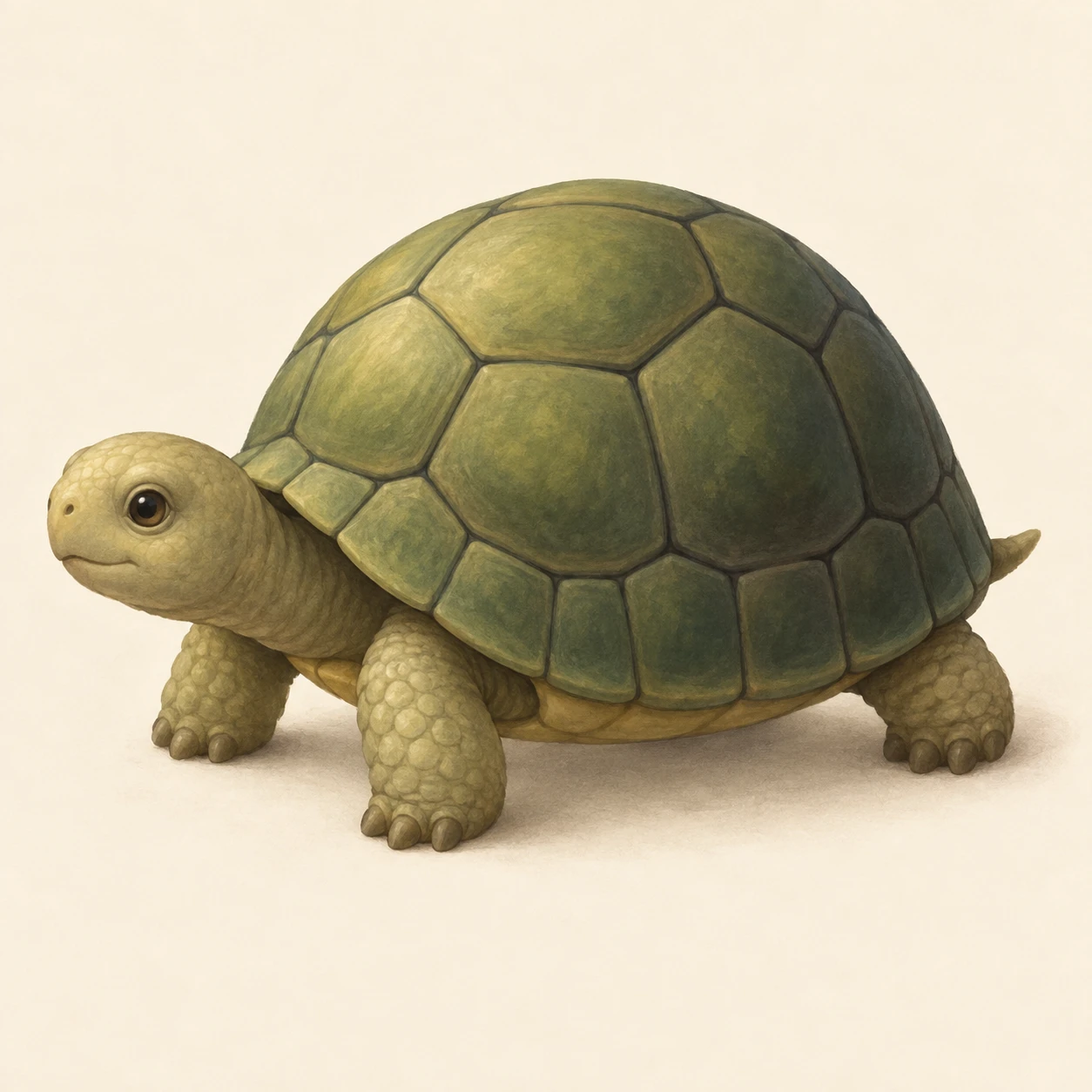
A little tortoise character whose polygonal shell scutes narrow toward the edges to reveal a rounded dome.
Little Tortoise Friend · Curvature-Compressed Shell Scutes
- Shape & line
- Draw a broad domed shell with a smooth outer contour and a connected network of gently curved polygon boundaries. Keep crown scutes broad, then progressively narrow the visible scutes toward the lower image-side rim and upper far rim; terminate their boundaries at the shell edge so the pattern reads as wrapping over a solid dome.
- Color & light
- Use muted moss green for the shell and warm pale olive for the head and legs. Place soft light at upper image-left, brighten the shell crown, and deepen the lower image-right flank with one broad shaded area; keep neighboring scutes similar in value so lighting describes the whole shell rather than separate tiles.
- Texture & material
- Render the character as a matte painted illustration with restrained, fine brush grain. Make scute divisions shallow dark grooves with softly softened edges, while leaving the scute faces mostly smooth; give the skin a softer finish without glossy highlights.
- Composition
- Center the tortoise on a plain warm ivory ground and make the shell the largest readable shape. Keep the head clear of the shell outline at image-left, expose the near legs beneath the lower rim, and place a small soft contact shadow directly beneath the body and planted feet.
Priority
Prioritize the visible narrowing of shell scutes as they turn away from the viewer.
What to avoid & what to check
Avoid equally sized flat polygons, raised tile-like scutes and heavy texture that obscures the boundary network.
Check that broad crown scutes become narrow edge scutes and that the shell still reads as one continuous dome.
Exact prompt for this example
SUBJECT
One original little tortoise character with a domed shell, a small rounded head, four short legs and a tiny tail. Its head extends toward image-left, and its shell carries connected polygonal scutes that follow the dome.

COMPOSITION
Show the entire character from an elevated three-quarter side view, with the head at image-left and the rear at image-right. Reveal both the shell crown and the near shell flank in the lower half of the image; leave open space around the feet.

STYLE GUIDE
1. Shape & line
Draw a broad domed shell with a smooth outer contour and a connected network of gently curved polygon boundaries. Keep crown scutes broad, then progressively narrow the visible scutes toward the lower image-side rim and upper far rim; terminate their boundaries at the shell edge so the pattern reads as wrapping over a solid dome.

2. Color & light
Use muted moss green for the shell and warm pale olive for the head and legs. Place soft light at upper image-left, brighten the shell crown, and deepen the lower image-right flank with one broad shaded area; keep neighboring scutes similar in value so lighting describes the whole shell rather than separate tiles.

3. Texture & material
Render the character as a matte painted illustration with restrained, fine brush grain. Make scute divisions shallow dark grooves with softly softened edges, while leaving the scute faces mostly smooth; give the skin a softer finish without glossy highlights.

4. Composition
Center the tortoise on a plain warm ivory ground and make the shell the largest readable shape. Keep the head clear of the shell outline at image-left, expose the near legs beneath the lower rim, and place a small soft contact shadow directly beneath the body and planted feet.

PRIORITY
Preserve the requested identity, count, action, composition and output settings. Apply the style rules within those constraints; a style reference must not replace the subject or layout. Within the style: Prioritize the visible narrowing of shell scutes as they turn away from the viewer.

AVOID
Avoid equally sized flat polygons, raised tile-like scutes and heavy texture that obscures the boundary network.

OUTPUT
One square image, with no lettering, labels, logos or watermark.

SELF-CHECK
Check that broad crown scutes become narrow edge scutes and that the shell still reads as one continuous dome.
Model information comes from image provenance. The same prompt may produce a different result.