Text to imageComicsStyle guide
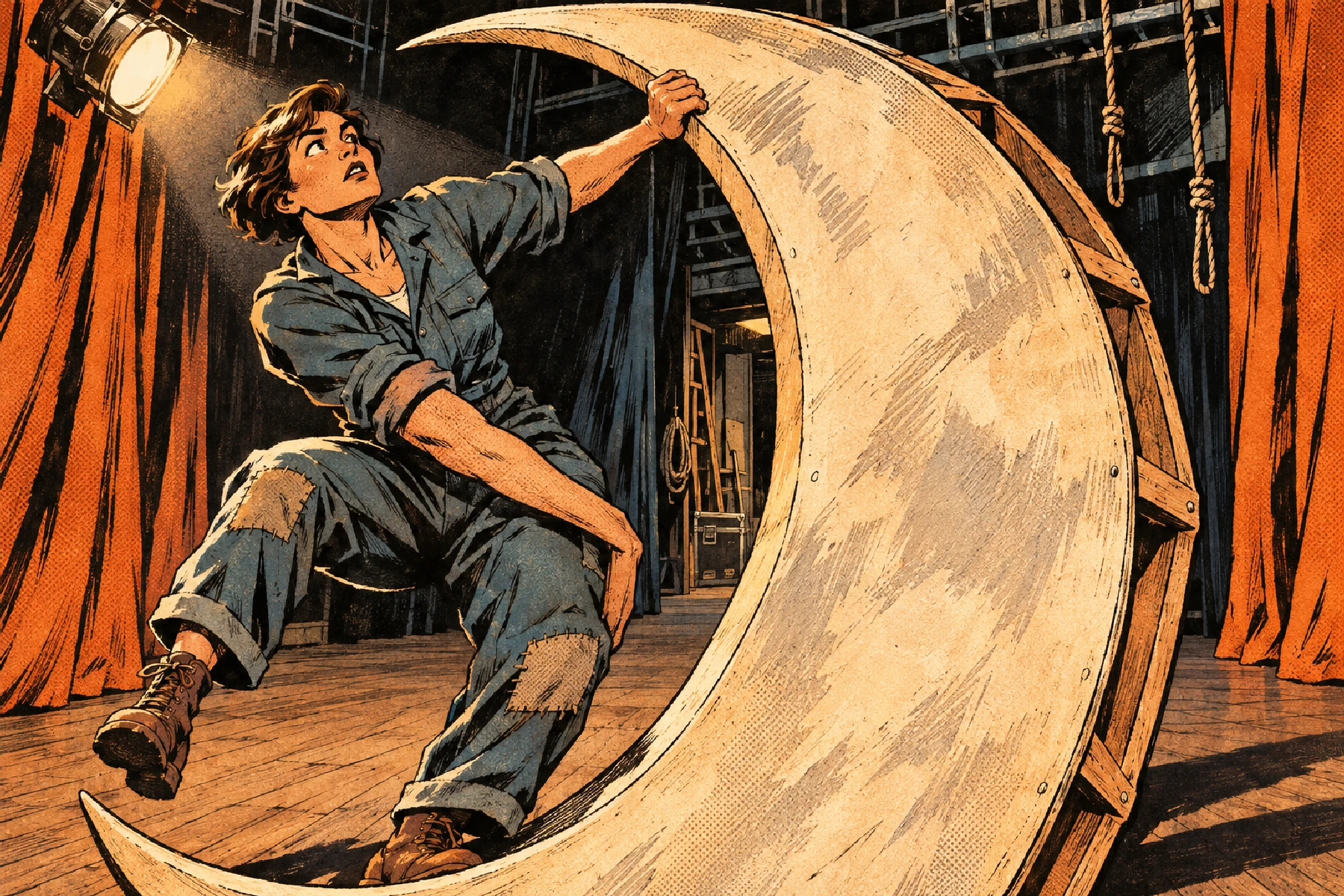
A Stagehand Caught in a Tipping Moon
Bold, elastic American comic inking catches a stagehand losing her balance inside a giant crescent moon set piece. Overlapping curves and vigorous ink marks propel the comic instant.
Remix this referenceA Stagehand Caught in a Tipping Moon
- Form language
- Reduce forms into forceful interlocking masses, alternating blunt wedges with sweeping curves; allow secondary shapes to vary naturally.
- Contour
- Use heavy brush-ink contours that swell under pressure and snap into fine tapered ends, with occasional dry splits and lost edges.
- Mark-making
- Group brisk parallel hatching into directional bursts; interrupt them with open passages and a few broad, imperfect ink strokes.
- Surface rendering
- Build tones with decisive spotted blacks, irregular color washes and selective broken halftone; retain paper flecks and abrupt tonal cuts.
Priority
Rendering medium: bold American comic illustration in brush ink and colored wash on paper.
What to avoid & what to check
Exact prompt for this example
MODULE OWNERSHIP
subject: Subject count, type, stable proportions and landmarks, resting face geometry, hair shape, physical materials, garment construction and permanent marks. No emotion, movement, color assignment or rendering recipe.
expression: Facial soft-tissue displacement and pupil direction, muscle coordination, regional intensity, asymmetry and onset/peak/release. No head/body pose, stable appearance, skin color or rendering.
gesture: Head/neck/body/limb orientation, joint movement, support, contact and pose-caused occlusion using existing anatomy. No eye/pupil movement, emotion, identity, props inventory or camera.
props: Prop count, type, construction, physical material and scale relative to the subject. Holding/contact belongs to gesture, position to composition, color to palette.
scene: Environment elements, terrain, backdrop/floor presence and structural detail. No canvas positions, camera, lighting, assigned colors or render texture.
camera: Projection, focal-length impression, camera elevation/yaw/roll, viewing distance and crop. No actor pose, world placement, lighting or canvas aspect ratio.
composition: Normalized 0-100% canvas positions, scale in frame, depth/overlap, focal hierarchy and margins. No joint pose, camera projection, rendering, subject/prop inventory or emotion.
palette: Color anchors, hue/saturation/value ranges, colors assigned to parts and approximate color coverage. No illumination direction, shading algorithm, physical material or layout.
lighting: Light-source direction/softness/intensity, ambient illumination, physical shadow direction/length and highlight position. Absence of directional illumination is allowed. No shading technique, palette or material changes.
style: Reusable form abstraction, contour weight/taper/edge quality, medium and mark scale/density/direction, surface rendering and tonal transition technique. No fixed subject proportions, anatomy, identity, expression, pose, palette, light-source direction, camera or layout.
output: Image count, aspect ratio, size, file/alpha requirements and global lettering/logo/watermark restrictions. No background scenery, crop, style, identity or pose.

SUBJECT
inventory: One adult woman stagehand, actor A; no other people.
geometry: A sturdy, compact build with broad hands, a square jaw, a rounded nose and short, side-swept hair.
resting-face: Straight brows, deep-set almond eyes and a broad upper lip establish the resting facial structure.
appearance: Cotton work coveralls with patched knees and sturdy leather work boots; small garment details may vary.

PRIORITY


AVOID


CHECK


EXPRESSION — ACTOR A
brows: Both brows lift, with the left brow rising slightly higher.
lids: Upper lids rise sharply; lower lids remain lightly braced.
cheeks: Cheeks remain mostly relaxed, without a smile lift.
nose: Nostrils widen slightly without wrinkling the bridge.
mouth: Lips part into a small uneven opening, one corner held tighter.
jaw: The jaw has just begun to drop.
gaze: Pupils track the crescent's upper horn.
coordination: The eyes register the mishap before the mouth fully reacts.
timing: Freeze the onset of surprise, just before a larger exclamation.

PRIORITY


AVOID


CHECK


GESTURE
head: A cranes her neck upward, keeping her chin clear of the raised shoulder.
torso: Her torso twists against the tipping crescent, shoulders countering the direction of her hips.
limbs: One arm reaches overhead and the other bends across her waist; one knee lifts while the other leg braces.
contact: Both hands grip the inner rim at different heights; one boot braces inside the lower curve as the other clears its tip.

PRIORITY


AVOID


CHECK


PROPS
inventory: One crescent moon theatrical flat, roughly twice A's height.
construction: A rigid plywood crescent with a broad outer curve, tapered horns and a shallow timber frame visible along its back edge.

PRIORITY


AVOID


CHECK


SCENE
inventory: A working theater stage with floorboards, heavy wing curtains and exposed overhead rigging.
structure: Curtain openings reveal a narrow backstage passage; a few suspended rope lines establish the fly space.

PRIORITY


AVOID


CHECK


CAMERA
projection: Perspective with a moderately wide lens impression and assertive near-to-far size changes.
viewpoint: View from slightly below waist height at a three-quarter angle, with a level horizon.
crop: Show A's full figure; let the nearest stretch of the moon's outer curve continue beyond the bottom edge.

PRIORITY


AVOID


CHECK


COMPOSITION
placement: The crescent sweeps diagonally across the middle and right; A occupies its open left side, her face the first focal point.
depth: The near horn overlaps A's lower legs; her arms cross the inner rim, with curtains and rigging layered behind.
spacing: Keep a clear pocket around the face and raised hand; compress the lower overlaps and leave breathing room above the upper horn.

PRIORITY


AVOID


CHECK


PALETTE
colors: Anchor the image in ink black, warm ivory, burnt orange and muted petrol blue, with restrained natural skin tones.
assignment: Ivory moon, petrol-blue coveralls, burnt-orange curtains, warm brown floor and dark brown hair and boots.
balance: Let ivory and black dominate, with substantial blue and smaller orange passages; keep distant hues subdued.

PRIORITY


AVOID


CHECK


LIGHTING
sources: A broad, strong work light enters from high left, supported by weak ambient stage illumination.
shadows: Cast shadows fall toward the right across the boards, with softened ends; the crescent shades parts of the coveralls.
highlights: Broad highlights catch the moon's upper-left rim, A's brow and the tops of her knuckles.

PRIORITY


AVOID


CHECK


STYLE GUIDE
form-language: Reduce forms into forceful interlocking masses, alternating blunt wedges with sweeping curves; allow secondary shapes to vary naturally.
contour: Use heavy brush-ink contours that swell under pressure and snap into fine tapered ends, with occasional dry splits and lost edges.
mark-making: Group brisk parallel hatching into directional bursts; interrupt them with open passages and a few broad, imperfect ink strokes.
surface-rendering: Build tones with decisive spotted blacks, irregular color washes and selective broken halftone; retain paper flecks and abrupt tonal cuts.

PRIORITY
Rendering medium: bold American comic illustration in brush ink and colored wash on paper.

AVOID


CHECK


OUTPUT
format: One finished illustration, landscape 3:2, 1800 × 1200 pixels, opaque PNG.
restrictions: No lettering, dialogue balloons, logos or watermarks.

PRIORITY


AVOID


CHECK


FINAL INTEGRATION
gesture + composition: Keep the bracing contacts readable through the overlapping forms.
lighting + style: Translate the light into the ink vocabulary while preserving its broad direction.
Model information comes from image provenance. The same prompt may produce a different result.