Text to imageProductStyle guide
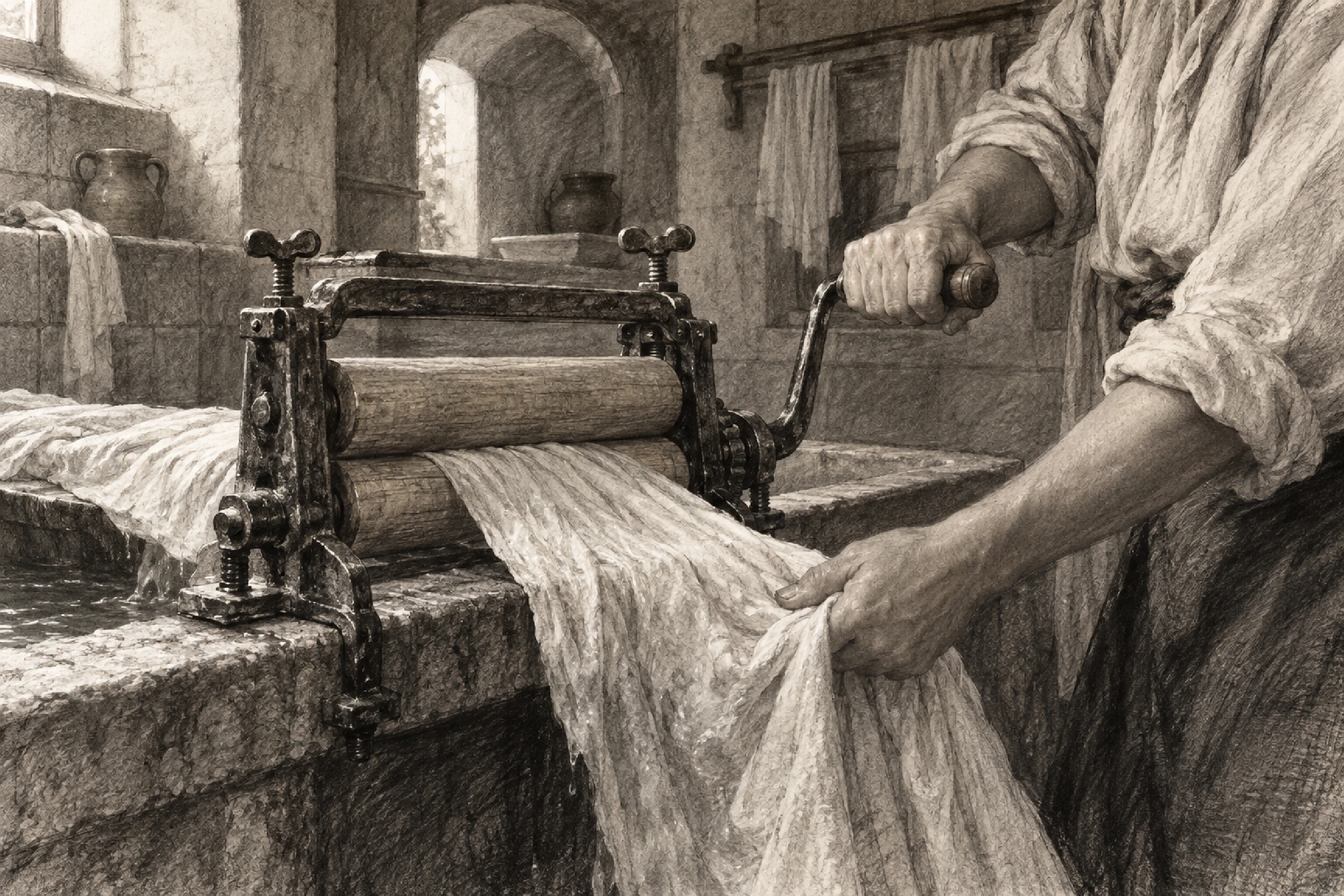
A Wringer Above the Laundry Trough
Hands turn a folding manual wringer above a built-in laundry trough. Layered space and wet linen emerge through rubbed charcoal and erased light.
Remix this referenceA Wringer Above the Laundry Trough
- Form language
- Build weight and volume from interlocking masses; simplify secondary detail while retaining transitions between structural planes.
- Contour
- Use searching, pressure-sensitive charcoal contours, alternating firm edges with broken and lost boundaries.
- Mark-making
- Combine broad side-of-stick sweeps with rubbed smudges and a few insistent narrow strokes; let revisions remain visible.
- Surface rendering
- Model tone through rubbed charcoal deposits and kneaded-eraser lifts, leaving paper tooth and irregular transitions visible.
Priority
Keep observational charcoal visible through smudged masses, searching edges and erased light.
What to avoid & what to check
Exact prompt for this example
MODULE OWNERSHIP
subject: Subject count, type, stable proportions and landmarks, resting face geometry, hair shape, physical materials, garment construction and permanent marks. No emotion, movement, color assignment or rendering recipe.
expression: Facial soft-tissue displacement and pupil direction, muscle coordination, regional intensity, asymmetry and onset/peak/release. No head/body pose, stable appearance, skin color or rendering.
gesture: Head/neck/body/limb orientation, joint movement, support, contact and pose-caused occlusion using existing anatomy. No eye/pupil movement, emotion, identity, props inventory or camera.
props: Prop count, type, construction, physical material and scale relative to the subject. Holding/contact belongs to gesture, position to composition, color to palette.
scene: Environment elements, terrain, backdrop/floor presence and structural detail. No canvas positions, camera, lighting, assigned colors or render texture.
camera: Projection, focal-length impression, camera elevation/yaw/roll, viewing distance and crop. No actor pose, world placement, lighting or canvas aspect ratio.
composition: Normalized 0-100% canvas positions, scale in frame, depth/overlap, focal hierarchy and margins. No joint pose, camera projection, rendering, subject/prop inventory or emotion.
palette: Color anchors, hue/saturation/value ranges, colors assigned to parts and approximate color coverage. No illumination direction, shading algorithm, physical material or layout.
lighting: Light-source direction/softness/intensity, ambient illumination, physical shadow direction/length and highlight position. Absence of directional illumination is allowed. No shading technique, palette or material changes.
style: Reusable form abstraction, contour weight/taper/edge quality, medium and mark scale/density/direction, surface rendering and tonal transition technique. No fixed subject proportions, anatomy, identity, expression, pose, palette, light-source direction, camera or layout.
output: Image count, aspect ratio, size, file/alpha requirements and global lettering/logo/watermark restrictions. No background scenery, crop, style, identity or pose.

SUBJECT
inventory: One original clamp-on manual laundry wringer and one adult operator, actor A.
geometry: Two broad rollers occupy a folding U-frame with a side crank and rim clamps; A has ordinary adult proportions.
resting-face: No facial geometry is prescribed for A.
appearance: Cast-iron frame, hardwood rollers and cork crank grip; A wears a loose woven shirt with folded cuffs.

PRIORITY


AVOID


CHECK


EXPRESSION — ACTOR A
brows: Brow displacement remains unprescribed.
lids: Eyelid tension and opening remain unprescribed.
cheeks: Cheek lift and compression remain unprescribed.
nose: Nasal wrinkling and nostril movement remain unprescribed.
mouth: Lip displacement and opening remain unprescribed.
jaw: Jaw release and tension remain unprescribed.
gaze: Pupil direction remains unprescribed.
coordination: No visible facial muscle coordination or asymmetry is prescribed.
timing: The neutral apex metadata adds no visible facial timing requirement.

PRIORITY


AVOID


CHECK


GESTURE
head: No head or neck orientation is prescribed.
torso: A leans slightly into the work, with the torso turned toward the wringer.
limbs: One forearm follows the crank's downward turn; the other extends toward the emerging linen.
contact: One hand grips the crank, the other supports cloth beyond the rollers; the wringer is clamped to the trough rim.

PRIORITY


AVOID


CHECK


PROPS
inventory: One wet linen sheet, broad enough to extend well beyond the wringer on both sides.
construction: Plain woven linen with a simple hem; incidental folds and wear may vary naturally.

PRIORITY


AVOID


CHECK


SCENE
inventory: An old laundry alcove contains a built-in stone trough, tiled walls, fixed drying rails and an arched service opening.
structure: The trough has a thick mounting rim; deep wall recesses flank the open arch.

PRIORITY


AVOID


CHECK


CAMERA
projection: Natural perspective with a normal-lens impression and no dramatic wide-angle stretching.
viewpoint: Observe from just above trough height, diagonally across the crank side, with a slight downward view.
crop: A close environmental crop includes the complete wringer and both hands; A is visible only from torso to hands.

PRIORITY


AVOID


CHECK


COMPOSITION
placement: The wringer sits left of center, its crank near the middle; A occupies the right edge and linen extends downward.
depth: Layer the cropped foreground trough, machine and hands, then recessed alcove; preserve the crank silhouette.
spacing: The crank-hand junction is the first focus and the roller opening the second; leave room around the upper-left recess.

PRIORITY


AVOID


CHECK


PALETTE
colors: Use warm ivory, smoke gray and charcoal black in a restrained near-monochrome range.
assignment: Linen and shirt are pale; hands, stone and wood use middle grays; the frame and deepest recesses approach black.
balance: Middle grays occupy most of the image, with selective ivory openings and concentrated black accents.

PRIORITY


AVOID


CHECK


LIGHTING
sources: A large opening above left supplies soft daylight, with subdued ambient light elsewhere.
shadows: Soft shadows fall down and right beneath the hands and frame; the trough interior remains substantially darker.
highlights: Broad highlights touch upper knuckles, roller crowns and raised wet folds.

PRIORITY


AVOID


CHECK


STYLE GUIDE
form-language: Build weight and volume from interlocking masses; simplify secondary detail while retaining transitions between structural planes.
contour: Use searching, pressure-sensitive charcoal contours, alternating firm edges with broken and lost boundaries.
mark-making: Combine broad side-of-stick sweeps with rubbed smudges and a few insistent narrow strokes; let revisions remain visible.
surface-rendering: Model tone through rubbed charcoal deposits and kneaded-eraser lifts, leaving paper tooth and irregular transitions visible.

PRIORITY
Keep observational charcoal visible through smudged masses, searching edges and erased light.

AVOID


CHECK


OUTPUT
format: One finished image, 3:2 aspect ratio, 2400 × 1600 pixels, opaque PNG.
restrictions: No lettering, logos or watermarks.

PRIORITY


AVOID


CHECK


FINAL INTEGRATION
subject + gesture + composition: Let the working interaction explain the product while keeping its construction understandable.
lighting + style: Translate the observed illumination into charcoal deposits and lifted passages without equalizing every edge.
Model information comes from image provenance. The same prompt may produce a different result.