Text to imageIllustrationStyle guide
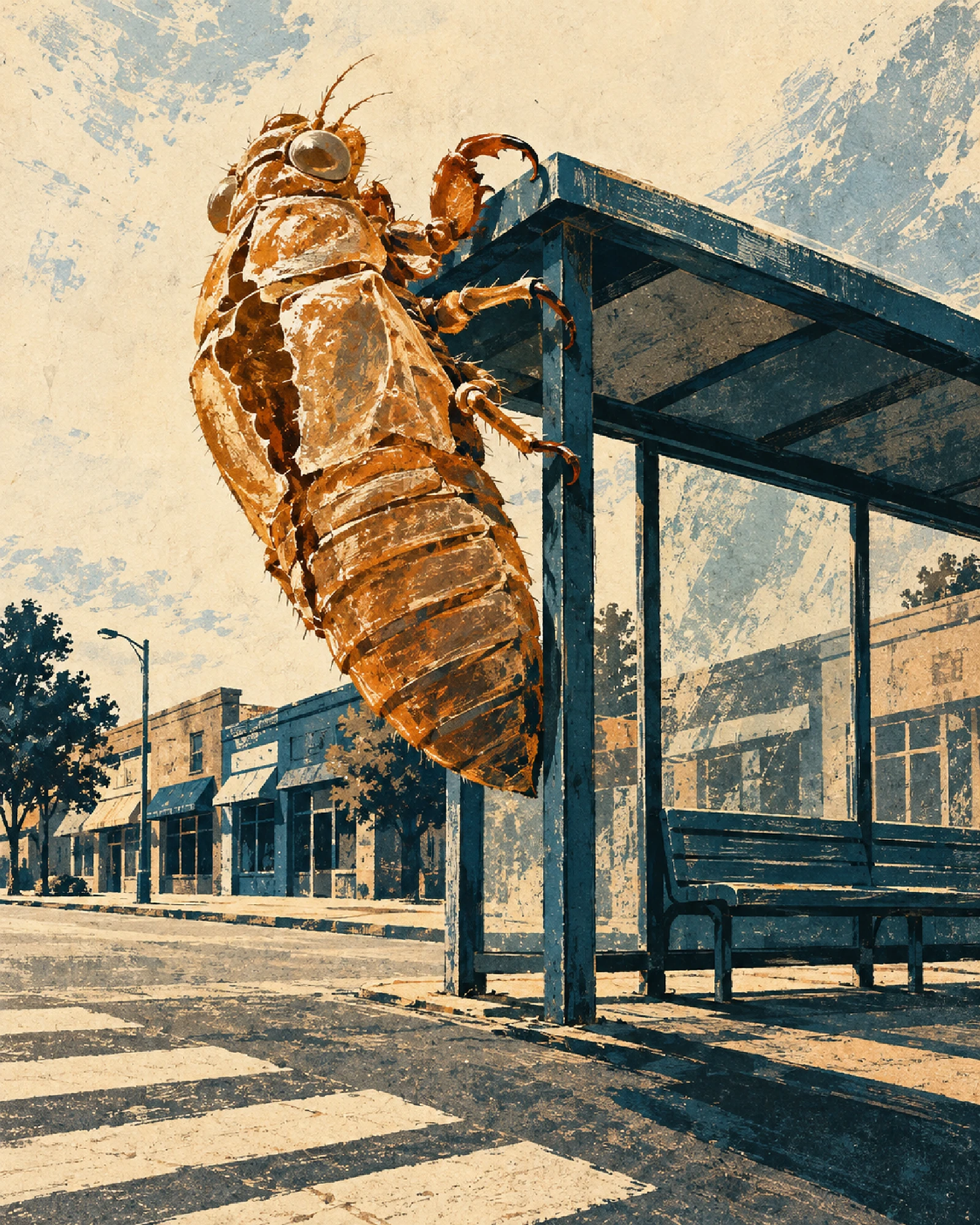
Giant Cicada Shell on a Bus Shelter
An enormous split cicada shell clings to an ordinary bus shelter. Bleeding ink and imperfect print overlaps turn the evidence of an unseen emergence into a strange urban poster.
Remix this referenceGiant Cicada Shell on a Bus Shelter
- Form language
- Reduce forms into interlocking blunt masses and sharp apertures; allow small details to vary within this vocabulary.
- Contour
- Loaded brush contours swell, feather and break, alternating decisive silhouettes with edges lost in adjacent ink.
- Mark-making
- Combine dragged dry-brush streaks with blunt stencil impressions, letting pressure and spacing vary naturally.
- Surface rendering
- Build tones through translucent print overlaps, pooled ink and exposed paper; slight registration slips leave lively edge echoes.
Priority
Let experimental ink-and-print processes visibly define the finished poster illustration.
What to avoid & what to check
Exact prompt for this example
MODULE OWNERSHIP
subject: Subject count, type, stable proportions and landmarks, resting face geometry, hair shape, physical materials, garment construction and permanent marks. No emotion, movement, color assignment or rendering recipe.
expression: Facial soft-tissue displacement and pupil direction, muscle coordination, regional intensity, asymmetry and onset/peak/release. No head/body pose, stable appearance, skin color or rendering.
gesture: Head/neck/body/limb orientation, joint movement, support, contact and pose-caused occlusion using existing anatomy. No eye/pupil movement, emotion, identity, props inventory or camera.
props: Prop count, type, construction, physical material and scale relative to the subject. Holding/contact belongs to gesture, position to composition, color to palette.
scene: Environment elements, terrain, backdrop/floor presence and structural detail. No canvas positions, camera, lighting, assigned colors or render texture.
camera: Projection, focal-length impression, camera elevation/yaw/roll, viewing distance and crop. No actor pose, world placement, lighting or canvas aspect ratio.
composition: Normalized 0-100% canvas positions, scale in frame, depth/overlap, focal hierarchy and margins. No joint pose, camera projection, rendering, subject/prop inventory or emotion.
palette: Color anchors, hue/saturation/value ranges, colors assigned to parts and approximate color coverage. No illumination direction, shading algorithm, physical material or layout.
lighting: Light-source direction/softness/intensity, ambient illumination, physical shadow direction/length and highlight position. Absence of directional illumination is allowed. No shading technique, palette or material changes.
style: Reusable form abstraction, contour weight/taper/edge quality, medium and mark scale/density/direction, surface rendering and tonal transition technique. No fixed subject proportions, anatomy, identity, expression, pose, palette, light-source direction, camera or layout.
output: Image count, aspect ratio, size, file/alpha requirements and global lettering/logo/watermark restrictions. No background scenery, crop, style, identity or pose.

SUBJECT
inventory: One empty cicada exoskeleton; no living figures.
geometry: Bus-shelter-sized cicada shell with a broad head, stout thorax, tapered segmented abdomen, six legs and small wing buds.
resting-face: Bulging compound-eye casings and compact mouthpart casing are empty, with no living facial tissue.
appearance: The shell is dry translucent chitin, with a rigid, hollow head, split-open back and brittle edges; no garments.

PRIORITY


AVOID


CHECK


GESTURE
head: The head tips slightly backward above the thorax.
torso: The shell remains nearly upright, its abdomen hanging beneath the split thorax.
limbs: Visible legs bend into loose hooks; far-side legs may be occluded by the body.
contact: Claw tips catch the shelter's end frame and roof lip, supporting the shell without crushing the structure.

PRIORITY


AVOID


CHECK


PROPS
inventory: No separate props or removable accessories.
construction: No prop construction applies.

PRIORITY


AVOID


CHECK


SCENE
inventory: A roadside bus shelter, curb, asphalt street, pedestrian crossing and a short row of modest storefronts.
structure: The shelter has a shallow metal roof, slender uprights, a glass windbreak and an integrated bench; storefront detail is sparse.

PRIORITY


AVOID


CHECK


CAMERA
projection: Moderate wide-angle perspective keeps familiar street architecture legible without extreme distortion.
viewpoint: Street-level three-quarter view, looking gently upward with a level horizon.
crop: A medium-wide environmental view includes the complete shell and shelter with a narrow strip of foreground road.

PRIORITY


AVOID


CHECK


COMPOSITION
placement: The shell dominates the left-middle; the shelter extends rightward beneath spacious upper-right negative space.
depth: The shell overlaps the near shelter frame; storefronts recede behind it, while crossing stripes enter the foreground.
spacing: The split back leads attention, the shelter establishes scale, and generous gaps preserve the hooked silhouette.

PRIORITY


AVOID


CHECK


PALETTE
colors: Warm paper cream, burnt orange, deep petrol blue and near-black form a restrained earthy palette.
assignment: Burnt orange belongs to the shell, petrol blue to architecture, cream to sky and road, and near-black to deep recesses.
balance: Cream occupies the largest share, blue supplies a broad counterweight, and orange stays concentrated on the shell.

PRIORITY


AVOID


CHECK


LIGHTING
sources: Broad afternoon light arrives from upper left, supported by soft ambient daylight.
shadows: Shell and shelter cast elongated, soft-edged shadows toward the lower right.
highlights: Upper-left shell ridges and the roof lip catch restrained highlights; hollow interiors remain subdued.

PRIORITY


AVOID


CHECK


STYLE GUIDE
form-language: Reduce forms into interlocking blunt masses and sharp apertures; allow small details to vary within this vocabulary.
contour: Loaded brush contours swell, feather and break, alternating decisive silhouettes with edges lost in adjacent ink.
mark-making: Combine dragged dry-brush streaks with blunt stencil impressions, letting pressure and spacing vary naturally.
surface-rendering: Build tones through translucent print overlaps, pooled ink and exposed paper; slight registration slips leave lively edge echoes.

PRIORITY
Let experimental ink-and-print processes visibly define the finished poster illustration.

AVOID


CHECK


OUTPUT
format: One finished illustration, portrait 4:5, 1600 × 2000 pixels, opaque PNG.
restrictions: No lettering, logos, signatures or watermarks.

PRIORITY


AVOID


CHECK
Model information comes from image provenance. The same prompt may produce a different result.