Text to imageArt stylesStyle guide
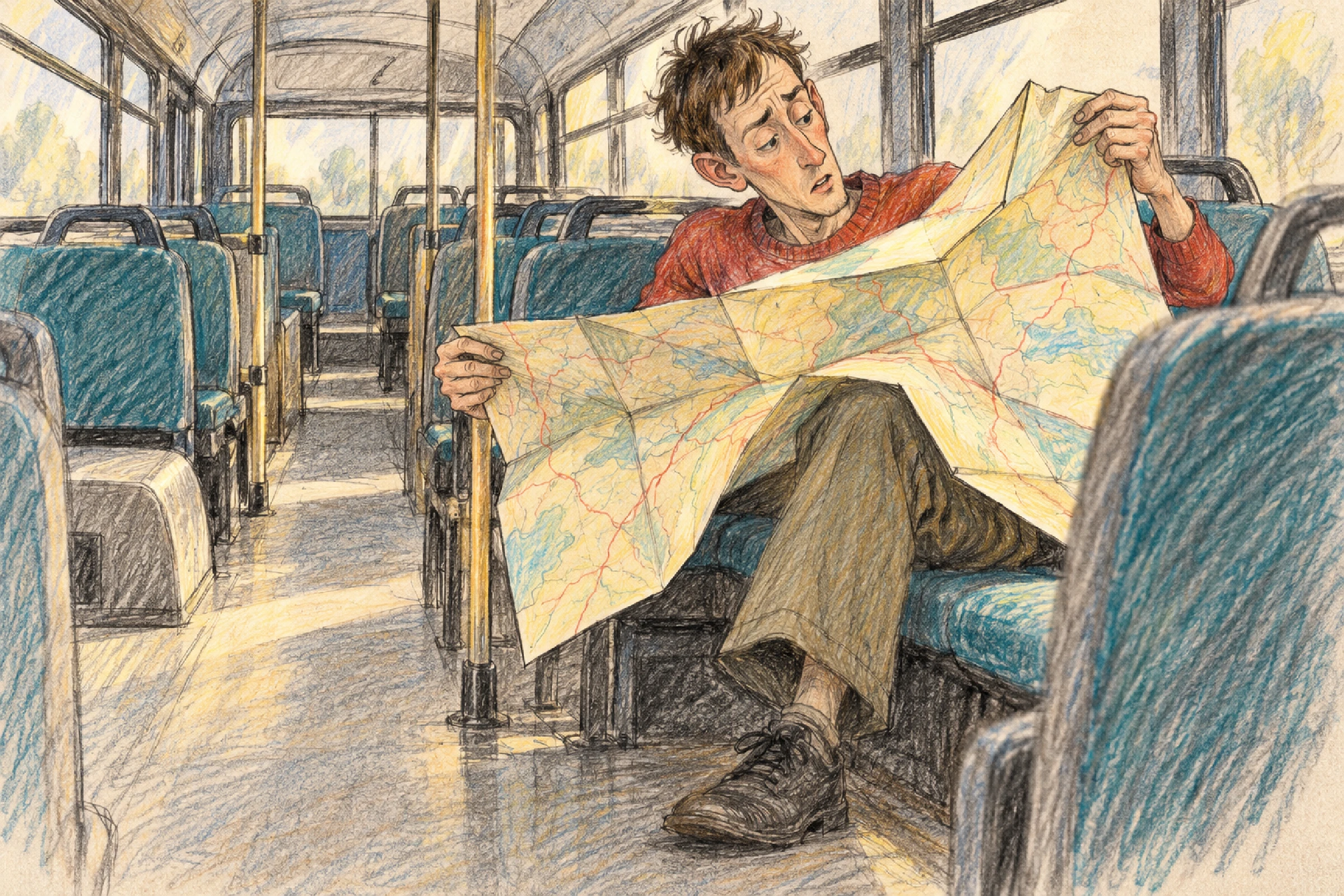
A Map Unfolded Across a Bus Seat
A traveler becomes tangled between empty bus seats while trying to refold an oversized map. Searching pencil lines and broken colored-pencil passages give the overlapping paper and movement a lively rhythm.
Remix this referenceA Map Unfolded Across a Bus Seat
- Form language
- Reduce complex forms to springy wedges and bent planes, allowing observed irregularities and loose secondary detail.
- Contour
- Use searching graphite contours with doubled attempts, pressure changes and deliberate gaps instead of polished closure.
- Mark-making
- Combine quick angular pencil strokes with broad side-of-pencil color scumbles; let direction and density vary naturally.
- Surface rendering
- Let paper tooth interrupt colored-pencil layers; build tone through uneven hatching, rubbed patches and exposed ground.
Priority
Make the rough pencil and colored-pencil sketchbook process visibly present.
What to avoid & what to check
Exact prompt for this example
MODULE OWNERSHIP
subject: Subject count, type, stable proportions and landmarks, resting face geometry, hair shape, physical materials, garment construction and permanent marks. No emotion, movement, color assignment or rendering recipe.
expression: Facial soft-tissue displacement and pupil direction, muscle coordination, regional intensity, asymmetry and onset/peak/release. No head/body pose, stable appearance, skin color or rendering.
gesture: Head/neck/body/limb orientation, joint movement, support, contact and pose-caused occlusion using existing anatomy. No eye/pupil movement, emotion, identity, props inventory or camera.
props: Prop count, type, construction, physical material and scale relative to the subject. Holding/contact belongs to gesture, position to composition, color to palette.
scene: Environment elements, terrain, backdrop/floor presence and structural detail. No canvas positions, camera, lighting, assigned colors or render texture.
camera: Projection, focal-length impression, camera elevation/yaw/roll, viewing distance and crop. No actor pose, world placement, lighting or canvas aspect ratio.
composition: Normalized 0-100% canvas positions, scale in frame, depth/overlap, focal hierarchy and margins. No joint pose, camera projection, rendering, subject/prop inventory or emotion.
palette: Color anchors, hue/saturation/value ranges, colors assigned to parts and approximate color coverage. No illumination direction, shading algorithm, physical material or layout.
lighting: Light-source direction/softness/intensity, ambient illumination, physical shadow direction/length and highlight position. Absence of directional illumination is allowed. No shading technique, palette or material changes.
style: Reusable form abstraction, contour weight/taper/edge quality, medium and mark scale/density/direction, surface rendering and tonal transition technique. No fixed subject proportions, anatomy, identity, expression, pose, palette, light-source direction, camera or layout.
output: Image count, aspect ratio, size, file/alpha requirements and global lettering/logo/watermark restrictions. No background scenery, crop, style, identity or pose.

SUBJECT
inventory: One adult traveler, actor A; no other passengers are visible.
geometry: A has a long face, narrow shoulders and a lanky build with large hands.
resting-face: Straight brows, widely spaced eyes, a long nose and a small mouth define the resting face.
appearance: A has a short uneven haircut, a cotton pullover, loose trousers and lace-up shoes.

PRIORITY


AVOID


CHECK


EXPRESSION — ACTOR A
brows: One brow rises while the other draws slightly inward.
lids: One upper lid opens wider; the opposite eye narrows slightly.
cheeks: Cheeks remain mostly slack, without a smile lift.
nose: Keep the nose relaxed, without nostril flare or bridge wrinkles.
mouth: Lips part narrowly, with one corner pulled sideways.
jaw: The jaw drops only enough to separate the lips.
gaze: Pupils turn toward the fold nearest the raised hand.
coordination: Uneven brows and lids lead the reaction; the mouth follows more weakly.
timing: Catch the onset as the traveler discovers another fold opening.

PRIORITY


AVOID


CHECK


GESTURE
head: A cranes the neck around a lifted map corner, tilting the head slightly sideways.
torso: The seated torso twists across the seat while the pelvis remains supported by the cushion.
limbs: One elbow lifts outward, the other stays tucked; one knee rises beneath the paper while the other foot braces.
contact: Both hands pinch different map edges; the lifted knee supports a sagging fold, which hides part of the forearm.

PRIORITY


AVOID


CHECK


PROPS
inventory: One paper road map, wide enough when unfolded to span roughly two bus seats.
construction: Thin creased paper forms connected rectangular panels; map graphics contain only branching route lines and irregular land shapes.

PRIORITY


AVOID


CHECK


SCENE
inventory: A modest bus interior with paired seats, windows, an aisle, a vertical grab pole and a visible floor.
structure: Rounded seat backs repeat along the cabin; window frames and a low wheel housing establish its practical construction.

PRIORITY


AVOID


CHECK


CAMERA
projection: Use moderately wide perspective with a candid observational impression.
viewpoint: Look from standing chest height across the aisle at an oblique angle, with a level horizon.
crop: Frame a medium-wide interior view including the whole seated figure, with nearby seat backs partially cut.

PRIORITY


AVOID


CHECK


COMPOSITION
placement: Place A right of center; the sprawling map crosses the middle, with the face and fold junction as the focal pair.
depth: A cropped seat back overlaps the map, which overlaps A; repeated seats carry depth into the rear.
spacing: Leave a generous open aisle on the left and readable gaps between the busiest overlapping forms.

PRIORITY


AVOID


CHECK


PALETTE
colors: Use graphite gray, faded vermilion, dusty turquoise and butter yellow over warm ivory.
assignment: Vermilion marks the pullover, turquoise the seats, butter yellow the map; graphite carries structural accents.
balance: Keep the ivory ground broadly present, with muted color fields and stronger small accents.

PRIORITY


AVOID


CHECK


LIGHTING
sources: Broad daylight enters through the windows from the left, supported by soft cabin ambient light.
shadows: Short, soft shadows fall to the right beneath folds and along the seat cushion.
highlights: Upturned paper ridges and the window-facing cheek receive broad, modest highlights.

PRIORITY


AVOID


CHECK


STYLE GUIDE
form-language: Reduce complex forms to springy wedges and bent planes, allowing observed irregularities and loose secondary detail.
contour: Use searching graphite contours with doubled attempts, pressure changes and deliberate gaps instead of polished closure.
mark-making: Combine quick angular pencil strokes with broad side-of-pencil color scumbles; let direction and density vary naturally.
surface-rendering: Let paper tooth interrupt colored-pencil layers; build tone through uneven hatching, rubbed patches and exposed ground.

PRIORITY
Make the rough pencil and colored-pencil sketchbook process visibly present.

AVOID


CHECK


OUTPUT
format: One finished image, landscape 3:2, 2400 × 1600 pixels, opaque PNG.
restrictions: No lettering, logos or watermarks.

PRIORITY


AVOID


CHECK


FINAL INTEGRATION
gesture + props + composition + style: Keep the contact relationships legible through the overlaps while allowing the drawing to retain exploratory energy.
Model information comes from image provenance. The same prompt may produce a different result.