Text to imageLandscapeStyle guide
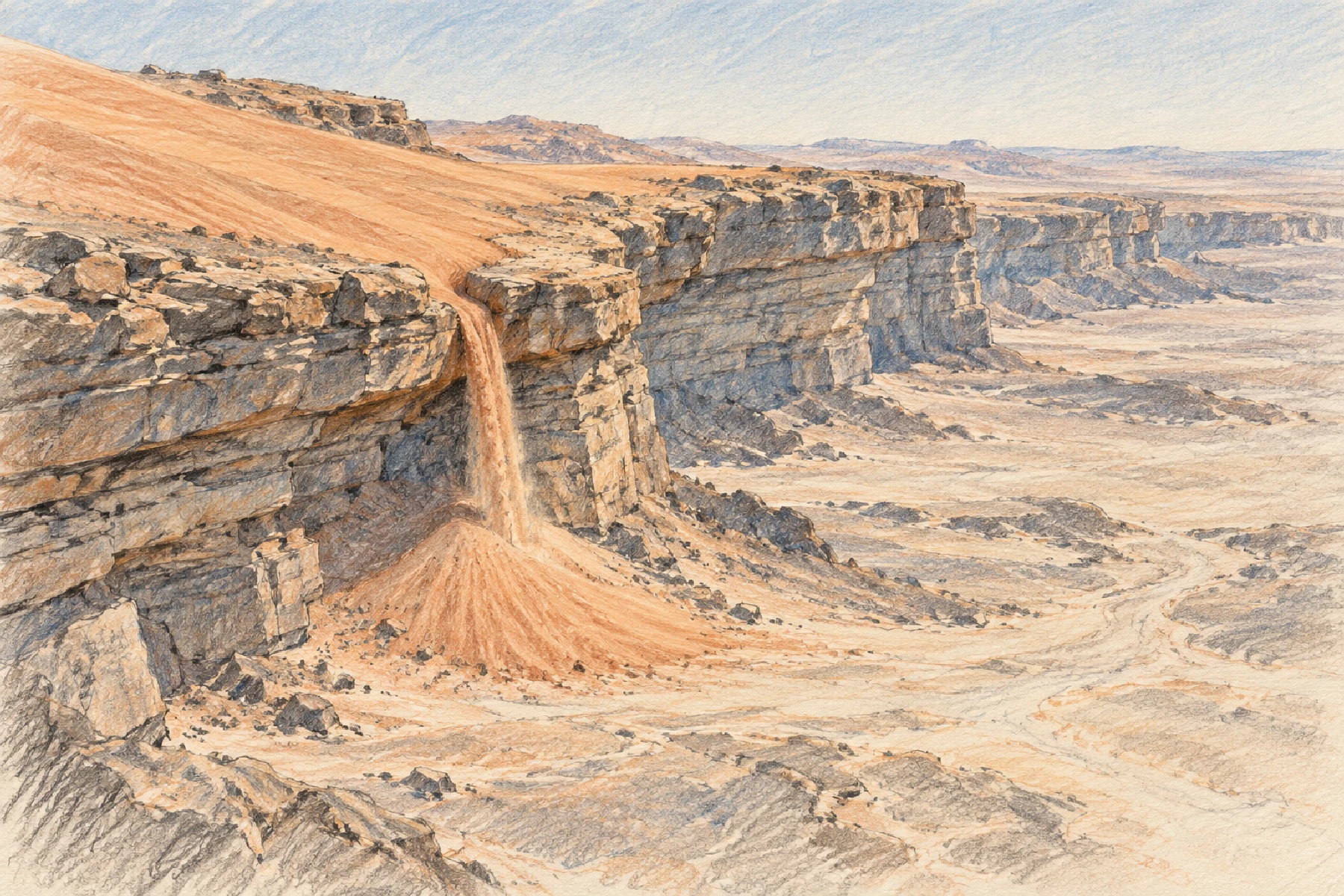
Sand Falling into a Rock Basin
A dune spills a thin sandfall over a sandstone rim. Rough pencil lines and open colored-pencil layers give the escarpment weight against an expansive, nearly empty basin.
Remix this referenceSand Falling into a Rock Basin
- Form language
- Reduce broad masses to uneven wedges and sweeping bands; let small irregularities vary within that spare vocabulary.
- Contour
- Use broken graphite contours with pressure changes, occasional searching double lines, and edges that dissolve into paper.
- Mark-making
- Mix sharp pencil scratches with broad side-of-lead colored-pencil strokes; change stroke direction with surface turns.
- Surface rendering
- Build translucent dry layers with paper tooth showing through; rubbed passages meet bare paper through ragged transitions.
Priority
Keep the rough graphite and colored-pencil sketchbook handling visibly present in the finished drawing.
What to avoid & what to check
Exact prompt for this example
MODULE OWNERSHIP
subject: Subject count, type, stable proportions and landmarks, resting face geometry, hair shape, physical materials, garment construction and permanent marks. No emotion, movement, color assignment or rendering recipe.
expression: Facial soft-tissue displacement and pupil direction, muscle coordination, regional intensity, asymmetry and onset/peak/release. No head/body pose, stable appearance, skin color or rendering.
gesture: Head/neck/body/limb orientation, joint movement, support, contact and pose-caused occlusion using existing anatomy. No eye/pupil movement, emotion, identity, props inventory or camera.
props: Prop count, type, construction, physical material and scale relative to the subject. Holding/contact belongs to gesture, position to composition, color to palette.
scene: Environment elements, terrain, backdrop/floor presence and structural detail. No canvas positions, camera, lighting, assigned colors or render texture.
camera: Projection, focal-length impression, camera elevation/yaw/roll, viewing distance and crop. No actor pose, world placement, lighting or canvas aspect ratio.
composition: Normalized 0-100% canvas positions, scale in frame, depth/overlap, focal hierarchy and margins. No joint pose, camera projection, rendering, subject/prop inventory or emotion.
palette: Color anchors, hue/saturation/value ranges, colors assigned to parts and approximate color coverage. No illumination direction, shading algorithm, physical material or layout.
lighting: Light-source direction/softness/intensity, ambient illumination, physical shadow direction/length and highlight position. Absence of directional illumination is allowed. No shading technique, palette or material changes.
style: Reusable form abstraction, contour weight/taper/edge quality, medium and mark scale/density/direction, surface rendering and tonal transition technique. No fixed subject proportions, anatomy, identity, expression, pose, palette, light-source direction, camera or layout.
output: Image count, aspect ratio, size, file/alpha requirements and global lettering/logo/watermark restrictions. No background scenery, crop, style, identity or pose.

SUBJECT
inventory: Landscape only; no people, animals, or discrete focal objects.
geometry: No discrete subject proportions apply.
resting-face: No faces are present.
appearance: No character appearance applies.

PRIORITY


AVOID


CHECK


PROPS
inventory: No separate props.
construction: No prop construction applies.

PRIORITY


AVOID


CHECK


SCENE
inventory: A dune overtops a sandstone escarpment above a broad, dry erosion basin; the sky is clear.
structure: Sand falls through a notch in the projecting rim, gathering in a small fan below; irregular bedding divides the rock.

PRIORITY


AVOID


CHECK


CAMERA
projection: Restrained perspective with a moderately long-lens impression.
viewpoint: An elevated oblique view looks diagonally across the escarpment with level roll.
crop: A distant, expansive view includes the rim and basin floor; the escarpment continues beyond the frame.

PRIORITY


AVOID


CHECK


COMPOSITION
placement: The escarpment enters from the upper left; the sandfall sits left of center, leaving the right half spacious.
depth: The projecting rim overlaps the recessed basin; the small sand fan connects these two depth layers.
spacing: Make the narrow sandfall the focal interruption in the heavy rim; keep the open basin free of competing accents.

PRIORITY


AVOID


CHECK


PALETTE
colors: Use burnt sienna, dusty peach, slate blue, graphite gray, and warm ivory with restrained saturation.
assignment: Give sand the peach and sienna range, rock the slate and graphite range, and sky and basin mostly ivory.
balance: Pale tones dominate; concentrated earth colors and dark grays provide a compact counterweight.

PRIORITY


AVOID


CHECK


LIGHTING
sources: Broad, soft daylight arrives from the upper left with generous ambient fill.
shadows: Short shadows fall toward the lower right; a deeper shadow remains beneath the overhanging rim.
highlights: Gentle highlights catch the upper-left-facing rim and the exposed falling sand.

PRIORITY


AVOID


CHECK


STYLE GUIDE
form-language: Reduce broad masses to uneven wedges and sweeping bands; let small irregularities vary within that spare vocabulary.
contour: Use broken graphite contours with pressure changes, occasional searching double lines, and edges that dissolve into paper.
mark-making: Mix sharp pencil scratches with broad side-of-lead colored-pencil strokes; change stroke direction with surface turns.
surface-rendering: Build translucent dry layers with paper tooth showing through; rubbed passages meet bare paper through ragged transitions.

PRIORITY
Keep the rough graphite and colored-pencil sketchbook handling visibly present in the finished drawing.

AVOID


CHECK


OUTPUT
format: One image, landscape 3:2, 1800 × 1200 pixels, opaque PNG.
restrictions: No lettering, logos, signatures, or watermarks.

PRIORITY


AVOID


CHECK
Model information comes from image provenance. The same prompt may produce a different result.