Text to imageAnimationStyle guide
A Nest in His Cap
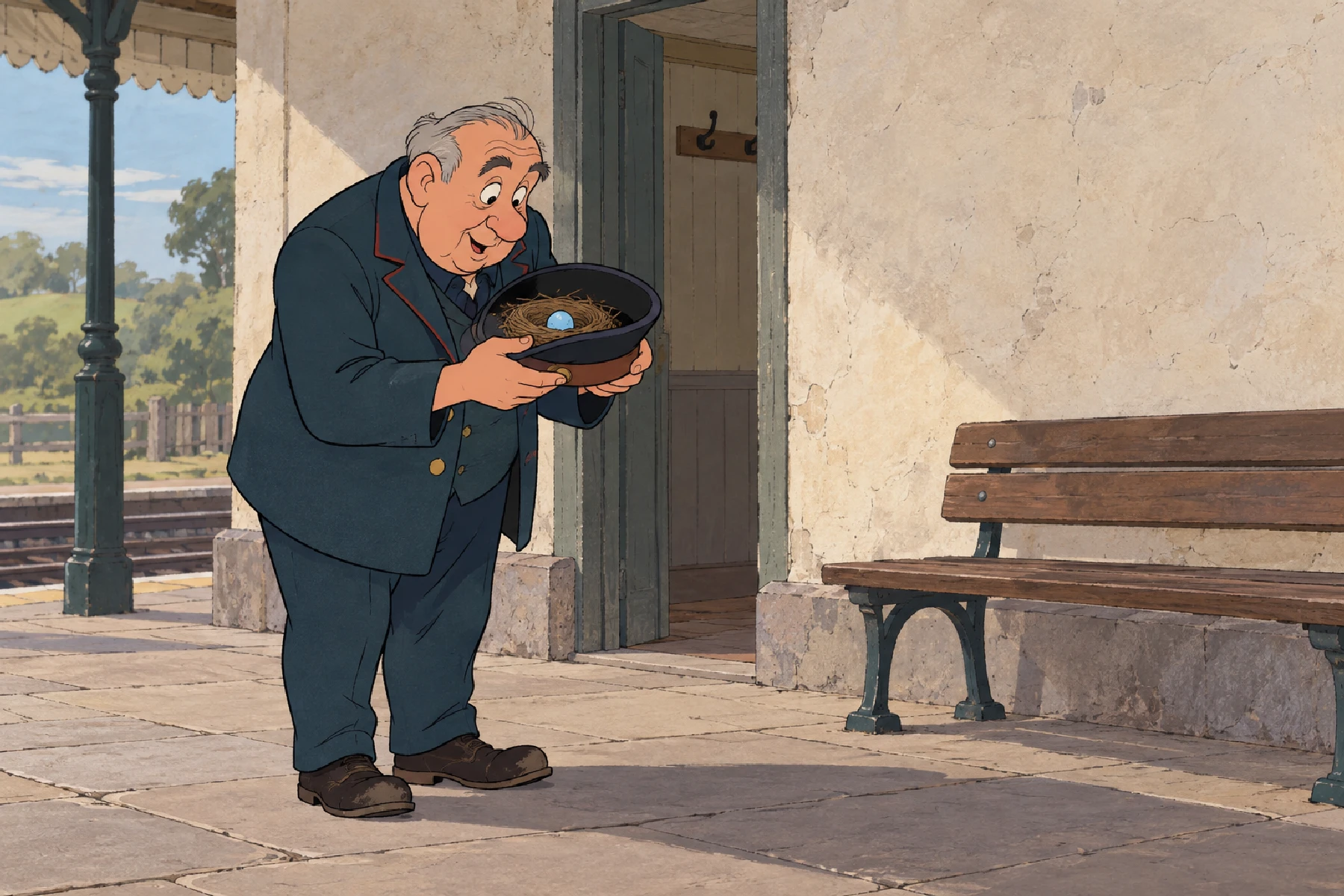
At a quiet rural station, a porter discovers a nest and egg inside his cap. His small, suspended surprise plays against an expansive station wall.
Remix this referenceA Nest in His Cap
- Form language
- Build legible interlocking masses with selective angular simplification; let small secondary shapes vary naturally.
- Contour
- Use sketch-like xerographic contours with slight weight fluctuations, tapered breaks, and occasional rough joins.
- Mark-making
- Retain selective short doubled outlines and broken pencil traces; keep broader brush marks loose and sparse.
- Surface rendering
- Use flat cel fills with few tonal steps and slight line-to-fill misregistration; allow dry, uneven painted edges.
Priority
Rendering medium: hand-drawn 2D xerographic cel-animation illustration; formal rendering reference: Walt Disney Studios · 1960s · One Hundred and One Dalmatians (1961)
What to avoid & what to check
Exact prompt for this example
MODULE OWNERSHIP
subject: Subject count, type, stable proportions and landmarks, resting face geometry, hair shape, physical materials, garment construction and permanent marks. No emotion, movement, color assignment or rendering recipe.
expression: Facial soft-tissue displacement and pupil direction, muscle coordination, regional intensity, asymmetry and onset/peak/release. No head/body pose, stable appearance, skin color or rendering.
gesture: Head/neck/body/limb orientation, joint movement, support, contact and pose-caused occlusion using existing anatomy. No eye/pupil movement, emotion, identity, props inventory or camera.
props: Prop count, type, construction, physical material and scale relative to the subject. Holding/contact belongs to gesture, position to composition, color to palette.
scene: Environment elements, terrain, backdrop/floor presence and structural detail. No canvas positions, camera, lighting, assigned colors or render texture.
camera: Projection, focal-length impression, camera elevation/yaw/roll, viewing distance and crop. No actor pose, world placement, lighting or canvas aspect ratio.
composition: Normalized 0-100% canvas positions, scale in frame, depth/overlap, focal hierarchy and margins. No joint pose, camera projection, rendering, subject/prop inventory or emotion.
palette: Color anchors, hue/saturation/value ranges, colors assigned to parts and approximate color coverage. No illumination direction, shading algorithm, physical material or layout.
lighting: Light-source direction/softness/intensity, ambient illumination, physical shadow direction/length and highlight position. Absence of directional illumination is allowed. No shading technique, palette or material changes.
style: Reusable form abstraction, contour weight/taper/edge quality, medium and mark scale/density/direction, surface rendering and tonal transition technique. No fixed subject proportions, anatomy, identity, expression, pose, palette, light-source direction, camera or layout.
output: Image count, aspect ratio, size, file/alpha requirements and global lettering/logo/watermark restrictions. No background scenery, crop, style, identity or pose.

SUBJECT
inventory: A is one original elderly male railway porter, the only character.
geometry: A barrel-shaped torso rests above short sturdy legs; a square nose and broad ears distinguish his face.
resting-face: At rest, his brows are low and straight, lower lids rounded, and broad mouth nearly horizontal.
appearance: Short combed-back hair, a cloth tunic with a stand collar, loose trousers, and worn leather work shoes.

PRIORITY


AVOID


CHECK


EXPRESSION — ACTOR A
brows: Both brows lift, with one rising slightly before the other.
lids: Upper lids open wider while the lower lids remain soft.
cheeks: Cheeks gather faintly upward without a full smile.
nose: The nose stays relaxed, with no nostril flare.
mouth: Lips part around a small breath; one corner begins to curl upward.
jaw: The jaw releases just enough to separate the lips.
gaze: Both pupils settle downward on the egg.
coordination: Raised brows and opening lids lead; the mouth responds more quietly.
timing: Catch the first recognition, before the emerging smile fully forms.

PRIORITY


AVOID


CHECK


GESTURE
head: A bows his head toward the cap, extending his neck slightly forward.
torso: His torso stays nearly upright with lowered shoulders and a small forward bend at the waist.
limbs: Bent elbows float away from his ribs; soft knees and one foot slightly ahead keep the stance grounded.
contact: Both palms support the inverted cap from beneath, tipping its opening toward him without covering the nest.

PRIORITY


AVOID


CHECK


PROPS
inventory: One head-sized railway cap, one small nest, and one thumb-sized egg.
construction: The cap has a soft wool crown and leather peak; the nest is loosely woven from twigs and dry grass.

PRIORITY


AVOID


CHECK


SCENE
inventory: A rural railway platform with a plaster station wall, an open cloakroom doorway, and a timber bench.
structure: A low wall plinth meets broad paving slabs; the doorway has a simple deep reveal and an empty coat peg.

PRIORITY


AVOID


CHECK


CAMERA
projection: Use natural perspective with a normal-lens impression and restrained foreshortening.
viewpoint: View from a gently elevated three-quarter angle with a level horizon, revealing the cap interior.
crop: A medium-long view includes the full figure; the bench continues beyond the right edge.

PRIORITY


AVOID


CHECK


COMPOSITION
placement: Place A in the left third at roughly 70% of canvas height; face, hands, and cap form the focal cluster.
depth: The egg sits within the nest and cap; the bench and doorway occupy a quieter plane behind A.
spacing: Leave a generous uninterrupted wall expanse above and to the right, with breathing room around the cap.

PRIORITY


AVOID


CHECK


PALETTE
colors: Use chalk cream, muted petrol, tobacco brown, and a small clear blue accent.
assignment: Cream belongs to plaster, petrol to the uniform, brown to cap and nest, blue to the egg; skin is warm peach.
balance: Pale neutrals dominate, the uniform supplies the main dark mass, and the egg carries the clearest saturation.

PRIORITY


AVOID


CHECK


LIGHTING
sources: Broad soft daylight arrives from the upper left, with gentle ambient fill across the platform.
shadows: Soft-edged shadows extend modestly to the right; the cap interior remains visibly illuminated.
highlights: A restrained highlight touches the egg's left curve and the upper edge of the cap.

PRIORITY


AVOID


CHECK


STYLE GUIDE
form-language: Build legible interlocking masses with selective angular simplification; let small secondary shapes vary naturally.
contour: Use sketch-like xerographic contours with slight weight fluctuations, tapered breaks, and occasional rough joins.
mark-making: Retain selective short doubled outlines and broken pencil traces; keep broader brush marks loose and sparse.
surface-rendering: Use flat cel fills with few tonal steps and slight line-to-fill misregistration; allow dry, uneven painted edges.

PRIORITY
Rendering medium: hand-drawn 2D xerographic cel-animation illustration; formal rendering reference: Walt Disney Studios · 1960s · One Hundred and One Dalmatians (1961)

AVOID


CHECK


OUTPUT
format: Deliver one finished 3:2 landscape image at 1800 × 1200 pixels as an opaque PNG.
restrictions: No lettering, logos, or watermarks.

PRIORITY


AVOID


CHECK
Art direction
디즈니 / Walt Disney Studios · 1960s · 101마리 달마시안(1961) / One Hundred and One Dalmatians (1961) ↗- Use legible form masses with selective angular simplification
- Sketch-like contours with small weight irregularities instead of polished ink uniformity
- Retain selective short doubled contour traces and broken pencil-like marks
- Flat fills with few tonal levels and slight line-to-fill edge misregistration
Model information comes from image provenance. The same prompt may produce a different result.