Text to imageProductStyle guide
Loop-Handled Crumb Sweeper
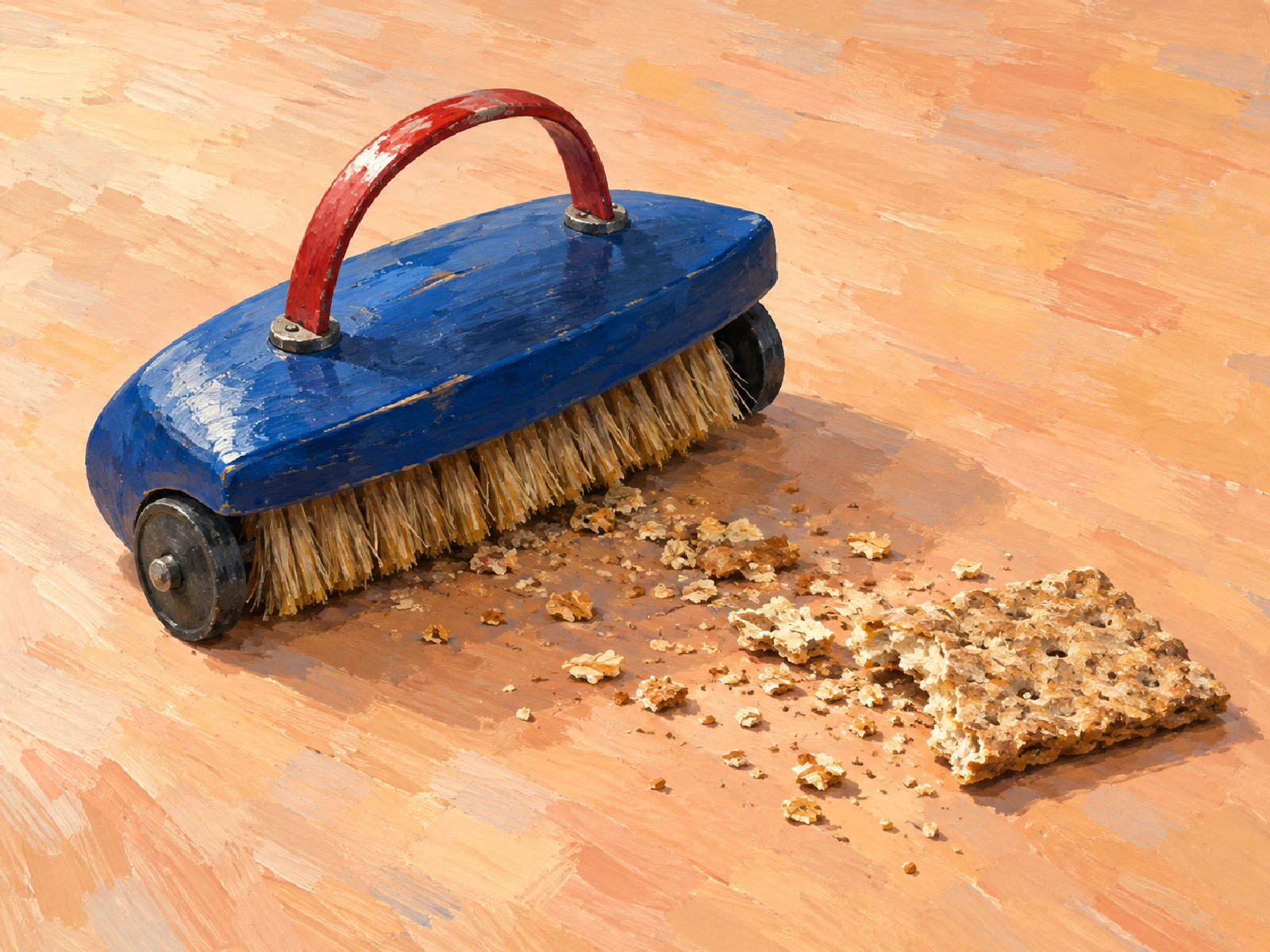
A small tabletop sweeper with an exposed brush roll sits beside broken crispbread in a spacious arrangement. Opaque gouache strokes give its painted shell and coarse bristles distinct, lively surfaces.
Remix this referenceLoop-Handled Crumb Sweeper
- Form language
- Build objects from generous, slightly lopsided painted shapes; simplify secondary mechanisms while preserving useful structural openings.
- Contour
- Let loaded brush edges define most contours, alternating crisp turns with soft dry skips; avoid a continuous enclosing outline.
- Mark-making
- Use broad opaque strokes with visible bristle splits, then a few nimble dragged marks; allow stroke width and paint load to vary naturally.
- Surface rendering
- Stack matte gouache patches while leaving earlier strokes exposed; turn tone through adjacent scumbles and occasional thick paint ridges.
Priority
Loose gouache with visibly opaque brushwork defines the finished image.
What to avoid & what to check
Exact prompt for this example
MODULE OWNERSHIP
subject: Subject count, type, stable proportions and landmarks, resting face geometry, hair shape, physical materials, garment construction and permanent marks. No emotion, movement, color assignment or rendering recipe.
expression: Facial soft-tissue displacement and pupil direction, muscle coordination, regional intensity, asymmetry and onset/peak/release. No head/body pose, stable appearance, skin color or rendering.
gesture: Head/neck/body/limb orientation, joint movement, support, contact and pose-caused occlusion using existing anatomy. No eye/pupil movement, emotion, identity, props inventory or camera.
props: Prop count, type, construction, physical material and scale relative to the subject. Holding/contact belongs to gesture, position to composition, color to palette.
scene: Environment elements, terrain, backdrop/floor presence and structural detail. No canvas positions, camera, lighting, assigned colors or render texture.
camera: Projection, focal-length impression, camera elevation/yaw/roll, viewing distance and crop. No actor pose, world placement, lighting or canvas aspect ratio.
composition: Normalized 0-100% canvas positions, scale in frame, depth/overlap, focal hierarchy and margins. No joint pose, camera projection, rendering, subject/prop inventory or emotion.
palette: Color anchors, hue/saturation/value ranges, colors assigned to parts and approximate color coverage. No illumination direction, shading algorithm, physical material or layout.
lighting: Light-source direction/softness/intensity, ambient illumination, physical shadow direction/length and highlight position. Absence of directional illumination is allowed. No shading technique, palette or material changes.
style: Reusable form abstraction, contour weight/taper/edge quality, medium and mark scale/density/direction, surface rendering and tonal transition technique. No fixed subject proportions, anatomy, identity, expression, pose, palette, light-source direction, camera or layout.
output: Image count, aspect ratio, size, file/alpha requirements and global lettering/logo/watermark restrictions. No background scenery, crop, style, identity or pose.

SUBJECT
inventory: One original manual tabletop crumb sweeper, without a person or mascot.
geometry: A low boat-shaped shell carries an arched loop grip; a broad brush cylinder and small wheels distinguish the underside.
resting-face: No face is present.
appearance: The shell is painted hardwood, the loop is bent metal, and the exposed brush has coarse natural-fiber bristles.

PRIORITY


AVOID


CHECK


PROPS
inventory: One broken crispbread wafer and a small quantity of crumbs; the wafer is shorter than the sweeper.
construction: The wafer is thin baked grain with an uneven snapped edge; crumbs range naturally from flakes to coarse grains.

PRIORITY


AVOID


CHECK


SCENE
inventory: A plain kitchen work surface provides the entire setting; no additional furnishings are visible.
structure: The work surface continues without a visible back edge, seam or upright backdrop.

PRIORITY


AVOID


CHECK


CAMERA
projection: Use a natural short-telephoto perspective with restrained depth compression.
viewpoint: Look down from a moderately elevated front three-quarter view, with no camera roll.
crop: Include the complete sweeper and crispbread in a generous tabletop view.

PRIORITY


AVOID


CHECK


COMPOSITION
placement: Group the sweeper left of center at roughly half the frame width; place the crispbread nearby in the lower-right interval and scatter crumbs across the gap.
depth: The shell overlaps the far wheel while the near brush remains readable; crumbs bridge the foreground gap without crossing the silhouette.
spacing: The product leads, the broken wafer answers, and a broad empty upper-right field gives the arrangement its graphic pause.

PRIORITY


AVOID


CHECK


PALETTE
colors: Use deep ultramarine, warm apricot, grain ochre and a small vermilion accent, supported by soft charcoal.
assignment: Assign ultramarine to the shell, vermilion to the loop, ochre to bristles and crispbread, and apricot to the work surface.
balance: Apricot occupies the largest area; the concentrated blue mass carries the color weight, with charcoal limited to recesses and wheels.

PRIORITY


AVOID


CHECK


LIGHTING
sources: A broad window source from the upper left gives soft, moderately bright illumination with gentle ambient fill.
shadows: A soft shadow extends toward the lower right, with firmer contact shadows beneath the wheels and brush.
highlights: Broad highlights sit on the shell's upper-left shoulder; the loop receives a small interrupted highlight.

PRIORITY


AVOID


CHECK


STYLE GUIDE
form-language: Build objects from generous, slightly lopsided painted shapes; simplify secondary mechanisms while preserving useful structural openings.
contour: Let loaded brush edges define most contours, alternating crisp turns with soft dry skips; avoid a continuous enclosing outline.
mark-making: Use broad opaque strokes with visible bristle splits, then a few nimble dragged marks; allow stroke width and paint load to vary naturally.
surface-rendering: Stack matte gouache patches while leaving earlier strokes exposed; turn tone through adjacent scumbles and occasional thick paint ridges.

PRIORITY
Loose gouache with visibly opaque brushwork defines the finished image.

AVOID


CHECK


OUTPUT
format: One finished image, landscape 4:3, 1600 × 1200 pixels, opaque PNG.
restrictions: No lettering, logos or watermarks.

PRIORITY


AVOID


CHECK


FINAL INTEGRATION
subject + composition + style: Keep the product's construction readable through loose brushwork, while the spacious arrangement lets small imperfections remain expressive.
Model information comes from image provenance. The same prompt may produce a different result.