Text to imageArt stylesStyle guide
Orchard Among Brick Kilns
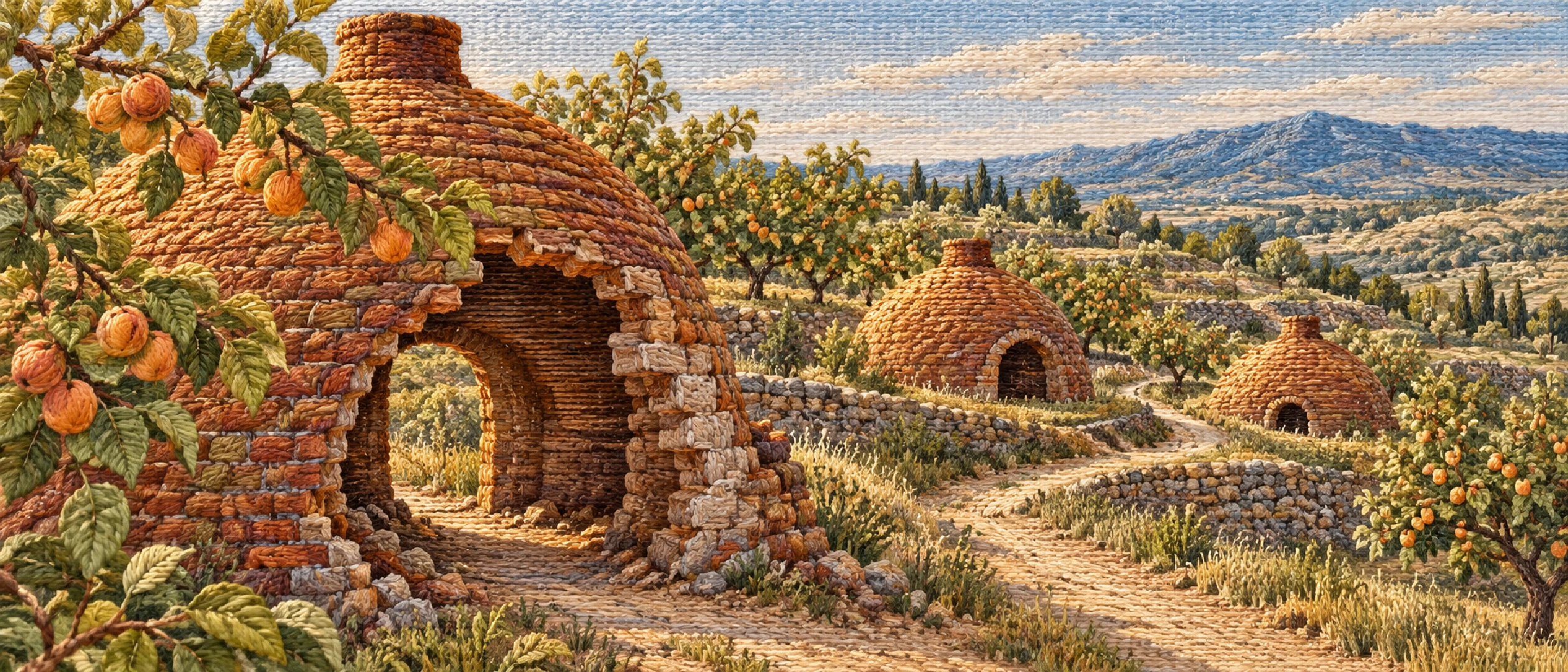
A panoramic embroidered illustration follows a path through ruined kilns into a hillside orchard, with raised threads and supple stitches.
Remix this referenceOrchard Among Brick Kilns
- Form language
- Translate forms into broad interlocking masses and simple apertures; allow small irregularities within a coherent textile language.
- Contour
- Soft corded boundaries vary in thickness; occasional loose fibers interrupt edges without enclosing every shape.
- Mark-making
- Directional stitches turn with each form; naturally changing stitch lengths give broad passages a hand-worked pulse.
- Surface rendering
- Raised stitched bands sit above visible woven ground; interleaved strands soften tonal transitions while preserving tactile relief.
Priority
The finished image reads as embroidered textile illustration with tangible thread relief.
What to avoid & what to check
Exact prompt for this example
MODULE OWNERSHIP
subject: Subject count, type, stable proportions and landmarks, resting face geometry, hair shape, physical materials, garment construction and permanent marks. No emotion, movement, color assignment or rendering recipe.
expression: Facial soft-tissue displacement and pupil direction, muscle coordination, regional intensity, asymmetry and onset/peak/release. No head/body pose, stable appearance, skin color or rendering.
gesture: Head/neck/body/limb orientation, joint movement, support, contact and pose-caused occlusion using existing anatomy. No eye/pupil movement, emotion, identity, props inventory or camera.
props: Prop count, type, construction, physical material and scale relative to the subject. Holding/contact belongs to gesture, position to composition, color to palette.
scene: Environment elements, terrain, backdrop/floor presence and structural detail. No canvas positions, camera, lighting, assigned colors or render texture.
camera: Projection, focal-length impression, camera elevation/yaw/roll, viewing distance and crop. No actor pose, world placement, lighting or canvas aspect ratio.
composition: Normalized 0-100% canvas positions, scale in frame, depth/overlap, focal hierarchy and margins. No joint pose, camera projection, rendering, subject/prop inventory or emotion.
palette: Color anchors, hue/saturation/value ranges, colors assigned to parts and approximate color coverage. No illumination direction, shading algorithm, physical material or layout.
lighting: Light-source direction/softness/intensity, ambient illumination, physical shadow direction/length and highlight position. Absence of directional illumination is allowed. No shading technique, palette or material changes.
style: Reusable form abstraction, contour weight/taper/edge quality, medium and mark scale/density/direction, surface rendering and tonal transition technique. No fixed subject proportions, anatomy, identity, expression, pose, palette, light-source direction, camera or layout.
output: Image count, aspect ratio, size, file/alpha requirements and global lettering/logo/watermark restrictions. No background scenery, crop, style, identity or pose.

SUBJECT
inventory: Three disused beehive brick kilns; no people or animals.
geometry: Squat domes have arched firing mouths and short chimney necks; one broken wall exposes a hollow chamber.
resting-face: No faces or facial features apply.
appearance: Fired-clay bricks retain scorch marks, worn edges and crumbling mortar; minor masonry details may vary.

PRIORITY


AVOID


CHECK


PROPS
inventory: No separate props.
construction: No prop construction applies.

PRIORITY


AVOID


CHECK


SCENE
inventory: A terraced apricot orchard, an earthen track, low retaining walls, grasses and a distant ridge beneath open sky.
structure: The track passes through the broken kiln chamber and winds between orchard terraces supported by rough stone walls.

PRIORITY


AVOID


CHECK


CAMERA
projection: Gentle perspective with a natural wide-lens impression and little edge distortion.
viewpoint: Look obliquely downhill from a modest elevation, with a level horizon.
crop: A broad environmental view crops part of the nearest kiln while including the distant orchard and sky.

PRIORITY


AVOID


CHECK


COMPOSITION
placement: The broken kiln fills the lower-left third; the path links it to smaller kilns across the middle and right.
depth: An orchard branch overlaps the nearest dome; successive terraces diminish toward a narrow distant ridge.
spacing: The broken chamber is the first focal stop; open intervals along the path carry attention across the panorama.

PRIORITY


AVOID


CHECK


PALETTE
colors: Terracotta, dusty apricot, olive green, smoky blue and warm flax form a softly muted palette.
assignment: Terracotta kilns, olive foliage, apricot fruit, smoky blue distance, and flax paths and sky.
balance: Earth and flax tones occupy broad areas; small apricot accents punctuate the greens.

PRIORITY


AVOID


CHECK


LIGHTING
sources: Broad daylight enters at a low angle from the upper left, supported by gentle ambient illumination.
shadows: Kilns cast soft shadows toward the lower right; raised threads cast tiny shadows in the same direction.
highlights: Restrained highlights catch upper-left dome rims and the crests of raised stitches.

PRIORITY


AVOID


CHECK


STYLE GUIDE
form-language: Translate forms into broad interlocking masses and simple apertures; allow small irregularities within a coherent textile language.
contour: Soft corded boundaries vary in thickness; occasional loose fibers interrupt edges without enclosing every shape.
mark-making: Directional stitches turn with each form; naturally changing stitch lengths give broad passages a hand-worked pulse.
surface-rendering: Raised stitched bands sit above visible woven ground; interleaved strands soften tonal transitions while preserving tactile relief.

PRIORITY
The finished image reads as embroidered textile illustration with tangible thread relief.

AVOID


CHECK


OUTPUT
format: One image, 21:9 aspect ratio, 2520 × 1080 pixels, opaque PNG.
restrictions: No lettering, logos or watermarks.

PRIORITY


AVOID


CHECK
Model information comes from image provenance. The same prompt may produce a different result.