Text to imagePortraitStyle guide
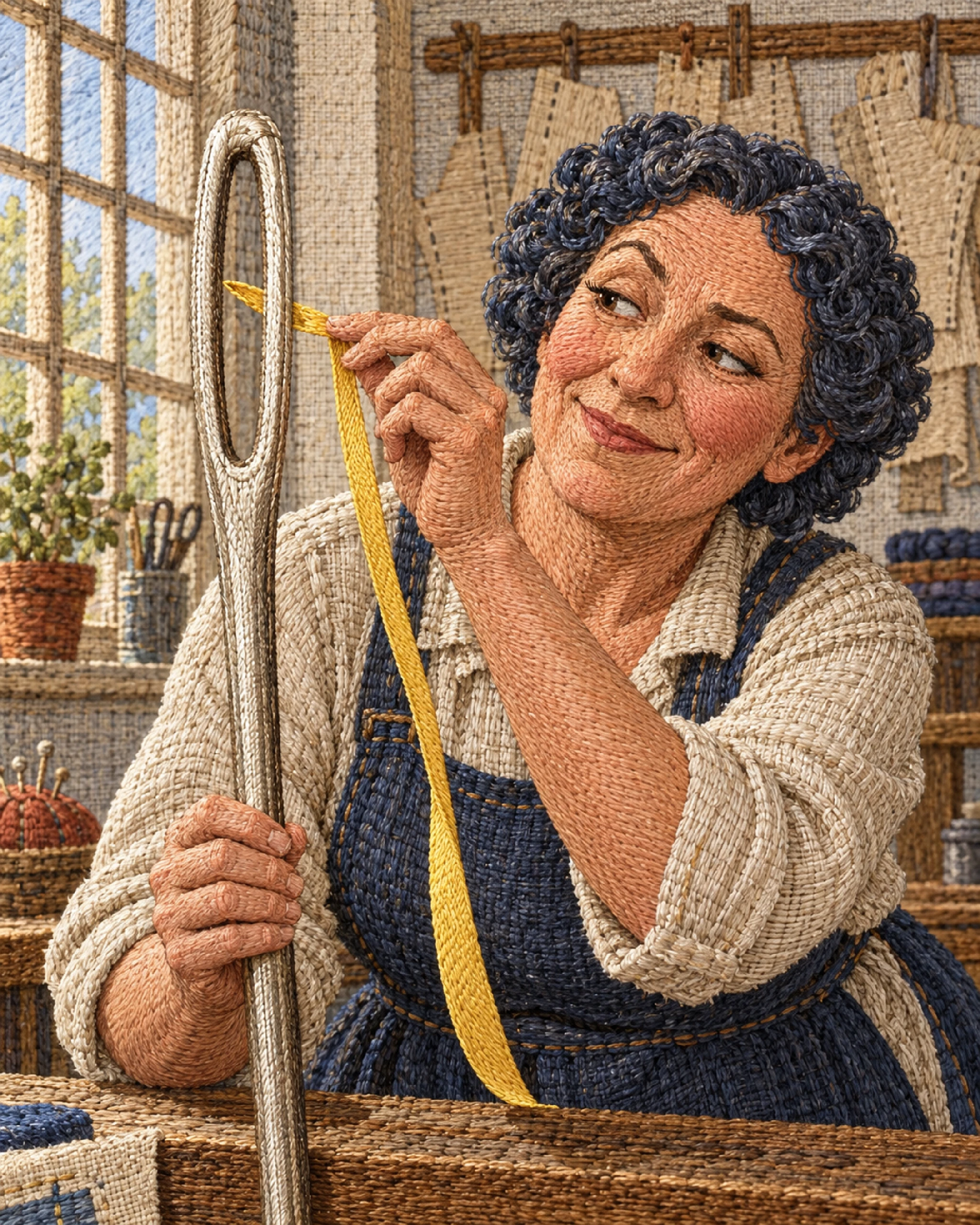
Woman Threading a Giant Needle
In a mending workshop, a woman threads ribbon through a needle eye the size of her face. Raised threads and exposed cloth turn the improbable scale into an intimate portrait.
Remix this referenceWoman Threading a Giant Needle
- Form language
- Reduce forms to nested rounded planes, allowing small handmade irregularities within a coherent embroidered language.
- Contour
- Use couched thread outlines that thicken at turns and break occasionally into exposed cloth; avoid uniformly sealed edges.
- Mark-making
- Fan satin stitches across broad planes and use short, uneven running stitches for small accents; let stitch lengths vary naturally.
- Surface rendering
- Build palpable thread relief through overlapping stitched bands; shift tone through thread grouping and exposed linen rather than smooth airbrushing.
Priority
The finished illustration must visibly read as raised embroidery on cloth.
What to avoid & what to check
Exact prompt for this example
MODULE OWNERSHIP
subject: Subject count, type, stable proportions and landmarks, resting face geometry, hair shape, physical materials, garment construction and permanent marks. No emotion, movement, color assignment or rendering recipe.
expression: Facial soft-tissue displacement and pupil direction, muscle coordination, regional intensity, asymmetry and onset/peak/release. No head/body pose, stable appearance, skin color or rendering.
gesture: Head/neck/body/limb orientation, joint movement, support, contact and pose-caused occlusion using existing anatomy. No eye/pupil movement, emotion, identity, props inventory or camera.
props: Prop count, type, construction, physical material and scale relative to the subject. Holding/contact belongs to gesture, position to composition, color to palette.
scene: Environment elements, terrain, backdrop/floor presence and structural detail. No canvas positions, camera, lighting, assigned colors or render texture.
camera: Projection, focal-length impression, camera elevation/yaw/roll, viewing distance and crop. No actor pose, world placement, lighting or canvas aspect ratio.
composition: Normalized 0-100% canvas positions, scale in frame, depth/overlap, focal hierarchy and margins. No joint pose, camera projection, rendering, subject/prop inventory or emotion.
palette: Color anchors, hue/saturation/value ranges, colors assigned to parts and approximate color coverage. No illumination direction, shading algorithm, physical material or layout.
lighting: Light-source direction/softness/intensity, ambient illumination, physical shadow direction/length and highlight position. Absence of directional illumination is allowed. No shading technique, palette or material changes.
style: Reusable form abstraction, contour weight/taper/edge quality, medium and mark scale/density/direction, surface rendering and tonal transition technique. No fixed subject proportions, anatomy, identity, expression, pose, palette, light-source direction, camera or layout.
output: Image count, aspect ratio, size, file/alpha requirements and global lettering/logo/watermark restrictions. No background scenery, crop, style, identity or pose.

SUBJECT
inventory: One middle-aged woman, actor A; no other figures.
geometry: An elongated oval face, broad cheek planes and a slightly hooked nose; ordinary adult proportions.
resting-face: Straight-set brows, hooded almond eyes and a broad mouth with a fuller lower lip at rest.
appearance: Short clustered curls; a cotton work shirt with roomy sleeves and folded cuffs beneath a cross-back canvas apron.

PRIORITY


AVOID


CHECK


EXPRESSION — ACTOR A
brows: One outer brow rises slightly; the other stays relaxed.
lids: Upper lids lift a little while lower lids gather softly.
cheeks: A small cheek lift follows the higher mouth corner.
nose: Nostrils remain relaxed, without wrinkling.
mouth: Closed lips begin an uneven smile, stronger on one side.
jaw: The jaw stays loose with the teeth together lightly.
gaze: Pupils turn toward the ribbon tip at the needle eye.
coordination: The cheek lift and uneven smile agree without becoming a squint.
timing: Catch amusement at its onset, before the smile fully opens.

PRIORITY


AVOID


CHECK


GESTURE
head: Tilt the head gently toward the needle eye, keeping the neck comfortably extended.
torso: Lean slightly over the workbench with one shoulder advanced.
limbs: One elbow bends close to the ribs; the other arm reaches across with loosely curved fingers.
contact: One hand steadies the needle against the bench; the other pinches ribbon through its eye without covering the face.

PRIORITY


AVOID


CHECK


PROPS
inventory: Two props: an oversized sewing needle and one narrow length of ribbon.
construction: The steel needle has an elongated open eye nearly as tall as her face and a shaft longer than her torso; the ribbon is woven silk.

PRIORITY


AVOID


CHECK


SCENE
inventory: A compact mending workshop with a wooden workbench, a tall sash window and a wall rail of hanging paper patterns.
structure: Deep window reveals and a worn bench edge establish an ordinary working room around the impossible tool.

PRIORITY


AVOID


CHECK


CAMERA
projection: Natural perspective with a mild portrait-lens compression.
viewpoint: View from face height, slightly around her front side, with no camera roll.
crop: An upper-body portrait retaining both working hands; the needle shaft may continue beyond the crop.

PRIORITY


AVOID


CHECK


COMPOSITION
placement: Place the face around 65% across and 40% down; the enlarged eye occupies the open left half.
depth: The needle crosses in front of the apron while the face remains clear; workshop fixtures recede behind both.
spacing: The face leads, the needle eye answers, and the loose ribbon links them; preserve breathing room around their meeting point.

PRIORITY


AVOID


CHECK


PALETTE
colors: Flax, deep indigo, warm terracotta and sharp citron, with restrained saturation outside the accent.
assignment: Use terracotta for skin, indigo for hair and apron, pale flax for the needle and room, and citron for the ribbon.
balance: Flax covers most of the image; indigo forms supporting masses, terracotta warms the portrait and citron stays scarce.

PRIORITY


AVOID


CHECK


LIGHTING
sources: Broad, soft window light arrives from the upper left with gentle ambient fill.
shadows: Soft shadows fall down and right; contact shadows remain short.
highlights: Quiet highlights catch upper-left edges and the highest raised surfaces.

PRIORITY


AVOID


CHECK


STYLE GUIDE
form-language: Reduce forms to nested rounded planes, allowing small handmade irregularities within a coherent embroidered language.
contour: Use couched thread outlines that thicken at turns and break occasionally into exposed cloth; avoid uniformly sealed edges.
mark-making: Fan satin stitches across broad planes and use short, uneven running stitches for small accents; let stitch lengths vary naturally.
surface-rendering: Build palpable thread relief through overlapping stitched bands; shift tone through thread grouping and exposed linen rather than smooth airbrushing.

PRIORITY
The finished illustration must visibly read as raised embroidery on cloth.

AVOID


CHECK


OUTPUT
format: One finished image, portrait 4:5, 2048 × 2560 pixels, opaque PNG; no lettering, logos or watermarks.
restrictions: One finished image, portrait 4:5, 2048 × 2560 pixels, opaque PNG; no lettering, logos or watermarks.

PRIORITY


AVOID


CHECK


FINAL INTEGRATION
expression + gesture + props: Facial acting and hand contact make the unusual tool feel part of a familiar working moment.
style + lighting: Illumination reveals the medium's relief while stitch organization supplies the illustrated tonal structure.
Model information comes from image provenance. The same prompt may produce a different result.