Text to imagePortraitStyle guide
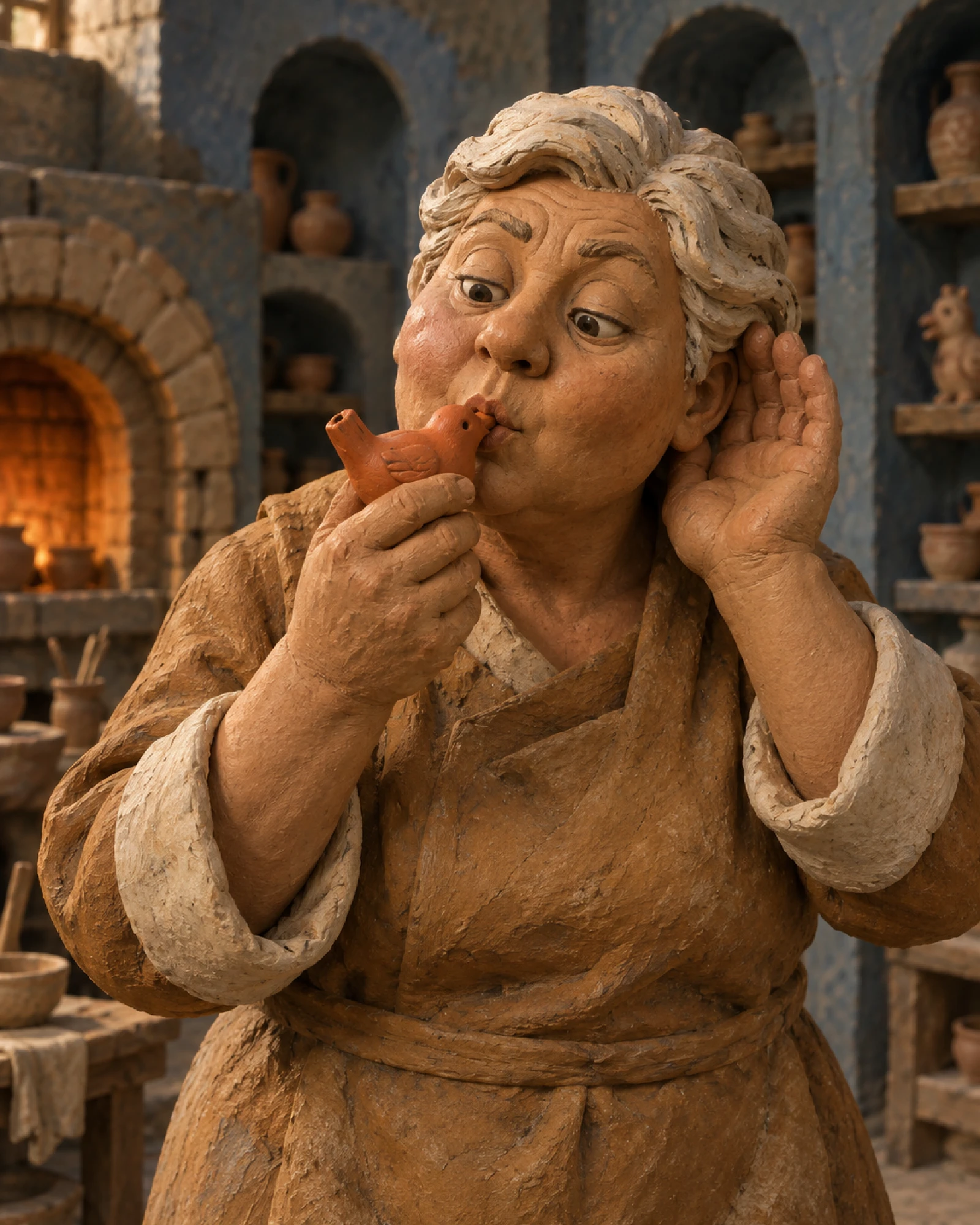
Potter Testing a Bird Whistle
A clay miniature portrait of a potter testing a little bird whistle with one hand cupped around her ear. Layered workshop niches and hand-shaped surfaces surround her attentive pause.
Remix this referencePotter Testing a Bird Whistle
- Form language
- Build a sculptural clay miniature from softly compressed masses and broad shallow planes; let small handmade irregularities vary naturally.
- Contour
- Use rounded, slightly wavering physical edges without drawn outlines; allow occasional pinched corners to interrupt the softness.
- Mark-making
- Leave selective thumb sweeps, blunt tool grooves and rubbed joins; vary their pressure and spacing rather than stamping a uniform texture.
- Surface rendering
- Favor dry matte surfaces with softly mottled pigment and gradual rounded tonal transitions; keep recesses visibly deep and edges tactile.
Priority
The finished image must visibly read as a hand-built clay miniature with tactile sculptural surfaces
What to avoid & what to check
Exact prompt for this example
MODULE OWNERSHIP
subject: Subject count, type, stable proportions and landmarks, resting face geometry, hair shape, physical materials, garment construction and permanent marks. No emotion, movement, color assignment or rendering recipe.
expression: Facial soft-tissue displacement and pupil direction, muscle coordination, regional intensity, asymmetry and onset/peak/release. No head/body pose, stable appearance, skin color or rendering.
gesture: Head/neck/body/limb orientation, joint movement, support, contact and pose-caused occlusion using existing anatomy. No eye/pupil movement, emotion, identity, props inventory or camera.
props: Prop count, type, construction, physical material and scale relative to the subject. Holding/contact belongs to gesture, position to composition, color to palette.
scene: Environment elements, terrain, backdrop/floor presence and structural detail. No canvas positions, camera, lighting, assigned colors or render texture.
camera: Projection, focal-length impression, camera elevation/yaw/roll, viewing distance and crop. No actor pose, world placement, lighting or canvas aspect ratio.
composition: Normalized 0-100% canvas positions, scale in frame, depth/overlap, focal hierarchy and margins. No joint pose, camera projection, rendering, subject/prop inventory or emotion.
palette: Color anchors, hue/saturation/value ranges, colors assigned to parts and approximate color coverage. No illumination direction, shading algorithm, physical material or layout.
lighting: Light-source direction/softness/intensity, ambient illumination, physical shadow direction/length and highlight position. Absence of directional illumination is allowed. No shading technique, palette or material changes.
style: Reusable form abstraction, contour weight/taper/edge quality, medium and mark scale/density/direction, surface rendering and tonal transition technique. No fixed subject proportions, anatomy, identity, expression, pose, palette, light-source direction, camera or layout.
output: Image count, aspect ratio, size, file/alpha requirements and global lettering/logo/watermark restrictions. No background scenery, crop, style, identity or pose.

SUBJECT
inventory: A is one older adult woman, a potter with a sturdy build.
geometry: A broad face, substantial nose and squared chin give her a recognizable, compact construction.
resting-face: Her resting face has hooded eyes, a generous lower lip and shallow folds beside the mouth.
appearance: Short swept hair forms a ridged cap; a canvas work smock has an overlapping neck and broad folded cuffs.

PRIORITY


AVOID


CHECK


EXPRESSION — ACTOR A
brows: Inner brows lift slightly, with a little more lift on her left.
lids: Upper lids open attentively while lower lids stay soft.
cheeks: Both cheeks swell gently with a small, sustained breath.
nose: Nostrils remain relaxed, without a wrinkle across the bridge.
mouth: Lips purse into a small forward seal; the corners remain relaxed.
jaw: The jaw stays nearly closed without clenching.
gaze: Pupils turn slightly downward toward the whistle.
coordination: Questioning brows and softly inflated cheeks convey attentive experimentation.
timing: Hold the apex of a gentle test note, before the cheeks release.

PRIORITY


AVOID


CHECK


GESTURE
head: A inclines her head toward her cupped left hand, keeping her neck comfortably extended.
torso: Her torso turns slightly to her right, with shoulders loose and unequal in height.
limbs: Her right hand raises the whistle to her mouth; her left elbow opens as the palm cups her ear.
contact: Right fingers cradle the whistle's belly; its beak touches her lips, and left fingertips touch her outer ear.

PRIORITY


AVOID


CHECK


PROPS
inventory: One palm-sized ceramic bird whistle, small enough to nest comfortably in one hand.
construction: A hollow rounded bird body joins a short beak mouthpiece, a stubby tail and a small sound opening.

PRIORITY


AVOID


CHECK


SCENE
inventory: A pottery workshop interior with thick walls, recessed storage niches, a built-in ledge and a kiln opening.
structure: Uneven arched recesses pass through successive wall bays; the kiln mouth has a deep stepped surround.

PRIORITY


AVOID


CHECK


CAMERA
projection: Use perspective with the gently compressed impression of a short portrait lens.
viewpoint: View at face height from slightly to A's right, with a level horizon and no roll.
crop: Make a medium-close portrait ending at the lower ribs, with the whole head and both raised hands visible.

PRIORITY


AVOID


CHECK


COMPOSITION
placement: Set the face near 60% canvas width and 35% height; the cupped hand counterbalances it across the left half.
depth: The whistle overlaps the lower face; successive wall bays recede behind the shoulders, with the kiln low at left.
spacing: Make the face primary and the hand-to-whistle arc secondary; preserve breathing room around the raised fingertips.

PRIORITY


AVOID


CHECK


PALETTE
colors: Anchor the image in earthen ochre, deep petrol, chalk cream and a concentrated persimmon accent.
assignment: Use warm ochre skin, a darker ochre smock, cream hair and cuffs, petrol architecture and a persimmon whistle.
balance: Let muted earthen and petrol tones dominate; reserve the strongest saturation for the small whistle.

PRIORITY


AVOID


CHECK


LIGHTING
sources: A broad soft source enters from high left, with gentle ambient fill reaching the workshop recesses.
shadows: Soft shadows fall down and right; deeper contact shadows separate fingers, whistle and face.
highlights: Broad restrained highlights sit on the upper-left cheek, finger ridges and the whistle's upper curve.

PRIORITY


AVOID


CHECK


STYLE GUIDE
form-language: Build a sculptural clay miniature from softly compressed masses and broad shallow planes; let small handmade irregularities vary naturally.
contour: Use rounded, slightly wavering physical edges without drawn outlines; allow occasional pinched corners to interrupt the softness.
mark-making: Leave selective thumb sweeps, blunt tool grooves and rubbed joins; vary their pressure and spacing rather than stamping a uniform texture.
surface-rendering: Favor dry matte surfaces with softly mottled pigment and gradual rounded tonal transitions; keep recesses visibly deep and edges tactile.

PRIORITY
The finished image must visibly read as a hand-built clay miniature with tactile sculptural surfaces

AVOID


CHECK


OUTPUT
format: Produce one finished image in a vertical 4:5 aspect ratio, 1600 × 2000 pixels, as an opaque PNG.
restrictions: No lettering, logos, signatures or watermarks.

PRIORITY


AVOID


CHECK


FINAL INTEGRATION
expression + gesture + props: Coordinate facial acting and prop contact so the test note remains physically clear and the cheeks remain readable.
scene + composition + lighting + style: Let spatial layering and illumination reveal the modeled depth while preserving the portrait's focal hierarchy.
Model information comes from image provenance. The same prompt may produce a different result.