Text to imageSpace & architectureStyle guide
Washhouse Open to the Canal
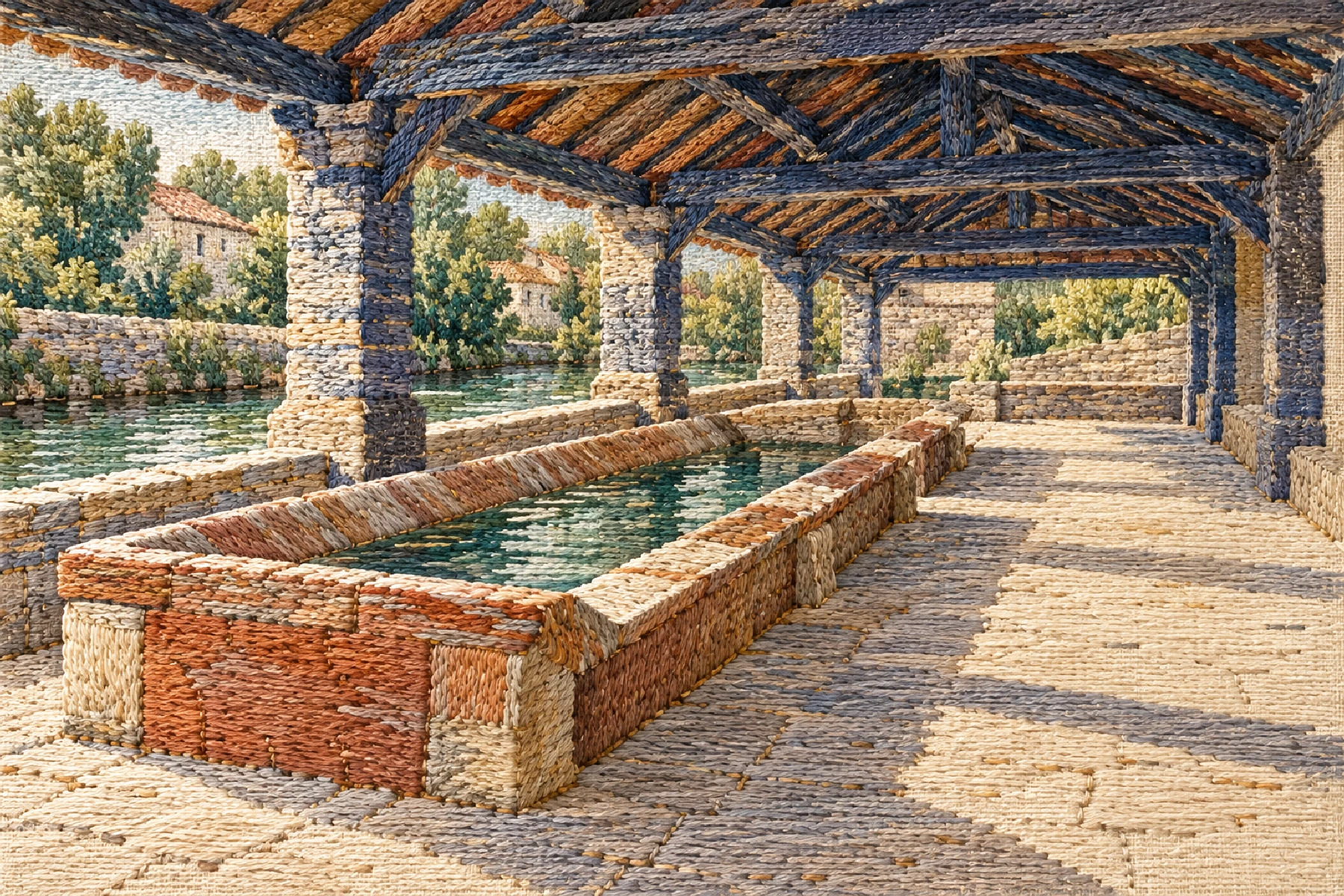
An embroidered illustration of a long communal washhouse opening onto a canal, with raised thread defining its trough and spacious architectural bays.
Remix this referenceWashhouse Open to the Canal
- Form language
- Translate broad planes into slightly uneven sewn shapes; simplify minor detail while retaining readable openings and connected volumes.
- Contour
- Use rounded couched-thread boundaries with occasional loose ends; let minor edges emerge from adjacent stitch directions.
- Mark-making
- Combine long satin stitches with sparse running stitches; allow stitch length and tension to vary naturally.
- Surface rendering
- Build shallow thread relief over visible linen; blend tones through interleaved strands and leave selected areas lightly worked.
Priority
The finished image must visibly read as embroidered textile with raised thread and exposed cloth.
What to avoid & what to check
Exact prompt for this example
MODULE OWNERSHIP
subject: Subject count, type, stable proportions and landmarks, resting face geometry, hair shape, physical materials, garment construction and permanent marks. No emotion, movement, color assignment or rendering recipe.
expression: Facial soft-tissue displacement and pupil direction, muscle coordination, regional intensity, asymmetry and onset/peak/release. No head/body pose, stable appearance, skin color or rendering.
gesture: Head/neck/body/limb orientation, joint movement, support, contact and pose-caused occlusion using existing anatomy. No eye/pupil movement, emotion, identity, props inventory or camera.
props: Prop count, type, construction, physical material and scale relative to the subject. Holding/contact belongs to gesture, position to composition, color to palette.
scene: Environment elements, terrain, backdrop/floor presence and structural detail. No canvas positions, camera, lighting, assigned colors or render texture.
camera: Projection, focal-length impression, camera elevation/yaw/roll, viewing distance and crop. No actor pose, world placement, lighting or canvas aspect ratio.
composition: Normalized 0-100% canvas positions, scale in frame, depth/overlap, focal hierarchy and margins. No joint pose, camera projection, rendering, subject/prop inventory or emotion.
palette: Color anchors, hue/saturation/value ranges, colors assigned to parts and approximate color coverage. No illumination direction, shading algorithm, physical material or layout.
lighting: Light-source direction/softness/intensity, ambient illumination, physical shadow direction/length and highlight position. Absence of directional illumination is allowed. No shading technique, palette or material changes.
style: Reusable form abstraction, contour weight/taper/edge quality, medium and mark scale/density/direction, surface rendering and tonal transition technique. No fixed subject proportions, anatomy, identity, expression, pose, palette, light-source direction, camera or layout.
output: Image count, aspect ratio, size, file/alpha requirements and global lettering/logo/watermark restrictions. No background scenery, crop, style, identity or pose.

SUBJECT
inventory: No occupants or independent objects.
geometry: No independent subject geometry applies.
resting-face: No faces are present.
appearance: No independent subject appearance applies.

PRIORITY


AVOID


CHECK


PROPS
inventory: No separate props.
construction: No prop construction applies.

PRIORITY


AVOID


CHECK


SCENE
inventory: A communal washhouse with a built-in stone trough, timber roof, broad floor apron, open bays, and an adjoining canal.
structure: The elongated trough has a sloping washing rim; squat piers support the roof above a low canal-side parapet. The intervals between piers vary.

PRIORITY


AVOID


CHECK


CAMERA
projection: Use gently compressed architectural perspective with a normal-lens impression.
viewpoint: View diagonally along the hall from standing height near its entrance, at a medium-wide distance without roll.
crop: Include the trough's near end and enough roof and floor to read the room as a continuous interior.

PRIORITY


AVOID


CHECK


COMPOSITION
placement: Keep the trough and piers left of center, balanced by a broad open floor passage on the right.
depth: The trough leads into overlapping bays; glimpses of canal form a secondary layer beyond the parapet.
spacing: Make the trough's open end the focal point; preserve generous quiet space across the floor.

PRIORITY


AVOID


CHECK


PALETTE
colors: Use warm ivory, dusty indigo, faded terracotta, and muted jade, with modest value contrasts.
assignment: Assign ivory to floor and open ground, indigo to roof and piers, terracotta to the trough, and jade to water.
balance: Let ivory dominate, with substantial indigo structure and smaller terracotta and jade passages.

PRIORITY


AVOID


CHECK


LIGHTING
sources: Soft daylight enters through the open bays from the upper left; diffuse ambient light reaches beneath the roof.
shadows: Broad, soft-edged pier shadows extend rightward across the floor; the roof underside remains gently shaded.
highlights: Place restrained highlights along upper trough edges.

PRIORITY


AVOID


CHECK


STYLE GUIDE
form-language: Translate broad planes into slightly uneven sewn shapes; simplify minor detail while retaining readable openings and connected volumes.
contour: Use rounded couched-thread boundaries with occasional loose ends; let minor edges emerge from adjacent stitch directions.
mark-making: Combine long satin stitches with sparse running stitches; allow stitch length and tension to vary naturally.
surface-rendering: Build shallow thread relief over visible linen; blend tones through interleaved strands and leave selected areas lightly worked.

PRIORITY
The finished image must visibly read as embroidered textile with raised thread and exposed cloth.

AVOID


CHECK


OUTPUT
format: One finished image, landscape 3:2, 1800 × 1200 pixels, opaque PNG.
restrictions: No lettering, logos, signatures, or watermarks.

PRIORITY


AVOID


CHECK


FINAL INTEGRATION
lighting + style: For this embroidered finish, let the restrained highlights catch the upper-left ridges of raised stitching.
Model information comes from image provenance. The same prompt may produce a different result.