Text to imageProductStyle guide
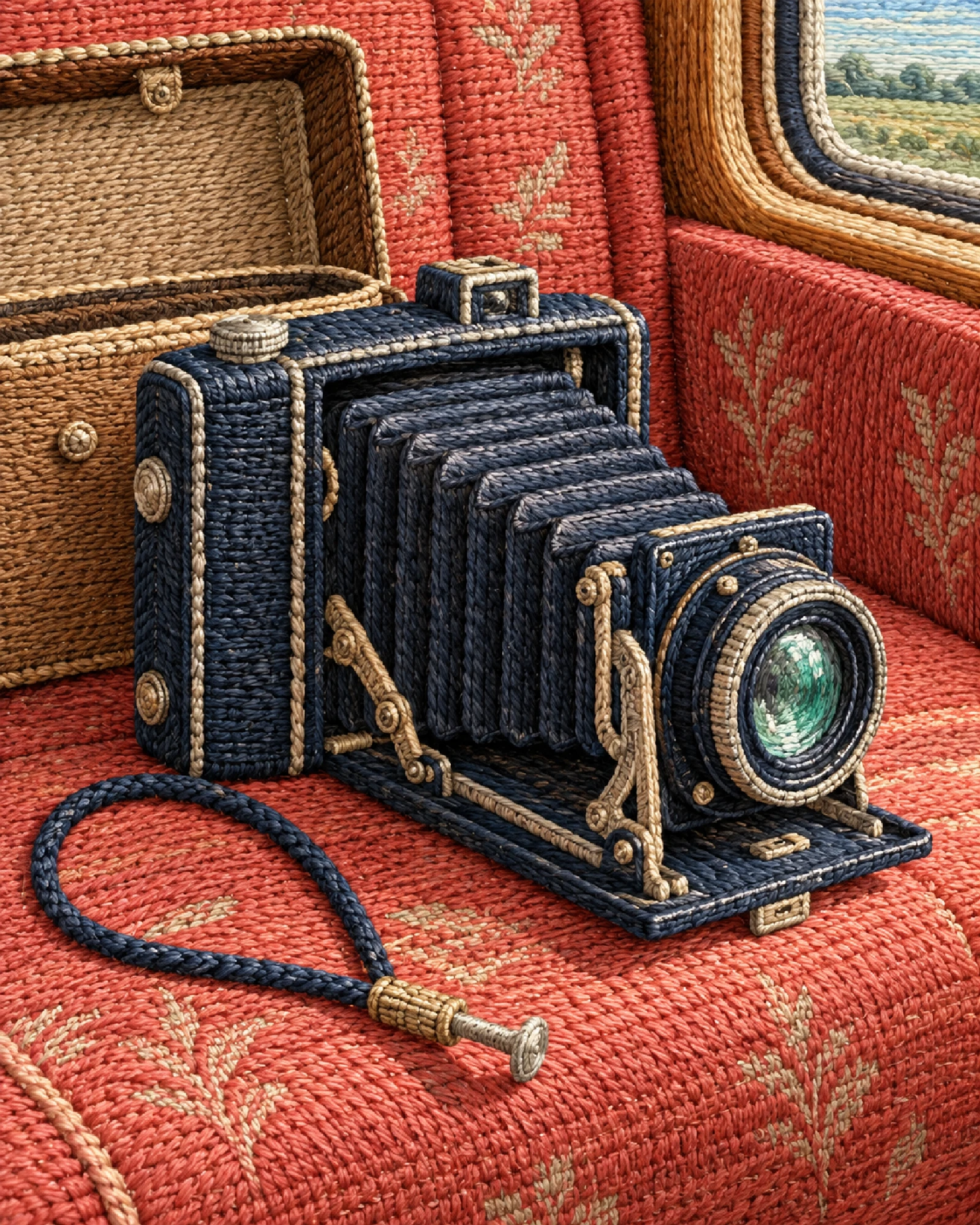
Folding Camera on a Train Seat
An intimate view of a folding camera beside its open leather case on a train seat. Raised embroidery and changing stitch directions distinguish bellows, lens and upholstery.
Remix this referenceFolding Camera on a Train Seat
- Form language
- Translate forms into softly padded panels and nested pleats, simplifying small mechanisms into a few readable stitched shapes.
- Contour
- Use couched cord for substantial boundaries and finer running stitches for secondary edges; allow slight wavering at turns.
- Mark-making
- Alternate long satin stitches, short directional stitches and occasional knots; vary stitch length naturally and leave some backing visible.
- Surface rendering
- Build tonal changes by interleaving thread shades and changing stitch direction; retain raised overlaps, soft fibers and uneven handmade density.
Priority
Make this visibly an embroidered textile illustration with tactile thread relief.
What to avoid & what to check
Exact prompt for this example
MODULE OWNERSHIP
subject: Subject count, type, stable proportions and landmarks, resting face geometry, hair shape, physical materials, garment construction and permanent marks. No emotion, movement, color assignment or rendering recipe.
expression: Facial soft-tissue displacement and pupil direction, muscle coordination, regional intensity, asymmetry and onset/peak/release. No head/body pose, stable appearance, skin color or rendering.
gesture: Head/neck/body/limb orientation, joint movement, support, contact and pose-caused occlusion using existing anatomy. No eye/pupil movement, emotion, identity, props inventory or camera.
props: Prop count, type, construction, physical material and scale relative to the subject. Holding/contact belongs to gesture, position to composition, color to palette.
scene: Environment elements, terrain, backdrop/floor presence and structural detail. No canvas positions, camera, lighting, assigned colors or render texture.
camera: Projection, focal-length impression, camera elevation/yaw/roll, viewing distance and crop. No actor pose, world placement, lighting or canvas aspect ratio.
composition: Normalized 0-100% canvas positions, scale in frame, depth/overlap, focal hierarchy and margins. No joint pose, camera projection, rendering, subject/prop inventory or emotion.
palette: Color anchors, hue/saturation/value ranges, colors assigned to parts and approximate color coverage. No illumination direction, shading algorithm, physical material or layout.
lighting: Light-source direction/softness/intensity, ambient illumination, physical shadow direction/length and highlight position. Absence of directional illumination is allowed. No shading technique, palette or material changes.
style: Reusable form abstraction, contour weight/taper/edge quality, medium and mark scale/density/direction, surface rendering and tonal transition technique. No fixed subject proportions, anatomy, identity, expression, pose, palette, light-source direction, camera or layout.
output: Image count, aspect ratio, size, file/alpha requirements and global lettering/logo/watermark restrictions. No background scenery, crop, style, identity or pose.

SUBJECT
inventory: One original folding roll-film photographic apparatus is the featured product; no people or animals are present.
geometry: A compact rectangular body connects through accordion bellows to a circular lens on a folding front standard.
resting-face: No face or facial landmarks apply.
appearance: Use metal body plates, leather bellows and glass optics; small fasteners and signs of handling may vary naturally.

PRIORITY


AVOID


CHECK


PROPS
inventory: Include one fitted camera case with a hinged lid and one short braided cable release.
construction: The leather case is sized for the folded camera; the flexible release ends in a small metal plunger.

PRIORITY


AVOID


CHECK


SCENE
inventory: The setting contains an upholstered train seat, its curved backrest and a narrow section of window surround.
structure: The seat cushion meets the backrest in a deep crease; the window recess establishes a close railway compartment.

PRIORITY


AVOID


CHECK


CAMERA
projection: Use a close, normal-lens perspective with restrained convergence and enough depth to describe the bellows.
viewpoint: Look slightly downward from seat-arm height and obliquely across the lens front toward the camera body; keep roll level.
crop: Take an intimate detail view: retain the complete lens opening while cropping a little of the rear body and case lid.

PRIORITY


AVOID


CHECK


COMPOSITION
placement: Place the lens in the lower-right third and the body across the left middle; the open case occupies the upper-left edge.
depth: Let the lens overlap the bellows, the body overlap the case and the cable form one loose loop across the exposed cushion.
spacing: The lens is the first read and the bellows the second; preserve a quiet pocket of upholstery beside the cable loop.

PRIORITY


AVOID


CHECK


PALETTE
colors: Use midnight blue, faded coral, warm flax and a small mint accent, with mostly subdued saturation.
assignment: Assign midnight blue to the camera, coral to the seat, flax to the case and metal details, and mint to the lens glass.
balance: Let coral and midnight blue carry the broad color relationship; keep flax selective and mint confined to a small accent.

PRIORITY


AVOID


CHECK


LIGHTING
sources: Soft window light enters from the upper right, supported by low, diffuse compartment illumination.
shadows: Cast short, soft shadows toward the lower left; retain small contact shadows beneath the raised thread ridges.
highlights: Catch the upper-right edges of thread relief and the lens rim with gentle highlights rather than sharp glare.

PRIORITY


AVOID


CHECK


STYLE GUIDE
form-language: Translate forms into softly padded panels and nested pleats, simplifying small mechanisms into a few readable stitched shapes.
contour: Use couched cord for substantial boundaries and finer running stitches for secondary edges; allow slight wavering at turns.
mark-making: Alternate long satin stitches, short directional stitches and occasional knots; vary stitch length naturally and leave some backing visible.
surface-rendering: Build tonal changes by interleaving thread shades and changing stitch direction; retain raised overlaps, soft fibers and uneven handmade density.

PRIORITY
Make this visibly an embroidered textile illustration with tactile thread relief.

AVOID


CHECK


OUTPUT
format: One finished image, 4:5 aspect ratio, 1600 × 2000 pixels, opaque PNG; no lettering, logos or watermarks.
restrictions: Deliver one finished image at 4:5, 1600 × 2000 pixels, as an opaque PNG, without lettering, logos or watermarks.

PRIORITY


AVOID


CHECK


FINAL INTEGRATION
subject + style + lighting: Keep the product construction legible through the embroidered translation; lighting should reveal the thread relief without obscuring it.
Model information comes from image provenance. The same prompt may produce a different result.