Text to imageCharacterStyle guide
Little Stuffed Donkey · Recessed Seams
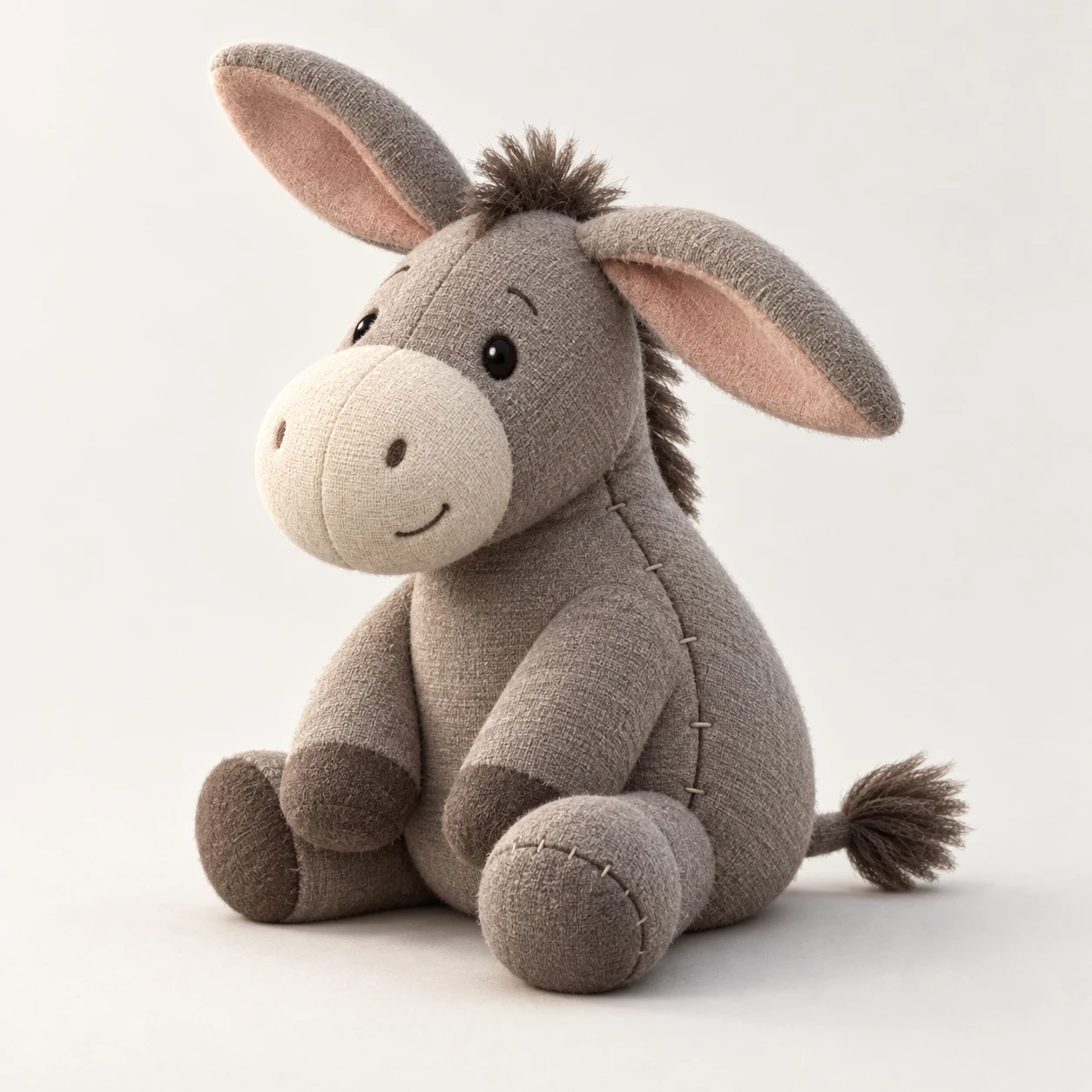
A little donkey character whose recessed seams separate softly stuffed, bulging fabric panels.
Little Stuffed Donkey · Recessed Seams
- Shape & line
- Build the donkey from rounded, gently uneven stuffed shapes and use clean, soft-edged contours. At each visible seam endpoint, pull the silhouette slightly inward, then let the adjoining panels swell outward; draw the seam as a shallow curved groove rather than a raised cord.
- Color & light
- Use warm gray fabric, a cream muzzle and muted pink ear interiors. Light from the upper image-left so the rounded panels have broad soft highlights, while each recessed seam contains a narrow darker trough with a softly lit lip on its image-left side.
- Texture & material
- Suggest matte woven cloth with sparse short fibers that follow the curved fabric surfaces. Place a few small stitches across the seam trough, with their ends disappearing into the two panel edges; keep the weave subdued so the indentation remains the strongest material cue.
- Composition
- Keep the arms clear of the image-right flank seam and angle one foot toward the viewer to reveal its crosswise seam. Set the seated body on a plain pale background with a small soft contact shadow directly beneath it, leaving both seam paths unobstructed.
Priority
Make the seams read as indentations between inflated fabric panels.
What to avoid & what to check
Avoid raised piping, rigid panel edges and dense stitch decoration.
Check that the groove shading and pinched silhouette together convey a recessed seam.
Exact prompt for this example
SUBJECT
One original little stuffed donkey character sitting upright, with long soft ears, a rounded muzzle, short limbs and a small friendly smile. A curved sewn seam runs down its visible flank, joining two stuffed fabric panels; another seam crosses one forward-facing foot.

COMPOSITION
Show the complete character in a three-quarter view, with its muzzle pointing toward image-left and its visible flank facing image-right. Place the character near the center with generous empty space, keeping the flank seam and the front of the foot clearly readable.

STYLE GUIDE
1. Shape & line
Build the donkey from rounded, gently uneven stuffed shapes and use clean, soft-edged contours. At each visible seam endpoint, pull the silhouette slightly inward, then let the adjoining panels swell outward; draw the seam as a shallow curved groove rather than a raised cord.

2. Color & light
Use warm gray fabric, a cream muzzle and muted pink ear interiors. Light from the upper image-left so the rounded panels have broad soft highlights, while each recessed seam contains a narrow darker trough with a softly lit lip on its image-left side.

3. Texture & material
Suggest matte woven cloth with sparse short fibers that follow the curved fabric surfaces. Place a few small stitches across the seam trough, with their ends disappearing into the two panel edges; keep the weave subdued so the indentation remains the strongest material cue.

4. Composition
Keep the arms clear of the image-right flank seam and angle one foot toward the viewer to reveal its crosswise seam. Set the seated body on a plain pale background with a small soft contact shadow directly beneath it, leaving both seam paths unobstructed.

PRIORITY
Preserve the requested identity, count, action, composition and output settings. Apply the style rules within those constraints; a style reference must not replace the subject or layout. Within the style: Make the seams read as indentations between inflated fabric panels.

AVOID
Avoid raised piping, rigid panel edges and dense stitch decoration.

OUTPUT
Create one square character illustration with no lettering, captions, logos or watermark.

SELF-CHECK
Check that the groove shading and pinched silhouette together convey a recessed seam.
Model information comes from image provenance. The same prompt may produce a different result.