Text to imageCharacterStyle guide
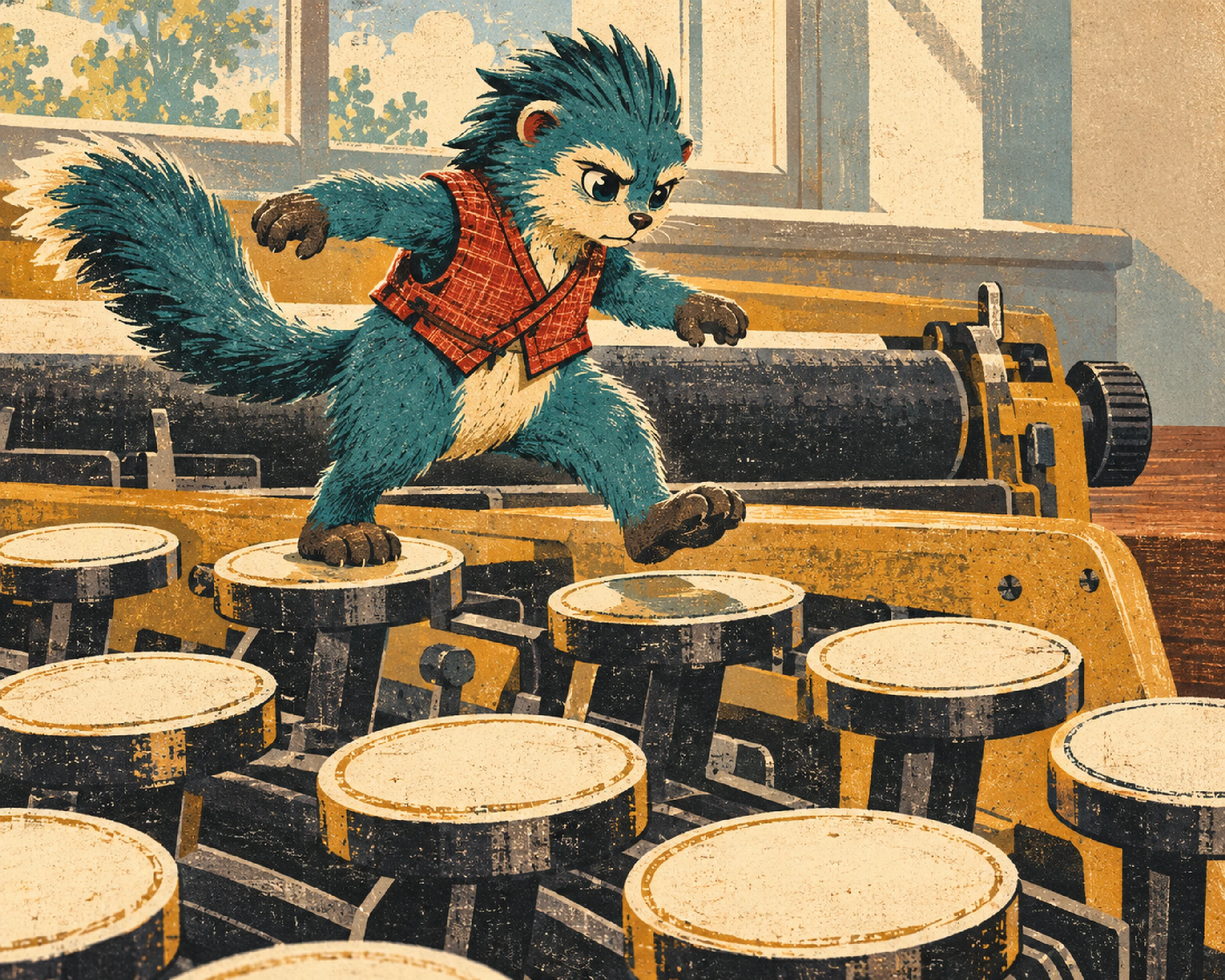
Tiny Creature Crossing Typewriter Keys
A tiny creature solemnly negotiates enormous typewriter keys. Bold shape rhythms and vivid overprinting turn an ordinary desk into an adventurous landscape.
Remix this referenceTiny Creature Crossing Typewriter Keys
- Form language
- Build a graphic screen print from broad curved masses interrupted by squared wedges; repeat shapes with lively irregularity.
- Contour
- Use decisive cut edges and selective heavy contour fragments; let some adjacent shapes meet without an outline.
- Mark-making
- Allow broad squeegee skips, occasional edge chatter and narrow registration slips, varying naturally across the print.
- Surface rendering
- Separate tones into opaque ink shapes; translucent overlaps create secondary tones, with restrained unevenness inside large fields.
Priority
Make decisive shape rhythm and visible ink overlap define the screen print.
What to avoid & what to check
Exact prompt for this example
MODULE OWNERSHIP
subject: Subject count, type, stable proportions and landmarks, resting face geometry, hair shape, physical materials, garment construction and permanent marks. No emotion, movement, color assignment or rendering recipe.
expression: Facial soft-tissue displacement and pupil direction, muscle coordination, regional intensity, asymmetry and onset/peak/release. No head/body pose, stable appearance, skin color or rendering.
gesture: Head/neck/body/limb orientation, joint movement, support, contact and pose-caused occlusion using existing anatomy. No eye/pupil movement, emotion, identity, props inventory or camera.
props: Prop count, type, construction, physical material and scale relative to the subject. Holding/contact belongs to gesture, position to composition, color to palette.
scene: Environment elements, terrain, backdrop/floor presence and structural detail. No canvas positions, camera, lighting, assigned colors or render texture.
camera: Projection, focal-length impression, camera elevation/yaw/roll, viewing distance and crop. No actor pose, world placement, lighting or canvas aspect ratio.
composition: Normalized 0-100% canvas positions, scale in frame, depth/overlap, focal hierarchy and margins. No joint pose, camera projection, rendering, subject/prop inventory or emotion.
palette: Color anchors, hue/saturation/value ranges, colors assigned to parts and approximate color coverage. No illumination direction, shading algorithm, physical material or layout.
lighting: Light-source direction/softness/intensity, ambient illumination, physical shadow direction/length and highlight position. Absence of directional illumination is allowed. No shading technique, palette or material changes.
style: Reusable form abstraction, contour weight/taper/edge quality, medium and mark scale/density/direction, surface rendering and tonal transition technique. No fixed subject proportions, anatomy, identity, expression, pose, palette, light-source direction, camera or layout.
output: Image count, aspect ratio, size, file/alpha requirements and global lettering/logo/watermark restrictions. No background scenery, crop, style, identity or pose.

SUBJECT
inventory: One original miniature bipedal creature, actor A; no other living subjects.
geometry: A pear-shaped trunk, chisel muzzle, swept bristle crest, broad mitten paws and a long brush-ended tail.
resting-face: Oval eyes beneath low brow ridges, a small nose pad and a broad mouth with a substantial upper lip.
appearance: Fine short fur and a coarse tail tuft; a woven wrap vest with an overlapping front and open armholes.

PRIORITY


AVOID


CHECK


EXPRESSION — ACTOR A
brows: Inner brows draw slightly down and together.
lids: Upper lids lower a little; lower lids remain gently firm.
cheeks: Cheeks stay nearly at rest, without a smile lift.
nose: Nostrils remain relaxed, with no muzzle wrinkle.
mouth: Lips press lightly together, one corner tucked inward.
jaw: Jaw stays closed without a hard clench.
gaze: Pupils aim at the next keycap.
coordination: The focused upper face carries more tension than the restrained mouth.
timing: Hold the apex of concentration during the crossing.

PRIORITY


AVOID


CHECK


GESTURE
head: The head projects forward with the chin slightly lowered.
torso: The trunk pitches forward while the tail sweeps behind as a counterbalance.
limbs: One foot bears weight while the other reaches across a gap; the arms spread unevenly for balance.
contact: The supporting foot depresses one key; the reaching foot has not yet touched the next.

PRIORITY


AVOID


CHECK


PROPS
inventory: One manual typewriter, enormous relative to A; each round keycap is approximately a foot's width.
construction: A cast-metal housing, staggered key stems, round inset keycaps and a rubber platen on a carriage.

PRIORITY


AVOID


CHECK


SCENE
inventory: A domestic writing desk beneath a sash window, with a shallow window recess and a plain plaster wall.
structure: The desk has a thick wooden top; the window has a broad sill and a simple divided frame.

PRIORITY


AVOID


CHECK


CAMERA
projection: Moderate perspective with a natural focal-length impression and legible near-to-far key rows.
viewpoint: A three-quarter view from just above the key bed, looking gently downward.
crop: Show A in full and crop the typewriter housing, retaining enough carriage to identify the machine.

PRIORITY


AVOID


CHECK


COMPOSITION
placement: A spans the upper middle, slightly left; the typewriter spreads across the lower field.
depth: Key rows overlap in a rising diagonal; the carriage sits behind A and the window recedes beyond it.
spacing: The face leads, followed by the gap between feet; leave open space ahead and a clear tail silhouette.

PRIORITY


AVOID


CHECK


PALETTE
colors: Petrol teal, vermilion, mustard ochre, charcoal and warm paper cream.
assignment: Teal fur, a vermilion vest, ochre machine casing, cream keycaps and charcoal mechanisms.
balance: Cream and ochre dominate; teal forms the main color mass and vermilion supplies a compact accent.

PRIORITY


AVOID


CHECK


LIGHTING
sources: Broad soft window light arrives from the upper left, with gentle room ambience.
shadows: Short shadows fall rightward beneath the paws and into the key gaps.
highlights: Light catches upper-left muzzle planes and the upper rims of nearby keycaps.

PRIORITY


AVOID


CHECK


STYLE GUIDE
form-language: Build a graphic screen print from broad curved masses interrupted by squared wedges; repeat shapes with lively irregularity.
contour: Use decisive cut edges and selective heavy contour fragments; let some adjacent shapes meet without an outline.
mark-making: Allow broad squeegee skips, occasional edge chatter and narrow registration slips, varying naturally across the print.
surface-rendering: Separate tones into opaque ink shapes; translucent overlaps create secondary tones, with restrained unevenness inside large fields.

PRIORITY
Make decisive shape rhythm and visible ink overlap define the screen print.

AVOID


CHECK


OUTPUT
format: One finished image, landscape 5:4, 2500 × 2000 pixels, opaque PNG.
restrictions: No lettering, logos or watermarks, including characters on the typewriter keys.

PRIORITY


AVOID


CHECK


FINAL INTEGRATION
subject + props + gesture: The relative scale and readable contact make the ordinary machine an obstacle suited to this character.
composition + style: Let repeated printed shapes reinforce the visual route without merging its essential separations.
Model information comes from image provenance. The same prompt may produce a different result.