Text to imageLandscapeStyle guide
One Sea Stack · Foam Wrapping
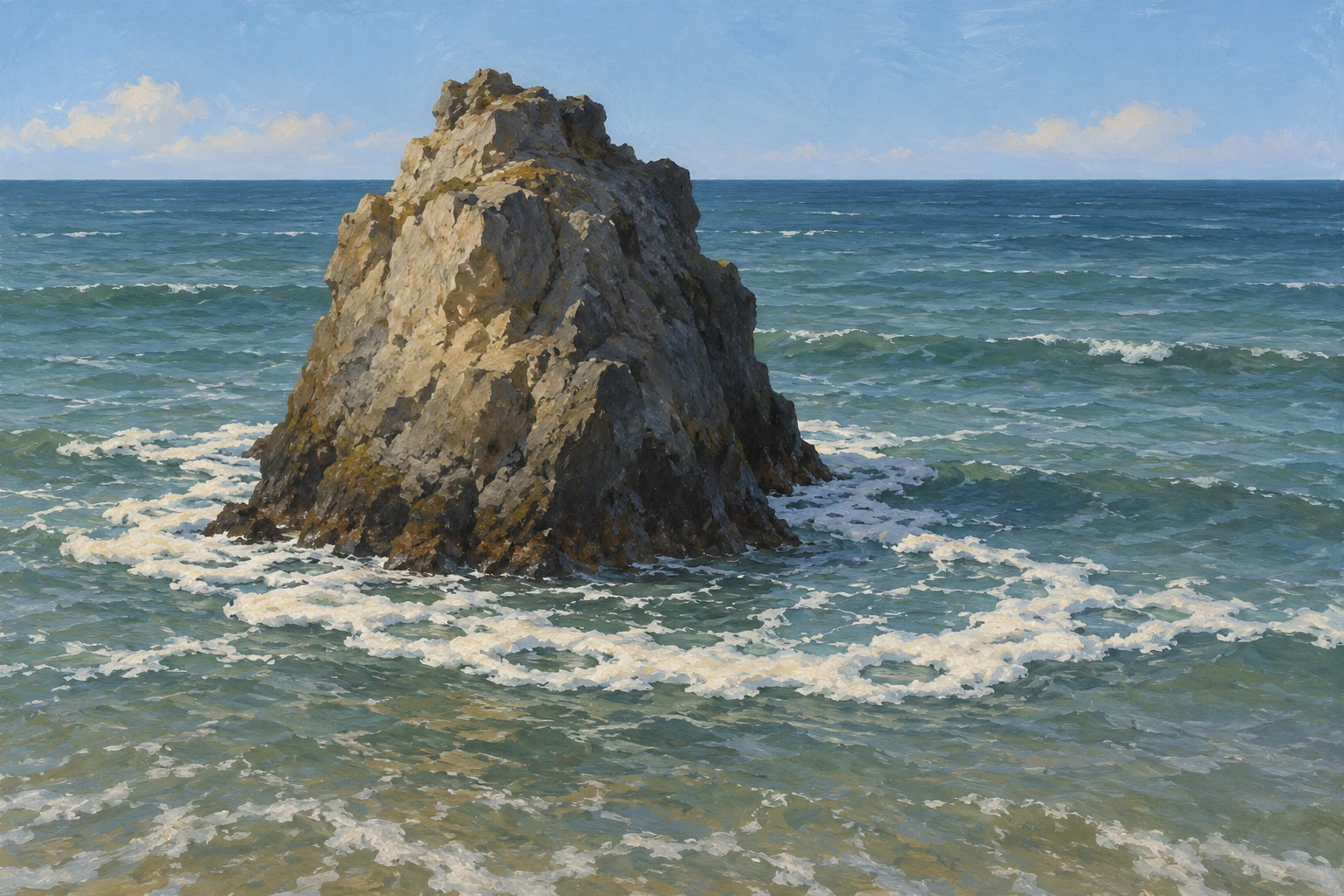
A landscape using curved, partially occluded foam bands to show the water plane and a sea stack’s contact with it.
One Sea Stack · Foam Wrapping
- Shape & line
- Build the rock from a broad, uneven silhouette and a few angular planes. Bend the foam into a flattened arc around its base: the foreground section crosses below the rock in the image, the side sections turn around its feet, and the rear section disappears behind the rock.
- Color & light
- Light the rock from the upper image-left, giving its left-facing planes muted warm gray and its right-facing planes cool charcoal. Use subdued blue-green water and warm off-white foam, with the darkest narrow water pockets directly against the rock so the contact remains visible.
- Texture & material
- Use matte, opaque gouache with broken dry-brush marks on the rock and broad, smooth strokes on the water. Paint the foam as irregular connected patches with small blue-green openings, keeping its outer edge broken while preserving the overall wrapping arc.
- Composition
- Make the foam band the main directional cue by showing its broadest curve in the lower foreground and its compressed turns beside the rock. Keep distant water marks short and nearly horizontal, and leave the sky plain so the eye can follow the wave around the base.
Priority
Prioritize a readable foam arc that turns around and is occluded by the rock.
What to avoid & what to check
Avoid a closed white outline around the rock or foam that climbs its vertical faces.
Check that the foam sits on the water plane and disappears behind the rock at both rear turns.
Exact prompt for this example
SUBJECT
One squat, irregular sea stack rising from shallow coastal water. A small incoming wave divides around its base, leaving a connected foam band visible on both sides and across the foreground-facing base.

COMPOSITION
Use a slightly elevated shoreward viewpoint in a horizontal frame. Place the sea stack just left of center, with its entire silhouette visible. Show enough foreground water to read the curved foam band; place a quiet, level horizon in the upper third.

STYLE GUIDE
1. Shape & line
Build the rock from a broad, uneven silhouette and a few angular planes. Bend the foam into a flattened arc around its base: the foreground section crosses below the rock in the image, the side sections turn around its feet, and the rear section disappears behind the rock.

2. Color & light
Light the rock from the upper image-left, giving its left-facing planes muted warm gray and its right-facing planes cool charcoal. Use subdued blue-green water and warm off-white foam, with the darkest narrow water pockets directly against the rock so the contact remains visible.

3. Texture & material
Use matte, opaque gouache with broken dry-brush marks on the rock and broad, smooth strokes on the water. Paint the foam as irregular connected patches with small blue-green openings, keeping its outer edge broken while preserving the overall wrapping arc.

4. Composition
Make the foam band the main directional cue by showing its broadest curve in the lower foreground and its compressed turns beside the rock. Keep distant water marks short and nearly horizontal, and leave the sky plain so the eye can follow the wave around the base.

PRIORITY
Preserve the requested identity, count, action, composition and output settings. Apply the style rules within those constraints; a style reference must not replace the subject or layout. Within the style: Prioritize a readable foam arc that turns around and is occluded by the rock.

AVOID
Avoid a closed white outline around the rock or foam that climbs its vertical faces.

OUTPUT
One landscape image, 3:2 aspect ratio, rendered as an opaque gouache painting without text, labels, borders, or watermarks.

SELF-CHECK
Check that the foam sits on the water plane and disappears behind the rock at both rear turns.
Model information comes from image provenance. The same prompt may produce a different result.