Text to imageCharacterStyle guide
A Snowflake on Its Tongue
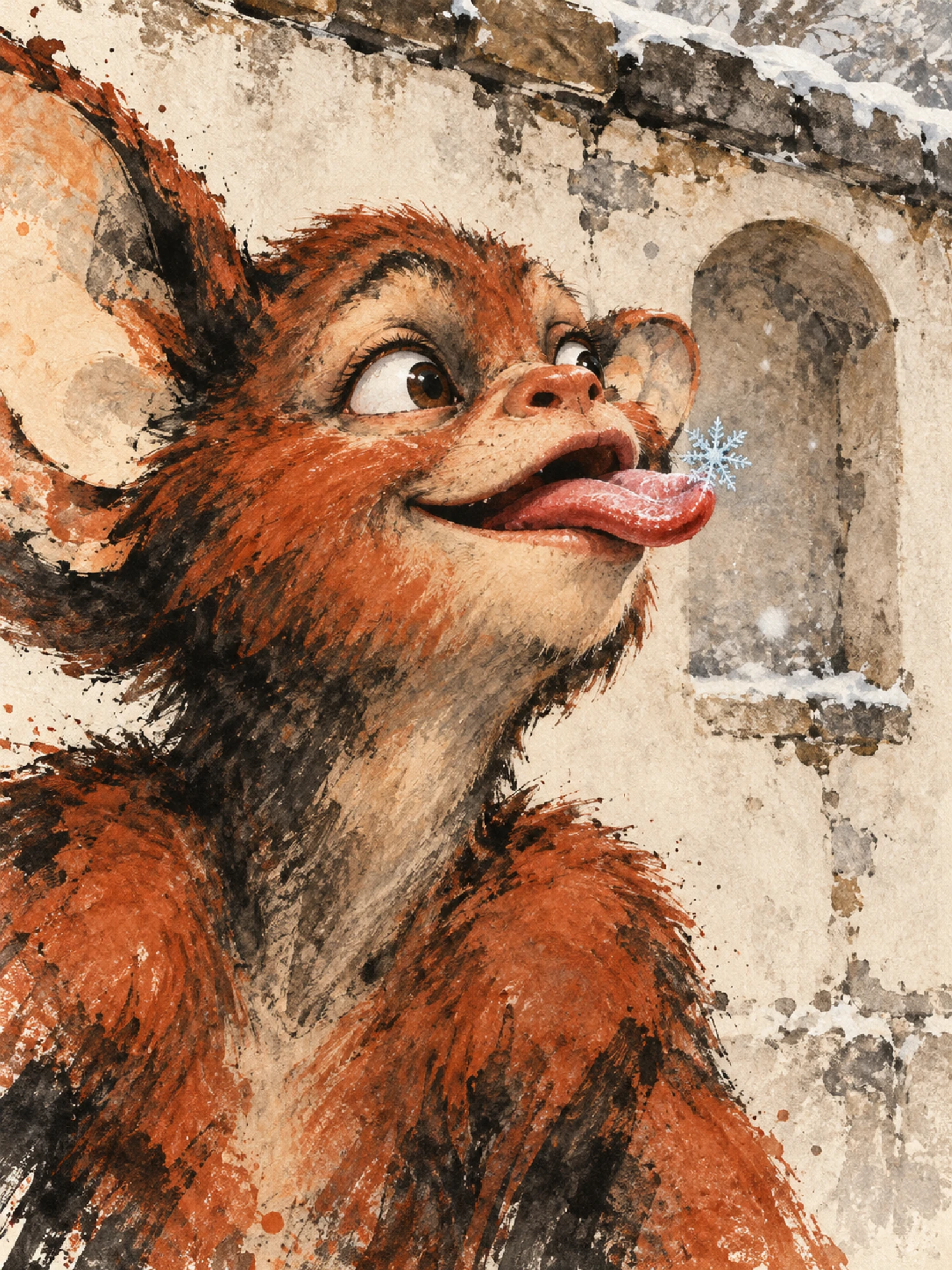
A creature with large cupped ears watches a snowflake touch its tongue, framed in an expressive close crop of bleeding ink and displaced print impressions.
Remix this referenceA Snowflake on Its Tongue
- Form language
- Simplify volumes into swelling ink masses and incisive cut shapes, allowing secondary shapes to depart from literal description.
- Contour
- Alternate swollen brush edges with abrupt blade-like cuts; let selected borders bleed, break or disappear into adjacent masses.
- Mark-making
- Use dragging bristle streaks and irregular transferred impressions; vary pressure and let small print offsets expose the making process.
- Surface rendering
- Build tones through translucent overprints, ink pooling and paper openings, with uneven transitions that retain the resistance of print.
Priority
Make the experimental ink-and-print process visibly active while keeping incidental marks free to vary.
What to avoid & what to check
Exact prompt for this example
MODULE OWNERSHIP
subject: Subject count, type, stable proportions and landmarks, resting face geometry, hair shape, physical materials, garment construction and permanent marks. No emotion, movement, color assignment or rendering recipe.
expression: Facial soft-tissue displacement and pupil direction, muscle coordination, regional intensity, asymmetry and onset/peak/release. No head/body pose, stable appearance, skin color or rendering.
gesture: Head/neck/body/limb orientation, joint movement, support, contact and pose-caused occlusion using existing anatomy. No eye/pupil movement, emotion, identity, props inventory or camera.
props: Prop count, type, construction, physical material and scale relative to the subject. Holding/contact belongs to gesture, position to composition, color to palette.
scene: Environment elements, terrain, backdrop/floor presence and structural detail. No canvas positions, camera, lighting, assigned colors or render texture.
camera: Projection, focal-length impression, camera elevation/yaw/roll, viewing distance and crop. No actor pose, world placement, lighting or canvas aspect ratio.
composition: Normalized 0-100% canvas positions, scale in frame, depth/overlap, focal hierarchy and margins. No joint pose, camera projection, rendering, subject/prop inventory or emotion.
palette: Color anchors, hue/saturation/value ranges, colors assigned to parts and approximate color coverage. No illumination direction, shading algorithm, physical material or layout.
lighting: Light-source direction/softness/intensity, ambient illumination, physical shadow direction/length and highlight position. Absence of directional illumination is allowed. No shading technique, palette or material changes.
style: Reusable form abstraction, contour weight/taper/edge quality, medium and mark scale/density/direction, surface rendering and tonal transition technique. No fixed subject proportions, anatomy, identity, expression, pose, palette, light-source direction, camera or layout.
output: Image count, aspect ratio, size, file/alpha requirements and global lettering/logo/watermark restrictions. No background scenery, crop, style, identity or pose.

SUBJECT
inventory: One original fictional creature, actor A, with a head, neck, torso and paired arms; no clothing.
geometry: A broad spade-shaped head, a small notched chin and large cupped ears with thick rolled rims.
resting-face: Wide-set round eyes, short brow ridges, a small flattened nose and a broad mouth with a flexible tongue.
appearance: Very short dense fur covers the face and shoulders; the ear interiors and nose have bare skin.

PRIORITY


AVOID


CHECK


EXPRESSION — ACTOR A
brows: The outer brow ridges lift slightly and unevenly.
lids: Upper lids open moderately while the lower lids lift softly.
cheeks: Both cheek pads rise, with a fuller lift on the nearer side.
nose: Keep the nose smooth and the nostrils unflared.
mouth: The mouth corners curl upward around an extended tongue with a gently raised tip.
jaw: The jaw drops enough to leave a clear gap beneath the tongue.
gaze: Both pupils converge toward the snowflake.
coordination: Cheek lift and curled mouth corners carry the delight while the eyes inspect the snowflake.
timing: Hold the apex of delight for a brief, still instant.

PRIORITY


AVOID


CHECK


GESTURE
head: The head tips back and turns slightly sideways, lengthening the visible throat.
torso: The upper torso leans forward beneath the lifted head; the shoulders remain unequal.
limbs: The upper arms hang loosely beside the torso.
contact: The snowflake just touches the tongue tip; no other contact needs depiction.

PRIORITY


AVOID


CHECK


PROPS
inventory: One snowflake, small enough to rest on the creature's tongue tip.
construction: A delicate ice crystal with a simple branching hexagonal structure.

PRIORITY


AVOID


CHECK


SCENE
inventory: A winter courtyard wall with a shallow plaster niche and exposed stone coping; no ground is visible.
structure: The niche interrupts a broad wall plane; weathered joints provide only sparse architectural detail.

PRIORITY


AVOID


CHECK


CAMERA
projection: A mild telephoto impression compresses depth without distorting the face.
viewpoint: View from slightly below mouth height at a shallow three-quarter yaw, with no roll.
crop: An intimate head-and-shoulders close-up cuts through the far ear and the lower portions of both upper arms.

PRIORITY


AVOID


CHECK


COMPOSITION
placement: The face dominates the left two-thirds; the tongue contact near 68% across and 62% down is the first focal point.
depth: The nearer cheek overlaps the neck; the wall remains a quiet rear plane behind the large silhouette.
spacing: Leave a generous opening beyond the tongue while allowing the ear silhouette to break the opposite edge.

PRIORITY


AVOID


CHECK


PALETTE
colors: Soot black, oxidized vermilion, warm paper cream and a small icy cyan accent.
assignment: Vermilion belongs to fur, cream to ear interiors, black to facial darks and wall accents, cyan to the snowflake.
balance: Broad cream areas temper the dense black and vermilion; cyan remains a rare high-value interruption.

PRIORITY


AVOID


CHECK


LIGHTING
sources: Soft winter daylight arrives broadly from the upper right with ample ambient fill.
shadows: Gentle shadows fall below the nose, tongue and ear rims, drifting slightly left.
highlights: Restrained highlights touch the upper cheek, nose ridge and exposed edge of the ice crystal.

PRIORITY


AVOID


CHECK


STYLE GUIDE
form-language: Simplify volumes into swelling ink masses and incisive cut shapes, allowing secondary shapes to depart from literal description.
contour: Alternate swollen brush edges with abrupt blade-like cuts; let selected borders bleed, break or disappear into adjacent masses.
mark-making: Use dragging bristle streaks and irregular transferred impressions; vary pressure and let small print offsets expose the making process.
surface-rendering: Build tones through translucent overprints, ink pooling and paper openings, with uneven transitions that retain the resistance of print.

PRIORITY
Make the experimental ink-and-print process visibly active while keeping incidental marks free to vary.

AVOID


CHECK


OUTPUT
format: One finished image, 3:4 aspect ratio, 1500 × 2000 pixels, opaque PNG.
restrictions: No lettering, logos, signatures or watermarks.

PRIORITY


AVOID


CHECK
Model information comes from image provenance. The same prompt may produce a different result.