Text to imageSpace & architectureStyle guide
Sand in the Changing Rooms
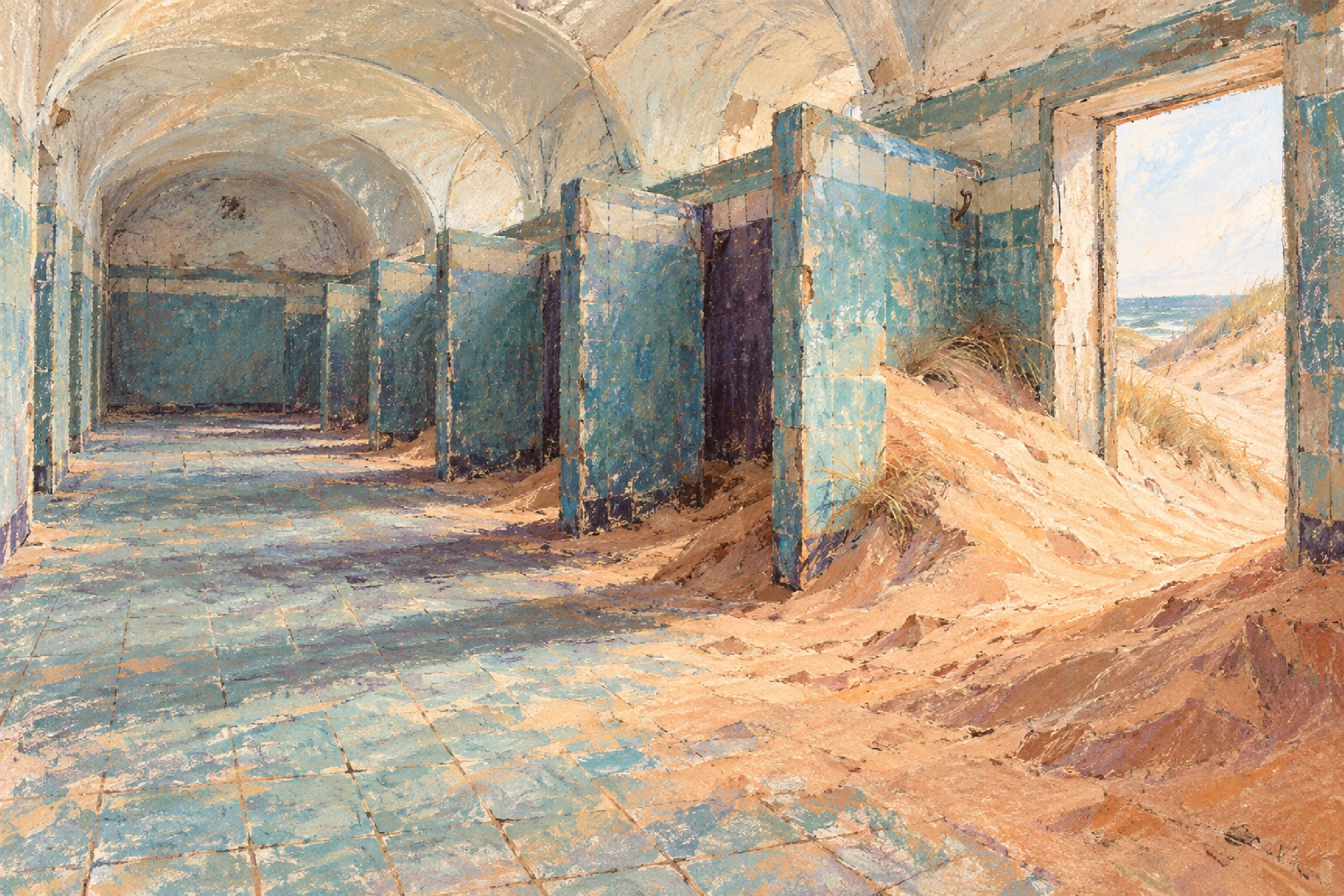
A dune has entered an empty seaside changing hall, half burying its tiled partitions. Rubbed and scratched oil pastel gives the spacious interior a dreamlike stillness.
Remix this referenceSand in the Changing Rooms
- Form language
- Simplify architecture into slightly wavering planes and soft volumes; allow minor irregularities without losing spatial continuity.
- Contour
- Let edges alternate between broad crayon ridges, rubbed disappearances, and a few sharp scratched interruptions.
- Mark-making
- Drag oil pastel sideways in loose passages, rub selected areas with a fingertip, and scratch wandering lines through waxy layers.
- Surface rendering
- Build hazy tonal transitions from partially blended layers; preserve waxy clumps and exposed undercolor for a tactile, dreamlike finish.
Priority
Keep rubbed and scratched oil pastel visibly present across the finished image.
What to avoid & what to check
Exact prompt for this example
MODULE OWNERSHIP
subject: Subject count, type, stable proportions and landmarks, resting face geometry, hair shape, physical materials, garment construction and permanent marks. No emotion, movement, color assignment or rendering recipe.
expression: Facial soft-tissue displacement and pupil direction, muscle coordination, regional intensity, asymmetry and onset/peak/release. No head/body pose, stable appearance, skin color or rendering.
gesture: Head/neck/body/limb orientation, joint movement, support, contact and pose-caused occlusion using existing anatomy. No eye/pupil movement, emotion, identity, props inventory or camera.
props: Prop count, type, construction, physical material and scale relative to the subject. Holding/contact belongs to gesture, position to composition, color to palette.
scene: Environment elements, terrain, backdrop/floor presence and structural detail. No canvas positions, camera, lighting, assigned colors or render texture.
camera: Projection, focal-length impression, camera elevation/yaw/roll, viewing distance and crop. No actor pose, world placement, lighting or canvas aspect ratio.
composition: Normalized 0-100% canvas positions, scale in frame, depth/overlap, focal hierarchy and margins. No joint pose, camera projection, rendering, subject/prop inventory or emotion.
palette: Color anchors, hue/saturation/value ranges, colors assigned to parts and approximate color coverage. No illumination direction, shading algorithm, physical material or layout.
lighting: Light-source direction/softness/intensity, ambient illumination, physical shadow direction/length and highlight position. Absence of directional illumination is allowed. No shading technique, palette or material changes.
style: Reusable form abstraction, contour weight/taper/edge quality, medium and mark scale/density/direction, surface rendering and tonal transition technique. No fixed subject proportions, anatomy, identity, expression, pose, palette, light-source direction, camera or layout.
output: Image count, aspect ratio, size, file/alpha requirements and global lettering/logo/watermark restrictions. No background scenery, crop, style, identity or pose.

SUBJECT
inventory: No people, animals, or discrete designed subjects.
geometry: No discrete subject proportions or landmarks apply.
resting-face: No faces are present.
appearance: No subject hair, garments, or permanent marks apply.

PRIORITY


AVOID


CHECK


PROPS
inventory: No separate props.
construction: No prop construction applies.

PRIORITY


AVOID


CHECK


SCENE
inventory: A disused coastal changing hall with tiled cubicle partitions, a shallow vaulted ceiling, one open doorway, and windblown sand.
structure: A dune continues through the doorway and half buries the nearest cubicles; intact tile flooring connects the remaining bays.

PRIORITY


AVOID


CHECK


CAMERA
projection: Use gently wide perspective with an architectural drawing's readable depth.
viewpoint: Look obliquely along the hall from standing height, with a level horizon and no roll.
crop: Include the vault, doorway, and nearest partition bases; let the side walls continue beyond the crop.

PRIORITY


AVOID


CHECK


COMPOSITION
placement: Gather the dune and doorway on the right; spread the open floor across the left and foreground.
depth: The sand crossing the partition bases is the focal junction; successive bays overlap toward a quiet rear wall.
spacing: Alternate narrow partition intervals with a generous uninterrupted floor area, keeping the visual weight off center.

PRIORITY


AVOID


CHECK


PALETTE
colors: Choose muted apricot, dusty turquoise, chalk cream, and deep aubergine.
assignment: Apricot belongs to sand, turquoise to tile, cream to the vault, and aubergine to the darkest recesses.
balance: Let pale turquoise and cream carry most of the room, with an apricot concentration and sparse deep accents.

PRIORITY


AVOID


CHECK


LIGHTING
sources: Soft daylight enters through the right-hand doorway, with subdued reflected illumination throughout the hall.
shadows: Broad partition shadows extend leftward across the floor, softening as they move away from their bases.
highlights: Keep broad highlights on the doorway-facing sand slope and the exposed partition edges.

PRIORITY


AVOID


CHECK


STYLE GUIDE
form-language: Simplify architecture into slightly wavering planes and soft volumes; allow minor irregularities without losing spatial continuity.
contour: Let edges alternate between broad crayon ridges, rubbed disappearances, and a few sharp scratched interruptions.
mark-making: Drag oil pastel sideways in loose passages, rub selected areas with a fingertip, and scratch wandering lines through waxy layers.
surface-rendering: Build hazy tonal transitions from partially blended layers; preserve waxy clumps and exposed undercolor for a tactile, dreamlike finish.

PRIORITY
Keep rubbed and scratched oil pastel visibly present across the finished image.

AVOID


CHECK


OUTPUT
format: One finished illustration, landscape 3:2, 2400 × 1600 px, opaque PNG.
restrictions: No lettering, logos, or watermarks.

PRIORITY


AVOID


CHECK
Model information comes from image provenance. The same prompt may produce a different result.