Text to imageAnimationStyle guide
A Giant Moth at the Cloakroom
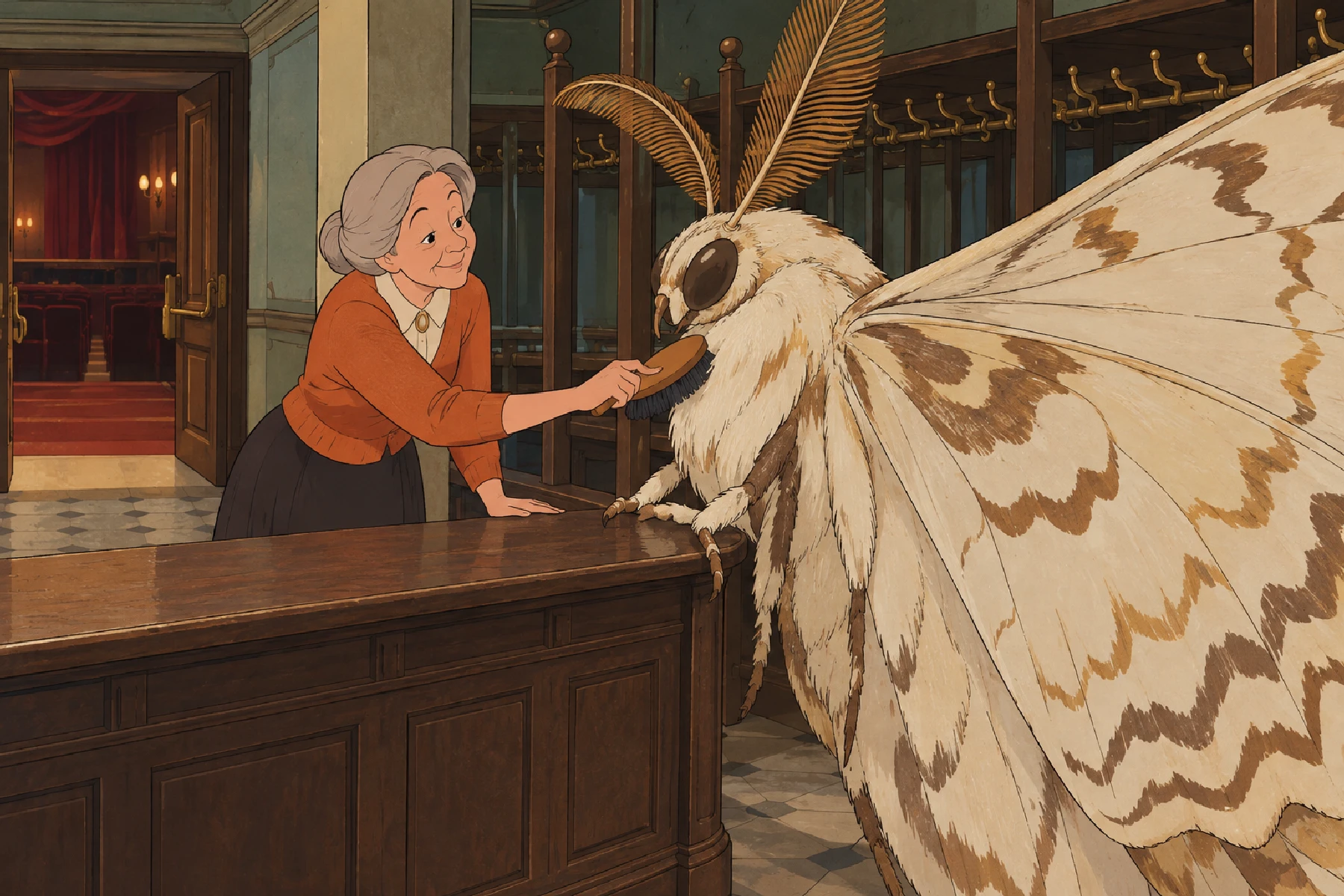
A theatre cloakroom attendant brushes the wing base of an enormous moth. A familiar gesture of hospitality becomes a tender encounter with an impossibly large guest.
Remix this referenceA Giant Moth at the Cloakroom
- Form language
- Build legible masses from sweeping curves interrupted by selective angular cuts; simplify secondary detail and allow small shape variations.
- Contour
- Use sketch-like contours with slight weight fluctuations, tapered exits and occasional open edges; preserve natural line irregularity.
- Mark-making
- Retain selective short doubled contour traces and broken pencil marks; follow broad forms and thin the marks across quieter passages.
- Surface rendering
- Use flat cel fills with few tonal steps and slight line-to-fill misregistration; allow loose brushed passages and irregular paint edges.
Priority
Rendering medium: hand-drawn 2D xerographic cel-animation illustration; formal rendering reference: Walt Disney Studios · 1960s · One Hundred and One Dalmatians (1961)
What to avoid & what to check
Exact prompt for this example
MODULE OWNERSHIP
subject: Subject count, type, stable proportions and landmarks, resting face geometry, hair shape, physical materials, garment construction and permanent marks. No emotion, movement, color assignment or rendering recipe.
expression: Facial soft-tissue displacement and pupil direction, muscle coordination, regional intensity, asymmetry and onset/peak/release. No head/body pose, stable appearance, skin color or rendering.
gesture: Head/neck/body/limb orientation, joint movement, support, contact and pose-caused occlusion using existing anatomy. No eye/pupil movement, emotion, identity, props inventory or camera.
props: Prop count, type, construction, physical material and scale relative to the subject. Holding/contact belongs to gesture, position to composition, color to palette.
scene: Environment elements, terrain, backdrop/floor presence and structural detail. No canvas positions, camera, lighting, assigned colors or render texture.
camera: Projection, focal-length impression, camera elevation/yaw/roll, viewing distance and crop. No actor pose, world placement, lighting or canvas aspect ratio.
composition: Normalized 0-100% canvas positions, scale in frame, depth/overlap, focal hierarchy and margins. No joint pose, camera projection, rendering, subject/prop inventory or emotion.
palette: Color anchors, hue/saturation/value ranges, colors assigned to parts and approximate color coverage. No illumination direction, shading algorithm, physical material or layout.
lighting: Light-source direction/softness/intensity, ambient illumination, physical shadow direction/length and highlight position. Absence of directional illumination is allowed. No shading technique, palette or material changes.
style: Reusable form abstraction, contour weight/taper/edge quality, medium and mark scale/density/direction, surface rendering and tonal transition technique. No fixed subject proportions, anatomy, identity, expression, pose, palette, light-source direction, camera or layout.
output: Image count, aspect ratio, size, file/alpha requirements and global lettering/logo/watermark restrictions. No background scenery, crop, style, identity or pose.

SUBJECT
inventory: A is an older woman working as a cloakroom attendant; B is one enormous moth. Both are original designs.
geometry: A has a long oval face and compact build. B has a stout body, broad leaf-shaped wings and feathery antennae; its height exceeds A's.
resting-face: A has a rounded nose, shallow-set eyes and a thin upper lip. B has a small natural insect face without human features.
appearance: A wears a low rolled bun and a wool cardigan over a collared blouse. B has a furry thorax, scalloped wing margins and irregular wing markings.

PRIORITY


AVOID


CHECK


EXPRESSION — ACTOR A
brows: One brow rises slightly while the other remains relaxed.
lids: Upper lids remain easy; lower lids gather gently beneath the eyes.
cheeks: A small cheek lift begins on the side of the rising mouth corner.
nose: The nose stays relaxed, without wrinkling or nostril flare.
mouth: Closed lips develop a small uneven smile, with one corner leading.
jaw: The jaw remains loose with no visible mouth opening.
gaze: Both pupils look toward the patch of wing beneath the brush.
coordination: The uneven smile and single raised brow develop together with restrained facial movement.
timing: Catch the onset of amusement before the smile spreads across the whole mouth.

PRIORITY


AVOID


CHECK


EXPRESSION — ACTOR B
brows: No brow action applies to the natural insect face.
lids: Keep the visible eye rims still, without squeezing or widening.
cheeks: No cheek displacement applies to the insect face.
nose: No nasal action applies to the insect face.
mouth: The small mouthparts remain at rest without pulling or pursing.
jaw: Show no jaw opening or chewing action.
gaze: Keep the compound eyes fixed; no pupil direction is prescribed.
coordination: Keep the facial region at rest without a human smile or brow performance.
timing: Sustain this resting state through the held moment.

PRIORITY


AVOID


CHECK


GESTURE
head: A inclines her head toward the brushing hand. B lowers its head slightly.
torso: A leans across the counter from the waist. B keeps its body upright with the near wing eased outward.
limbs: A extends one bent arm in a short brushing stroke; B's visible forelegs bend onto the counter lip.
contact: A grips the brush against B's wing base and supports herself with her free palm on the counter. B is supported by the floor.

PRIORITY


AVOID


CHECK


PROPS
inventory: One clothes brush, small enough to fit comfortably in A's palm.
construction: The brush has an oval wooden back and a short, dense bed of natural bristles.

PRIORITY


AVOID


CHECK


SCENE
inventory: An old theatre cloakroom with a built-in service counter, empty coat rails, a tiled floor and an open auditorium doorway.
structure: A low counter opening connects the lobby to a narrow staff aisle; repeated hooks establish an ordinary human-sized interior.

PRIORITY


AVOID


CHECK


CAMERA
projection: Use gentle perspective with a normal-lens impression and little foreground exaggeration.
viewpoint: Look obliquely along the counter from standing eye level, with a level horizon.
crop: Use a medium-wide view including A to the hips and B's body; let the far wing continue beyond the frame.

PRIORITY


AVOID


CHECK


COMPOSITION
placement: Place A around the left third and B across the right half, with B's head beside the counter; the brush contact between them is the first focal point.
depth: The counter overlaps A's lower body; B interrupts the distant hook rhythm, while the open doorway recedes behind the encounter.
spacing: Leave breathing room around A's face and a clear gap between the reaching arm and antennae; the broad wing forms an enclosing mass.

PRIORITY


AVOID


CHECK


PALETTE
colors: Anchor the image in tobacco brown, dusty celadon, warm ivory and a small note of persimmon orange.
assignment: Give B ivory wings with tobacco markings, A a persimmon cardigan, the walls celadon and the counter deep brown.
balance: Muted middle values dominate; the pale wing is the largest light area and the cardigan supplies the concentrated warm accent.

PRIORITY


AVOID


CHECK


LIGHTING
sources: Broad, soft lobby light arrives from the upper left, with gentle ambient illumination throughout the cloakroom.
shadows: Soft shadows fall toward the lower right; the counter casts a short shadow across the floor.
highlights: Keep broad light on A's upper cheek and B's upper wing ridge, with restrained highlights elsewhere.

PRIORITY


AVOID


CHECK


STYLE GUIDE
form-language: Build legible masses from sweeping curves interrupted by selective angular cuts; simplify secondary detail and allow small shape variations.
contour: Use sketch-like contours with slight weight fluctuations, tapered exits and occasional open edges; preserve natural line irregularity.
mark-making: Retain selective short doubled contour traces and broken pencil marks; follow broad forms and thin the marks across quieter passages.
surface-rendering: Use flat cel fills with few tonal steps and slight line-to-fill misregistration; allow loose brushed passages and irregular paint edges.

PRIORITY
Rendering medium: hand-drawn 2D xerographic cel-animation illustration; formal rendering reference: Walt Disney Studios · 1960s · One Hundred and One Dalmatians (1961)

AVOID


CHECK


OUTPUT
format: Create one finished image, landscape 3:2, 1800 × 1200 pixels, as an opaque PNG.
restrictions: No lettering, logos or watermarks.

PRIORITY


AVOID


CHECK


FINAL INTEGRATION
subject + scene + composition: Let the guest's relationship to the familiar architecture make the scale change immediately understandable.
expression + gesture: Coordinate the emerging smile with the service gesture so the surprising encounter feels like habitual hospitality.
Art direction
디즈니 / Walt Disney Studios · 1960s · 101마리 달마시안(1961) / One Hundred and One Dalmatians (1961) ↗- Use legible form masses with selective angular simplification
- Sketch-like contours with small weight irregularities instead of polished ink uniformity
- Retain selective short doubled contour traces and broken pencil-like marks
- Flat fills with few tonal levels and slight line-to-fill edge misregistration
Model information comes from image provenance. The same prompt may produce a different result.