Text to imageArt stylesStyle guide
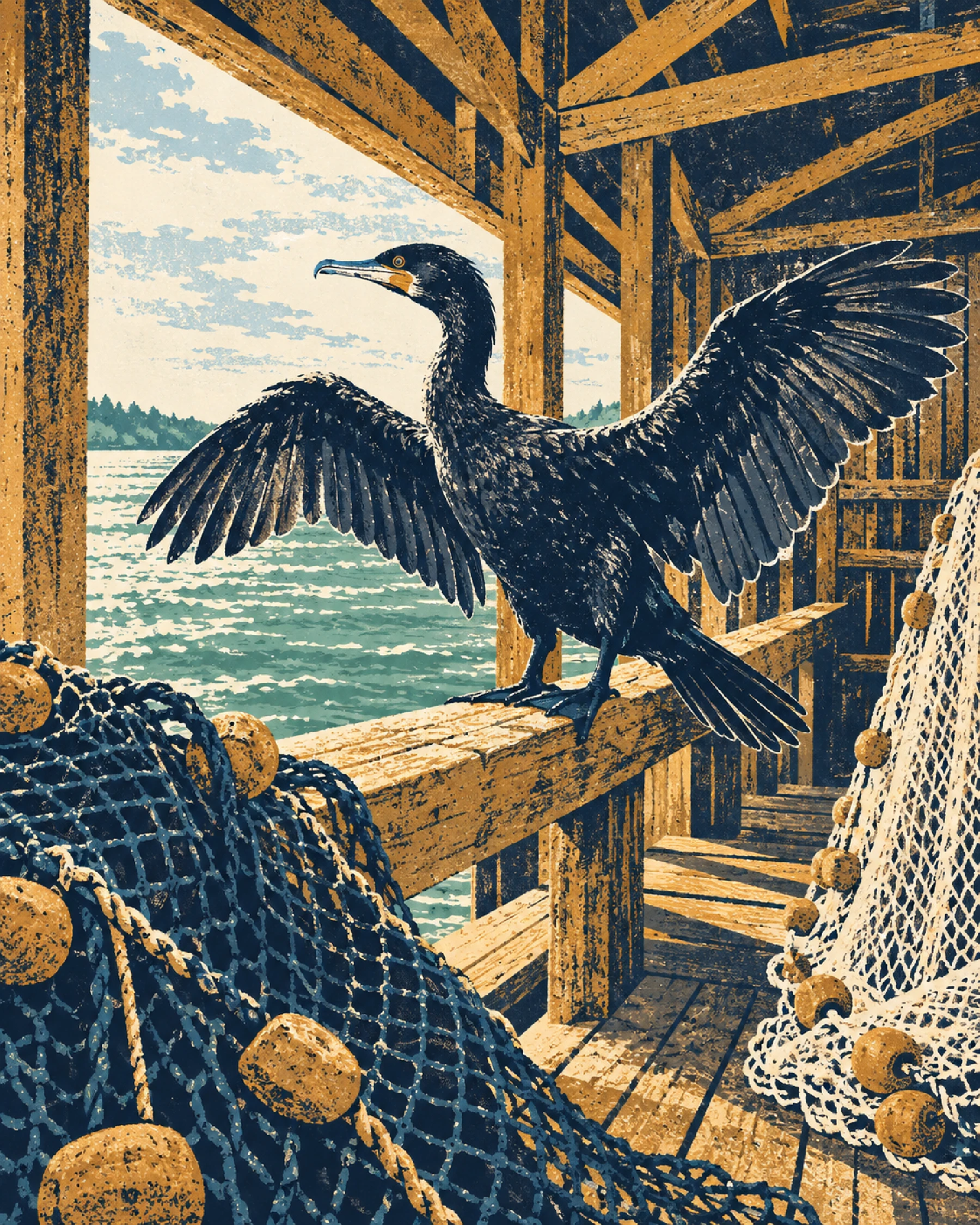
Cormorant in the Net Loft
A cormorant spreads its wings inside a loft layered with nets and timber, rendered through bold screenprinted shapes and uneven ink overlaps.
Remix this referenceCormorant in the Net Loft
- Form language
- Reduce forms to decisive wedges, bowed bands and open cutouts; alternate broad masses with tight repeating intervals, allowing minor shape variation.
- Contour
- Let shapes meet through mostly unoutlined, blunt ink edges, with occasional narrow incisions and local edge wobble.
- Mark-making
- Use broad squeegee-drag breaks and sparse directional scuffs; uneven ink pickup interrupts otherwise firm shapes.
- Surface rendering
- Separate screenprinted layers create opaque blocks and translucent overlaps; selective registration slips reveal small paper slivers at joins.
Priority
Let decisive ink shapes and open cutouts carry the hand-pulled screenprint character.
What to avoid & what to check
Exact prompt for this example
MODULE OWNERSHIP
subject: Subject count, type, stable proportions and landmarks, resting face geometry, hair shape, physical materials, garment construction and permanent marks. No emotion, movement, color assignment or rendering recipe.
expression: Facial soft-tissue displacement and pupil direction, muscle coordination, regional intensity, asymmetry and onset/peak/release. No head/body pose, stable appearance, skin color or rendering.
gesture: Head/neck/body/limb orientation, joint movement, support, contact and pose-caused occlusion using existing anatomy. No eye/pupil movement, emotion, identity, props inventory or camera.
props: Prop count, type, construction, physical material and scale relative to the subject. Holding/contact belongs to gesture, position to composition, color to palette.
scene: Environment elements, terrain, backdrop/floor presence and structural detail. No canvas positions, camera, lighting, assigned colors or render texture.
camera: Projection, focal-length impression, camera elevation/yaw/roll, viewing distance and crop. No actor pose, world placement, lighting or canvas aspect ratio.
composition: Normalized 0-100% canvas positions, scale in frame, depth/overlap, focal hierarchy and margins. No joint pose, camera projection, rendering, subject/prop inventory or emotion.
palette: Color anchors, hue/saturation/value ranges, colors assigned to parts and approximate color coverage. No illumination direction, shading algorithm, physical material or layout.
lighting: Light-source direction/softness/intensity, ambient illumination, physical shadow direction/length and highlight position. Absence of directional illumination is allowed. No shading technique, palette or material changes.
style: Reusable form abstraction, contour weight/taper/edge quality, medium and mark scale/density/direction, surface rendering and tonal transition technique. No fixed subject proportions, anatomy, identity, expression, pose, palette, light-source direction, camera or layout.
output: Image count, aspect ratio, size, file/alpha requirements and global lettering/logo/watermark restrictions. No background scenery, crop, style, identity or pose.

SUBJECT
inventory: One original cormorant, actor A; no other animals or people.
geometry: A long body, flexible neck, broad wings, wedge-shaped tail and webbed feet give recognizable cormorant construction.
resting-face: Small round eyes sit above a long narrow bill with a hooked tip; facial feathering stays close.
appearance: Dense body plumage, overlapping stiff flight feathers, a keratin bill and scaled feet; minor feather irregularities may vary.

PRIORITY


AVOID


CHECK


EXPRESSION — ACTOR A
brows: No separate brow movement is prescribed.
lids: Visible lids remain comfortably open without squinting or widening.
cheeks: No separate cheek displacement is prescribed.
nose: No independent nasal movement is prescribed.
mouth: The bill remains gently closed, without tension at its base.
jaw: The lower mandible rests against the upper bill without a gape.
gaze: The visible pupil directs attention toward the loft opening.
coordination: An open eye and relaxed closed bill form a quiet, attentive resting state.
timing: Hold the settled neutral state without an emerging or fading reaction.

PRIORITY


AVOID


CHECK


GESTURE
head: The neck curves forward and the head turns slightly toward the open side of the loft.
torso: The body rises upright with a slight forward cant and the tail lowered for balance.
limbs: Both wings spread in a broad uneven V, one higher than the other; bent legs brace beneath the body.
contact: Webbed feet grip the timber rail while the chest and wings remain clear of the nets.

PRIORITY


AVOID


CHECK


PROPS
inventory: Two fishing nets with attached floats, each larger than the bird.
construction: Coarse knotted cord mesh with irregular cork floats and edges gathered onto stout rope.

PRIORITY


AVOID


CHECK


SCENE
inventory: An open-sided timber boathouse loft with roof trusses, a thick rail, slatted flooring and water beyond.
structure: Heavy posts and cross-braces support the roof; the rail borders a broad loading opening.

PRIORITY


AVOID


CHECK


CAMERA
projection: Moderately wide perspective conveys the surrounding architecture without severe distortion.
viewpoint: From inside the loft at the bird's eye height, look obliquely along the rail with no camera roll.
crop: Keep the complete bird in frame while cropping through nearby nets, floor and roof structure.

PRIORITY


AVOID


CHECK


COMPOSITION
placement: Place the bird just right of center, its wing span occupying most of the image width; the loading opening occupies screen left.
depth: Overlapping nets form foreground screens; timber recedes behind the bird toward the open-water gap.
spacing: The bird leads as the largest uninterrupted shape; preserve open gaps around its wing edges amid the mesh.

PRIORITY


AVOID


CHECK


PALETTE
colors: Deep ink navy, warm ochre, chalk white and muted petrol green.
assignment: Navy bird and nearer net, ochre timber, chalk farther net and sky, petrol-green water.
balance: Ochre and navy dominate; chalk opens dense passages while green remains secondary.

PRIORITY


AVOID


CHECK


LIGHTING
sources: Broad daylight enters from screen left, with weaker ambient light inside the loft.
shadows: Soft shadows extend rightward across the planks and deepen beneath the roof structure.
highlights: Broad highlights touch left-facing feather edges, the bill ridge and exposed rail tops.

PRIORITY


AVOID


CHECK


STYLE GUIDE
form-language: Reduce forms to decisive wedges, bowed bands and open cutouts; alternate broad masses with tight repeating intervals, allowing minor shape variation.
contour: Let shapes meet through mostly unoutlined, blunt ink edges, with occasional narrow incisions and local edge wobble.
mark-making: Use broad squeegee-drag breaks and sparse directional scuffs; uneven ink pickup interrupts otherwise firm shapes.
surface-rendering: Separate screenprinted layers create opaque blocks and translucent overlaps; selective registration slips reveal small paper slivers at joins.

PRIORITY
Let decisive ink shapes and open cutouts carry the hand-pulled screenprint character.

AVOID


CHECK


OUTPUT
format: One opaque PNG, 1800 × 2250 pixels, with a 4:5 aspect ratio.
restrictions: No lettering, logos, signatures or watermarks.

PRIORITY


AVOID


CHECK
Model information comes from image provenance. The same prompt may produce a different result.