Text to imageSpace & architectureStyle guide
A Theater in the Cutlery Drawer
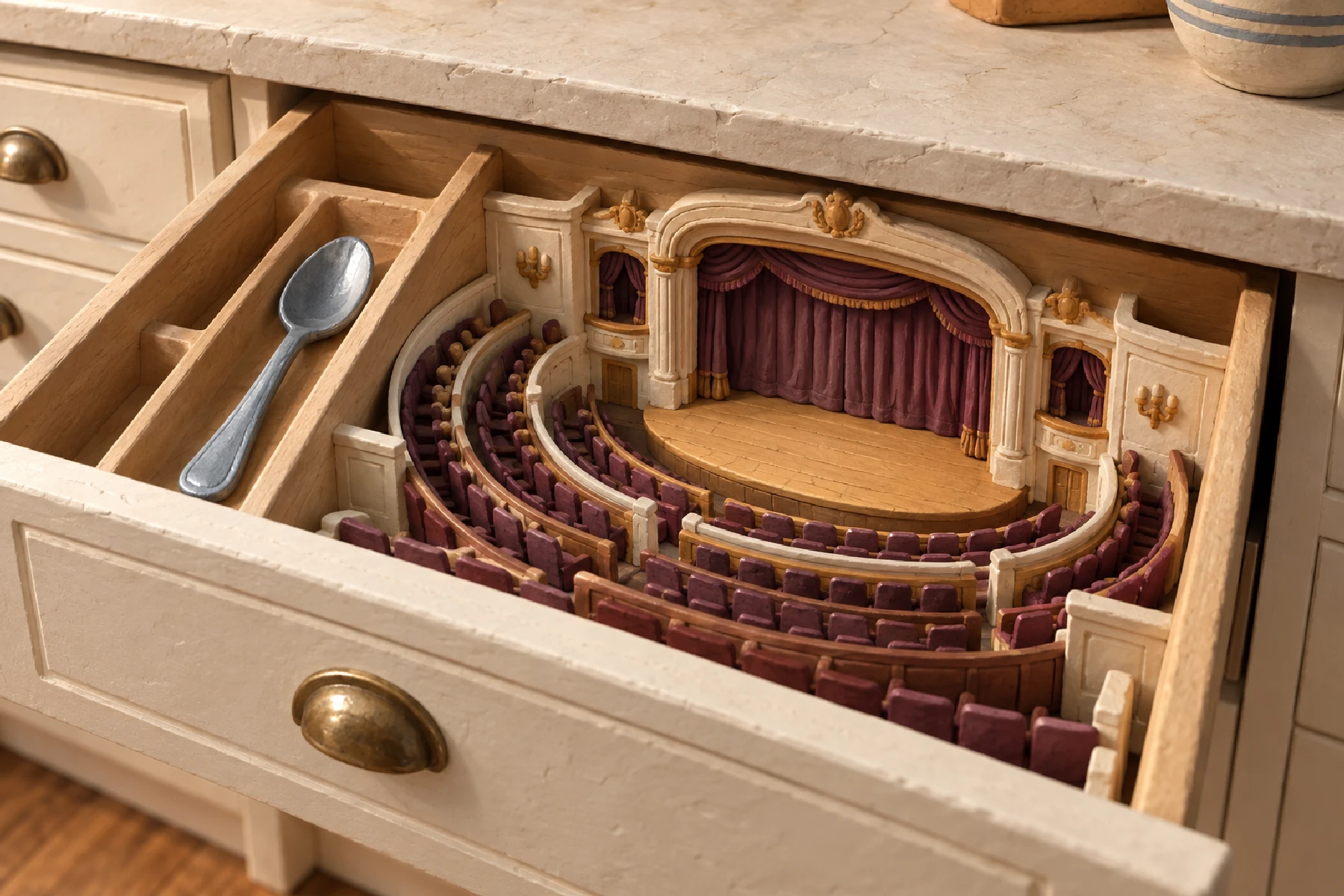
A horseshoe auditorium and tiny stage occupy an open kitchen drawer. An ordinary spoon reveals their surprising scale in a handmade clay miniature.
Remix this referenceA Theater in the Cutlery Drawer
- Form language
- Build the image as a sculptural clay miniature: compress architecture into stout slab forms and softly pinched details.
- Contour
- Use rounded, slightly wavering silhouettes and softened tool-cut edges, without a drawn outline.
- Mark-making
- Leave occasional thumb sweeps and irregular modeling-tool impressions; let marks change naturally with each formed plane.
- Surface rendering
- Render matte clay with broad rounded tonal transitions and shallow pressed relief, keeping handmade joins softly visible.
Priority
Every represented material should retain the tactile unity of a hand-built clay model.
What to avoid & what to check
Exact prompt for this example
MODULE OWNERSHIP
subject: Subject count, type, stable proportions and landmarks, resting face geometry, hair shape, physical materials, garment construction and permanent marks. No emotion, movement, color assignment or rendering recipe.
expression: Facial soft-tissue displacement and pupil direction, muscle coordination, regional intensity, asymmetry and onset/peak/release. No head/body pose, stable appearance, skin color or rendering.
gesture: Head/neck/body/limb orientation, joint movement, support, contact and pose-caused occlusion using existing anatomy. No eye/pupil movement, emotion, identity, props inventory or camera.
props: Prop count, type, construction, physical material and scale relative to the subject. Holding/contact belongs to gesture, position to composition, color to palette.
scene: Environment elements, terrain, backdrop/floor presence and structural detail. No canvas positions, camera, lighting, assigned colors or render texture.
camera: Projection, focal-length impression, camera elevation/yaw/roll, viewing distance and crop. No actor pose, world placement, lighting or canvas aspect ratio.
composition: Normalized 0-100% canvas positions, scale in frame, depth/overlap, focal hierarchy and margins. No joint pose, camera projection, rendering, subject/prop inventory or emotion.
palette: Color anchors, hue/saturation/value ranges, colors assigned to parts and approximate color coverage. No illumination direction, shading algorithm, physical material or layout.
lighting: Light-source direction/softness/intensity, ambient illumination, physical shadow direction/length and highlight position. Absence of directional illumination is allowed. No shading technique, palette or material changes.
style: Reusable form abstraction, contour weight/taper/edge quality, medium and mark scale/density/direction, surface rendering and tonal transition technique. No fixed subject proportions, anatomy, identity, expression, pose, palette, light-source direction, camera or layout.
output: Image count, aspect ratio, size, file/alpha requirements and global lettering/logo/watermark restrictions. No background scenery, crop, style, identity or pose.

SUBJECT
inventory: One miniature theater interior, with an auditorium and a performance stage; no people.
geometry: Horseshoe seating terraces embrace a shallow apron stage beneath a broad proscenium arch.
resting-face: No faces are present.
appearance: Plaster walls, timber benches and a fabric stage curtain; small architectural details may vary coherently.

PRIORITY


AVOID


CHECK


PROPS
inventory: One ordinary teaspoon, longer than the miniature stage is wide.
construction: A single stainless-steel utensil with an oval bowl and a narrow, gently rounded handle.

PRIORITY


AVOID


CHECK


SCENE
inventory: A domestic kitchen base cabinet, countertop edge and open cutlery drawer with an exposed organizer.
structure: The drawer organizer has one broad compartment and adjacent utensil recesses.

PRIORITY


AVOID


CHECK


CAMERA
projection: Moderate perspective with a normal-lens impression and restrained near-to-far enlargement.
viewpoint: Look obliquely downward from counter height, across the drawer's open front.
crop: Include the complete auditorium and enough surrounding cabinetry to recognize the drawer.

PRIORITY


AVOID


CHECK


COMPOSITION
placement: Place the theater inside the broad drawer compartment, the stage near 65% width and 55% height, and the open drawer across the lower two-thirds.
depth: Cabinetry surrounds the seating and curtain; the drawer front overlaps the nearest seating, and the spoon occupies the neighboring recess on the left.
spacing: Make the stage the first focal point and the spoon the scale discovery; leave a quiet countertop band above.

PRIORITY


AVOID


CHECK


PALETTE
colors: Use chalk cream, dusty aubergine, muted ochre and a small blue-gray accent.
assignment: Assign cream to the cabinetry, aubergine to the seating and curtain, ochre to the stage and blue-gray to the spoon.
balance: Let pale neutrals dominate, with the deepest values inside the auditorium and restrained accent saturation.

PRIORITY


AVOID


CHECK


LIGHTING
sources: A broad soft source from the upper left, supported by gentle room ambience.
shadows: Short shadows fall toward the lower right; deeper shelter remains beneath the arch and drawer lip.
highlights: Soft highlights gather on upper bench edges, the arch crown and the spoon's raised rim.

PRIORITY


AVOID


CHECK


STYLE GUIDE
form-language: Build the image as a sculptural clay miniature: compress architecture into stout slab forms and softly pinched details.
contour: Use rounded, slightly wavering silhouettes and softened tool-cut edges, without a drawn outline.
mark-making: Leave occasional thumb sweeps and irregular modeling-tool impressions; let marks change naturally with each formed plane.
surface-rendering: Render matte clay with broad rounded tonal transitions and shallow pressed relief, keeping handmade joins softly visible.

PRIORITY
Every represented material should retain the tactile unity of a hand-built clay model.

AVOID


CHECK


OUTPUT
format: One finished image, landscape 3:2, 1800 × 1200 pixels, opaque PNG; no lettering, logos or watermarks.
restrictions: One finished image, landscape 3:2, 1800 × 1200 pixels, opaque PNG; no lettering, logos or watermarks.

PRIORITY


AVOID


CHECK


FINAL INTEGRATION
subject + scene + props + composition: The architectural interior and everyday kitchen context cooperate to make the scale reversal immediately legible.
style + lighting: Illumination reveals the modeled surfaces while the handmade treatment unifies the whole miniature.
Model information comes from image provenance. The same prompt may produce a different result.