Text to imageCharacterStyle guide
A Wedge-Headed Creature Listening at a Wall
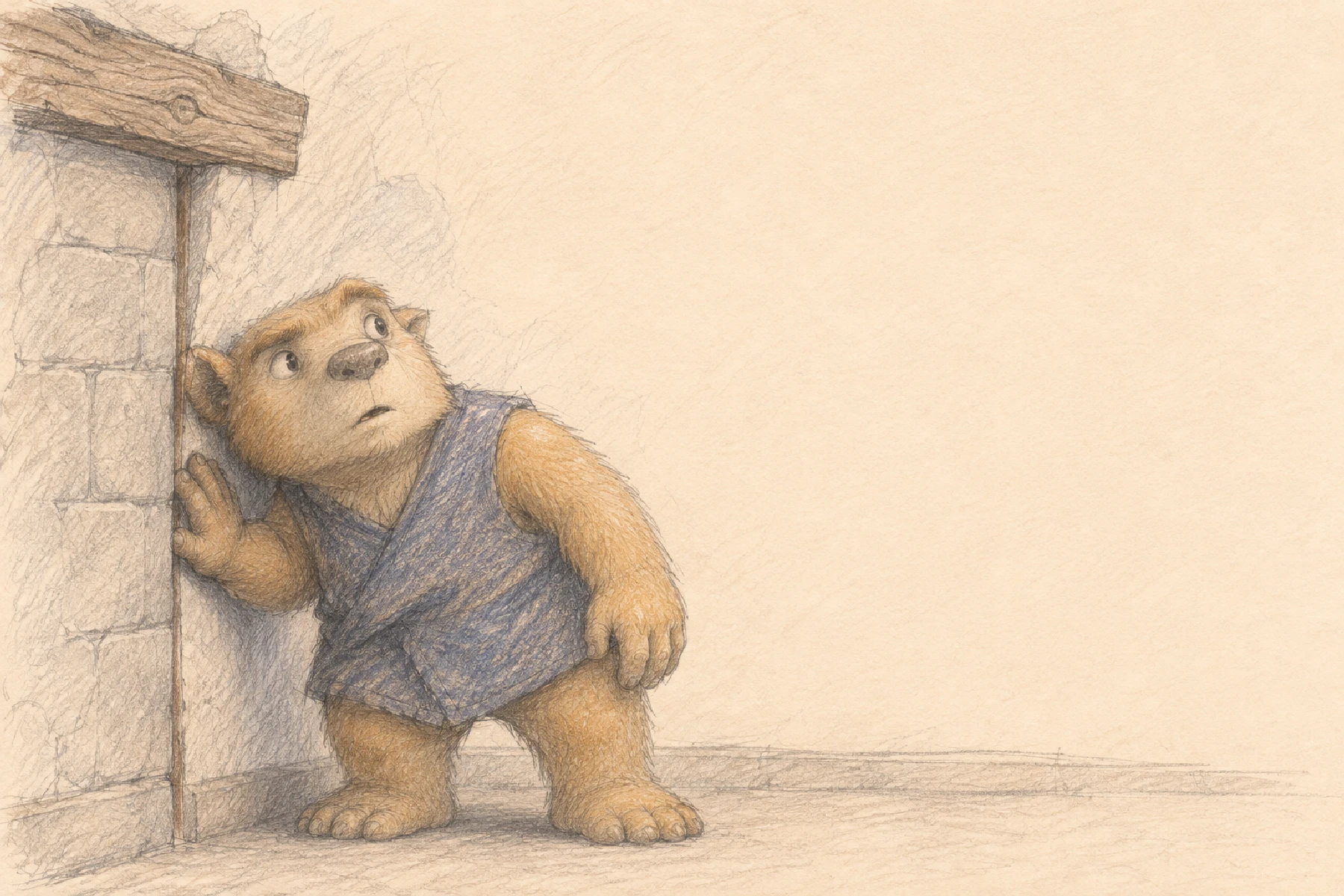
A wedge-headed creature in a work smock listens at a blocked doorway. Rough searching pencil lines and sparse colored-pencil layers give its small act of curiosity a spacious sketchbook setting.
Remix this referenceA Wedge-Headed Creature Listening at a Wall
- Form language
- Reduce forms to blunt wedges and pliable blocks, allowing exploratory construction arcs and small shape irregularities to remain.
- Contour
- Use broken, repeatedly searched pencil contours, pressing harder at contact edges and letting other edges trail away.
- Mark-making
- Combine loose graphite hatching with oblique colored-pencil strokes; preserve natural shifts in pressure and stroke length.
- Surface rendering
- Build partial tones through translucent pencil layers, leaving paper tooth and faint erased revisions visible between marks.
Priority
Keep the finished image visibly rooted in rough pencil and colored-pencil sketchbook drawing.
What to avoid & what to check
Exact prompt for this example
MODULE OWNERSHIP
subject: Subject count, type, stable proportions and landmarks, resting face geometry, hair shape, physical materials, garment construction and permanent marks. No emotion, movement, color assignment or rendering recipe.
expression: Facial soft-tissue displacement and pupil direction, muscle coordination, regional intensity, asymmetry and onset/peak/release. No head/body pose, stable appearance, skin color or rendering.
gesture: Head/neck/body/limb orientation, joint movement, support, contact and pose-caused occlusion using existing anatomy. No eye/pupil movement, emotion, identity, props inventory or camera.
props: Prop count, type, construction, physical material and scale relative to the subject. Holding/contact belongs to gesture, position to composition, color to palette.
scene: Environment elements, terrain, backdrop/floor presence and structural detail. No canvas positions, camera, lighting, assigned colors or render texture.
camera: Projection, focal-length impression, camera elevation/yaw/roll, viewing distance and crop. No actor pose, world placement, lighting or canvas aspect ratio.
composition: Normalized 0-100% canvas positions, scale in frame, depth/overlap, focal hierarchy and margins. No joint pose, camera projection, rendering, subject/prop inventory or emotion.
palette: Color anchors, hue/saturation/value ranges, colors assigned to parts and approximate color coverage. No illumination direction, shading algorithm, physical material or layout.
lighting: Light-source direction/softness/intensity, ambient illumination, physical shadow direction/length and highlight position. Absence of directional illumination is allowed. No shading technique, palette or material changes.
style: Reusable form abstraction, contour weight/taper/edge quality, medium and mark scale/density/direction, surface rendering and tonal transition technique. No fixed subject proportions, anatomy, identity, expression, pose, palette, light-source direction, camera or layout.
output: Image count, aspect ratio, size, file/alpha requirements and global lettering/logo/watermark restrictions. No background scenery, crop, style, identity or pose.

SUBJECT
inventory: One original upright creature, actor A.
geometry: A wedge-shaped head with a squared muzzle, a tapered torso, broad hands and short legs with wide feet.
resting-face: Small, widely spaced oval eyes, low heavy brows, a rounded nose and a short straight mouth.
appearance: Short dense fur, small cupped ears and a leathery nose; a sleeveless canvas smock with a crossed front.

PRIORITY


AVOID


CHECK


EXPRESSION — ACTOR A
brows: The visible outer brow begins to rise in a shallow arch.
lids: The visible upper lid lifts slightly; the lower lid stays loose.
cheeks: Cheeks remain unraised, with little muscular tension.
nose: The nose remains relaxed without nostril flare.
mouth: Lips part at the center while the corners remain nearly level.
jaw: The jaw releases only enough to support the small lip opening.
gaze: The visible pupil shifts upward toward the doorway seam.
coordination: The brow and lid lead the response; the lower face remains quiet.
timing: Show the onset of attention, just as a faint sound is noticed.

PRIORITY


AVOID


CHECK


GESTURE
head: Incline the head toward the wall and turn the muzzle outward enough to expose the far eye.
torso: Lean sideways from a planted stance, letting one shoulder sink toward the wall.
limbs: Bend the knees slightly; extend one arm to the wall while the free hand hangs beside the hip.
contact: One ear rests against the plaster; the spread palm braces below it while both feet support the lean.

PRIORITY


AVOID


CHECK


PROPS
inventory: No separate props.
construction: No prop construction applies.

PRIORITY


AVOID


CHECK


SCENE
inventory: A fragment of plaster wall containing a blocked doorway, a timber lintel and a narrow strip of floor.
structure: Infill masonry leaves a thin seam inside the old doorway; a shallow skirting meets the plain floor.

PRIORITY


AVOID


CHECK


CAMERA
projection: Use mild perspective with a long-normal lens impression and little near-to-far distortion.
viewpoint: Observe from the creature's chest height at a shallow three-quarter angle, without roll.
crop: Show the whole creature and enough wall and floor to explain the contact.

PRIORITY


AVOID


CHECK


COMPOSITION
placement: Group the wall and creature in the left half, with the creature occupying roughly half the image height.
depth: Make the listening face the first read, then the bracing hand; overlap the ear narrowly with the wall edge.
spacing: Leave most of the right half and a generous upper margin open, with ample clearance around the feet.

PRIORITY


AVOID


CHECK


PALETTE
colors: Graphite gray, muted ochre and dusty indigo on warm ivory, with a restrained value range.
assignment: Ochre belongs to the fur, indigo to the smock, pale gray to the wall and ivory to the open ground.
balance: The ivory ground dominates; ochre and indigo remain small, distinct color accents.

PRIORITY


AVOID


CHECK


LIGHTING
sources: A broad, weak light arrives from the upper right within soft ambient illumination.
shadows: Short, soft shadows fall lower left, gathering beneath the feet and at the wall contact.
highlights: Keep highlights broad and modest along the upper muzzle and outward shoulder.

PRIORITY


AVOID


CHECK


STYLE GUIDE
form-language: Reduce forms to blunt wedges and pliable blocks, allowing exploratory construction arcs and small shape irregularities to remain.
contour: Use broken, repeatedly searched pencil contours, pressing harder at contact edges and letting other edges trail away.
mark-making: Combine loose graphite hatching with oblique colored-pencil strokes; preserve natural shifts in pressure and stroke length.
surface-rendering: Build partial tones through translucent pencil layers, leaving paper tooth and faint erased revisions visible between marks.

PRIORITY
Keep the finished image visibly rooted in rough pencil and colored-pencil sketchbook drawing.

AVOID


CHECK


OUTPUT
format: One finished image, landscape 3:2, 1800 × 1200 pixels, opaque PNG.
restrictions: No lettering, logos or watermarks.

PRIORITY


AVOID


CHECK


FINAL INTEGRATION
gesture + scene + style: Keep the contact between the figure and architecture understandable through the exploratory drawing.
Model information comes from image provenance. The same prompt may produce a different result.