Text to imagePortraitStyle guide
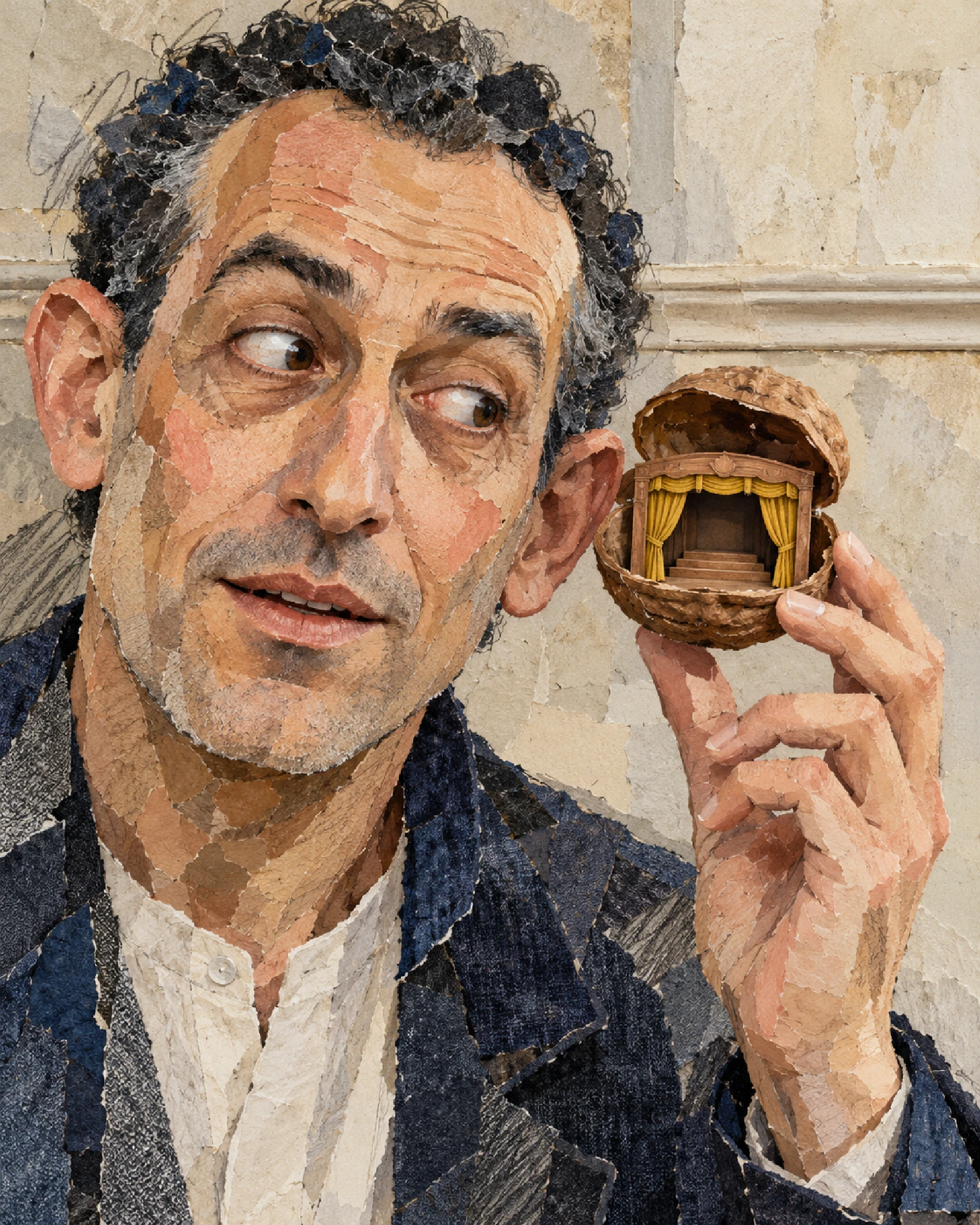
A Man Listening to a Walnut Theatre
A man raises a tiny theatre inside an open walnut shell toward his ear. Photographic fragments, torn paper and pencil marks overlap to create a curious moment of impossible scale.
Remix this referenceA Man Listening to a Walnut Theatre
- Form language
- Assemble recognizable volumes from mismatched cut fragments, allowing abrupt changes of descriptive detail at their joins.
- Contour
- Alternate scissor-sharp edges with fibrous tears; leave occasional offset pencil contours visible beyond a cut edge.
- Mark-making
- Combine continuous-tone photographic scraps with broad gouache interruptions and loose, directional pencil hatching.
- Surface rendering
- Let printed grain, paper fibres and opaque overpaint coexist; tonal passages may jump at seams rather than blend smoothly.
Priority
Make surreal mixed-media collage visibly assembled, with natural variation in fragment edges and overdrawn marks.
What to avoid & what to check
Exact prompt for this example
MODULE OWNERSHIP
subject: Subject count, type, stable proportions and landmarks, resting face geometry, hair shape, physical materials, garment construction and permanent marks. No emotion, movement, color assignment or rendering recipe.
expression: Facial soft-tissue displacement and pupil direction, muscle coordination, regional intensity, asymmetry and onset/peak/release. No head/body pose, stable appearance, skin color or rendering.
gesture: Head/neck/body/limb orientation, joint movement, support, contact and pose-caused occlusion using existing anatomy. No eye/pupil movement, emotion, identity, props inventory or camera.
props: Prop count, type, construction, physical material and scale relative to the subject. Holding/contact belongs to gesture, position to composition, color to palette.
scene: Environment elements, terrain, backdrop/floor presence and structural detail. No canvas positions, camera, lighting, assigned colors or render texture.
camera: Projection, focal-length impression, camera elevation/yaw/roll, viewing distance and crop. No actor pose, world placement, lighting or canvas aspect ratio.
composition: Normalized 0-100% canvas positions, scale in frame, depth/overlap, focal hierarchy and margins. No joint pose, camera projection, rendering, subject/prop inventory or emotion.
palette: Color anchors, hue/saturation/value ranges, colors assigned to parts and approximate color coverage. No illumination direction, shading algorithm, physical material or layout.
lighting: Light-source direction/softness/intensity, ambient illumination, physical shadow direction/length and highlight position. Absence of directional illumination is allowed. No shading technique, palette or material changes.
style: Reusable form abstraction, contour weight/taper/edge quality, medium and mark scale/density/direction, surface rendering and tonal transition technique. No fixed subject proportions, anatomy, identity, expression, pose, palette, light-source direction, camera or layout.
output: Image count, aspect ratio, size, file/alpha requirements and global lettering/logo/watermark restrictions. No background scenery, crop, style, identity or pose.

SUBJECT
inventory: A is one original middle-aged man; there are no other people or animals.
geometry: A has a narrow upper face, a broad jaw, prominent ears and long, tapering fingers.
resting-face: Deep-set eyes sit beneath straight brows; a long nose ends above a wide mouth with an uneven upper lip.
appearance: His close-cropped curls recede at the temples; he wears a soft wool jacket over a collarless cotton shirt.

PRIORITY


AVOID


CHECK


EXPRESSION — ACTOR A
brows: Both inner brows rise, with a slightly higher arch on the theatre side.
lids: Upper lids lift slightly; the lower lids remain soft.
cheeks: The theatre-side cheek gathers faintly while the other remains relaxed.
nose: Keep the nose unwrinkled and the nostrils easy.
mouth: The lips part narrowly, with one corner beginning to curl upward.
jaw: Release the jaw just enough to separate the lips.
gaze: Pupils glance sideways toward the theatre without reaching an extreme.
coordination: The brow lift arrives before the small mouth response, suggesting newly caught interest.
timing: Capture curiosity at onset, before it becomes a full smile.

PRIORITY


AVOID


CHECK


GESTURE
head: A inclines his head toward the raised walnut, bringing one ear closer to its opening.
torso: His shoulders turn gently away from the head tilt, leaving a relaxed bend through the neck.
limbs: One elbow bends to raise the hand beside the jaw; the other arm rests loosely at his side.
contact: Thumb and two fingertips cradle the shell underneath, leaving the stage opening unobstructed; the fingers overlap the jaw edge.

PRIORITY


AVOID


CHECK


PROPS
inventory: One palm-sized walnut theatre, small enough to sit between A's thumb and fingertips.
construction: A hinged walnut shell encloses a tiny wooden proscenium, cloth curtains and an empty stepped stage.

PRIORITY


AVOID


CHECK


SCENE
inventory: A quiet interior has a plain plaster wall and one narrow strip of wall moulding; no floor is visible.
structure: The moulding divides two uninterrupted wall surfaces without doors, windows or furnishings.

PRIORITY


AVOID


CHECK


CAMERA
projection: Use a mild portrait-lens perspective, with natural facial depth and little near-hand enlargement.
viewpoint: View at eye level from a three-quarter direction, with no roll.
crop: Frame the head, upper chest and raised hand; crop below the jacket lapels and leave the resting arm outside the frame.

PRIORITY


AVOID


CHECK


COMPOSITION
placement: The large face fills the left side; the tiny theatre occupies an open pocket beside the ear on the right.
depth: The face is primary and the theatre secondary; the wall recedes behind them.
spacing: Let the hair approach the upper edge; preserve a clear interval between the shell opening and ear.

PRIORITY


AVOID


CHECK


PALETTE
colors: Use smoky indigo, faded coral, parchment cream, walnut brown and a small acid-yellow accent.
assignment: Assign coral and cream to skin, indigo to hair and jacket, brown to the shell, and yellow to the curtains.
balance: Keep the wall and shirt pale; darker clothing supports the warmer face, with yellow confined to the miniature.

PRIORITY


AVOID


CHECK


LIGHTING
sources: A broad, soft source from the upper right lights the scene; ambient fill keeps both eyes readable.
shadows: Soft shadows fall down-left beneath the nose, chin and supporting fingers.
highlights: Place broad highlights on the right temple and fingertips; the miniature has no independent glow.

PRIORITY


AVOID


CHECK


STYLE GUIDE
form-language: Assemble recognizable volumes from mismatched cut fragments, allowing abrupt changes of descriptive detail at their joins.
contour: Alternate scissor-sharp edges with fibrous tears; leave occasional offset pencil contours visible beyond a cut edge.
mark-making: Combine continuous-tone photographic scraps with broad gouache interruptions and loose, directional pencil hatching.
surface-rendering: Let printed grain, paper fibres and opaque overpaint coexist; tonal passages may jump at seams rather than blend smoothly.

PRIORITY
Make surreal mixed-media collage visibly assembled, with natural variation in fragment edges and overdrawn marks.

AVOID


CHECK


OUTPUT
format: Deliver one finished image, 4:5 portrait, 1600 × 2000 pixels, opaque PNG.
restrictions: Deliver one finished image, 4:5 portrait, 1600 × 2000 pixels, opaque PNG; no lettering, logos or watermarks.

PRIORITY


AVOID


CHECK


FINAL INTEGRATION
props + composition + style: Let the miniature remain understandable within the scale contrast while the collage joins reinforce the surreal encounter.
expression + gesture: Coordinate the emerging facial response with the listening action so the moment feels newly discovered.
Model information comes from image provenance. The same prompt may produce a different result.