Text to imageCharacterStyle guide
Little Walrus Friend · Three-Dimensional Whisker Fans
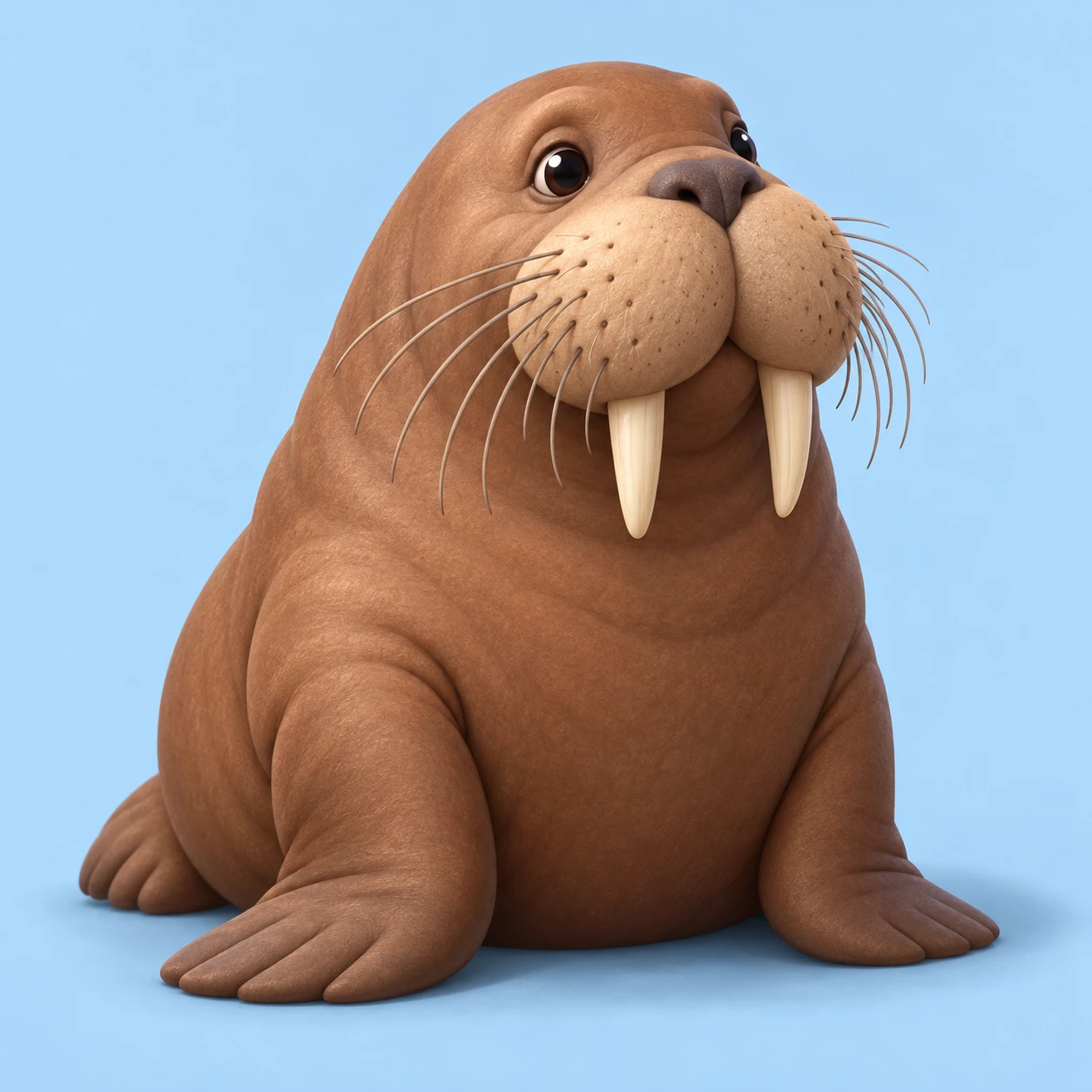
A little walrus character whose whisker directions and overlaps reveal the rounded volume of its muzzle.
Little Walrus Friend · Three-Dimensional Whisker Fans
- Shape & line
- Build the muzzle from two rounded pads and draw whiskers emerging from scattered points across their surfaces. Curve each whisker outward from its root and taper it toward the tip; let the nearer image-left fan spread broadly while the farther image-right fan appears shorter and partly disappears behind the muzzle.
- Color & light
- Use warm brown for the body, a lighter tan muzzle, and muted ivory tusks. Light from image-upper-left, placing a broad soft highlight across the upper-left muzzle pads and a connected gentle shadow beneath them so the whisker-bearing surfaces read as rounded.
- Texture & material
- Render the skin with soft matte shading and a few broad folds where the flippers meet the body. Keep the whiskers smooth and slightly darker than the muzzle, adding small subdued root dots while leaving their tapered tips clean and distinct.
- Composition
- Center the seated body against a plain pale blue background and place a soft oval ground shadow directly beneath it. Separate most whisker tips with visible background gaps, allowing only a few clear crossings near the roots so both fans remain readable at thumbnail size.
Priority
Prioritize whiskers that visibly grow from and describe the rounded muzzle.
What to avoid & what to check
Avoid whiskers arranged as identical straight spokes from a single flat point.
Check that distinct roots, curved tapers, and partial far-side occlusion make both whisker fans feel attached to the muzzle.
Exact prompt for this example
SUBJECT
One original little walrus character sitting upright, with a plump brown body, two rounded muzzle pads, two short ivory tusks, and whiskers growing from both muzzle pads. Its front flippers rest beside its body.

COMPOSITION
Show the entire character in a close, eye-level three-quarter view, with its nose pointing slightly toward image-right. Keep the muzzle large enough to read individual whisker roots and curves, with generous empty space around the whisker tips.

STYLE GUIDE
1. Shape & line
Build the muzzle from two rounded pads and draw whiskers emerging from scattered points across their surfaces. Curve each whisker outward from its root and taper it toward the tip; let the nearer image-left fan spread broadly while the farther image-right fan appears shorter and partly disappears behind the muzzle.

2. Color & light
Use warm brown for the body, a lighter tan muzzle, and muted ivory tusks. Light from image-upper-left, placing a broad soft highlight across the upper-left muzzle pads and a connected gentle shadow beneath them so the whisker-bearing surfaces read as rounded.

3. Texture & material
Render the skin with soft matte shading and a few broad folds where the flippers meet the body. Keep the whiskers smooth and slightly darker than the muzzle, adding small subdued root dots while leaving their tapered tips clean and distinct.

4. Composition
Center the seated body against a plain pale blue background and place a soft oval ground shadow directly beneath it. Separate most whisker tips with visible background gaps, allowing only a few clear crossings near the roots so both fans remain readable at thumbnail size.

PRIORITY
Preserve the requested identity, count, action, composition and output settings. Apply the style rules within those constraints; a style reference must not replace the subject or layout. Within the style: Prioritize whiskers that visibly grow from and describe the rounded muzzle.

AVOID
Avoid whiskers arranged as identical straight spokes from a single flat point.

OUTPUT
One square image, presented as a finished character illustration without lettering, captions, logos, or watermarks.

SELF-CHECK
Check that distinct roots, curved tapers, and partial far-side occlusion make both whisker fans feel attached to the muzzle.
Model information comes from image provenance. The same prompt may produce a different result.