Text to imageProductStyle guide
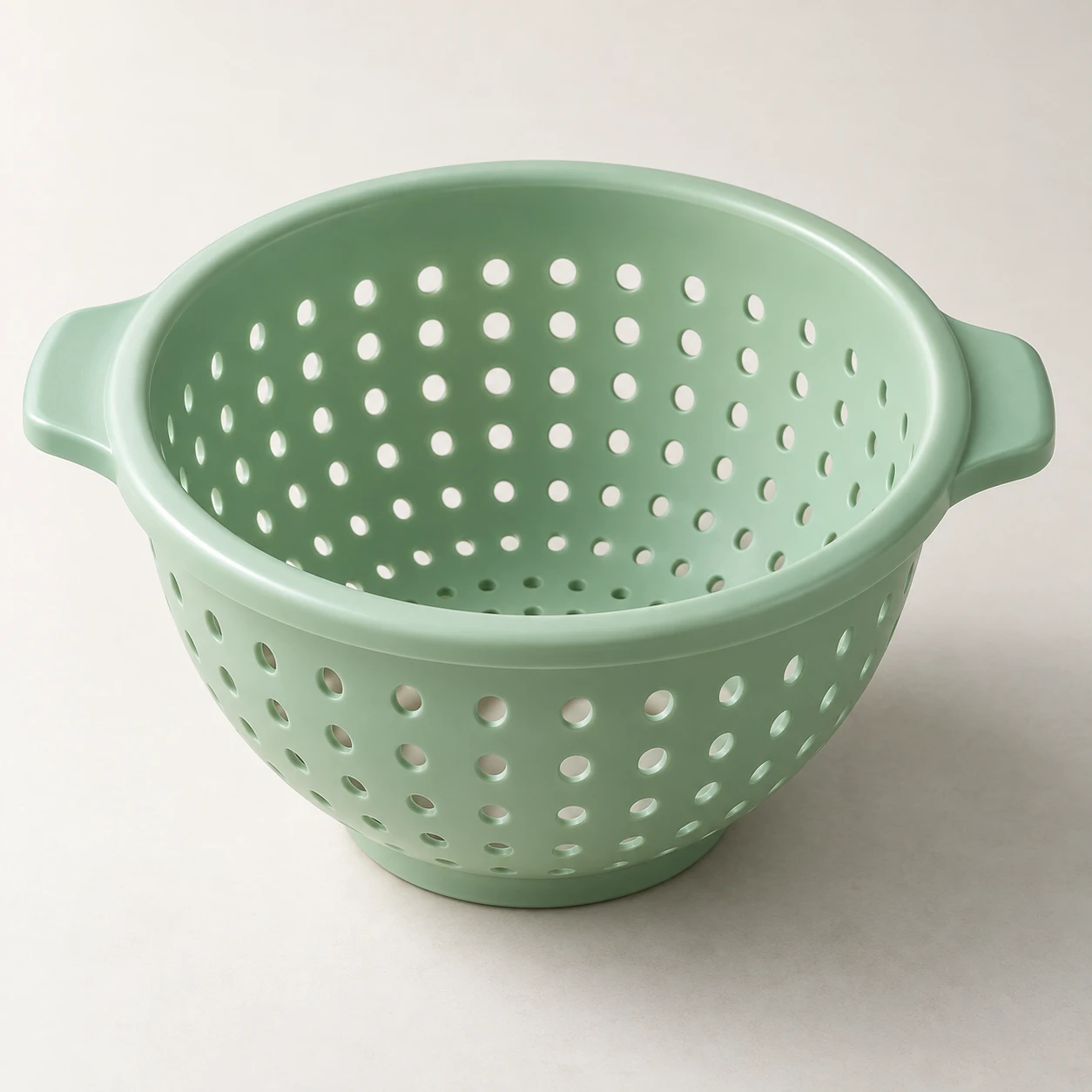
One Mint Colander · Curvature Through Hole Foreshortening
A product study that reveals a colander’s curved bowl and wall thickness through round holes that narrow toward its silhouette.
One Mint Colander · Curvature Through Hole Foreshortening
- Shape & line
- Build a smooth bowl silhouette and consistent rim thickness. Keep perforations nearly round where the wall faces the camera, then progressively compress them into narrow ovals toward the image-left and image-right silhouette; align each oval with its local curved surface.
- Color & light
- Use a soft key light from image-upper-left, giving the left rim a pale highlight and the right outer wall a cooler mint shadow. Let broad tonal transitions describe the bowl while keeping the perforations readable against the surfaces seen through them.
- Texture & material
- Render satin-finish plastic with broad subdued reflections. Show a slim shaded cut edge inside the nearer perforations to reveal wall thickness, and let holes reveal the tabletop or opposite inner wall according to their sightline instead of filling every opening with uniform black.
- Composition
- Keep the front perforations large enough to compare their changing shapes, with both handles and the rear rim fully visible. Use sharp focus across the bowl and a quiet background; place a soft grounding shadow beneath the base that extends toward image-lower-right.
Priority
Prioritize progressive hole foreshortening that makes the bowl’s curvature immediately legible.
What to avoid & what to check
Avoid identical circular holes across every surface and uniformly black openings.
Check that holes narrow toward both side silhouettes and reveal plausible surfaces behind them.
Exact prompt for this example
SUBJECT
One mint-green molded-plastic colander with a rounded bowl, a continuous thick rim, and two short opposing handles. Repeated circular perforations pass through the bowl wall; the visible inner and outer surfaces belong to the same single object.

COMPOSITION
Show the entire colander in an elevated three-quarter view on a warm off-white tabletop, with its opening facing upward. Keep the front wall in the lower half of the image and the rear inner wall in the upper half. Place the handles toward image-left and image-right, and leave comfortable space around the silhouette.

STYLE GUIDE
1. Shape & line
Build a smooth bowl silhouette and consistent rim thickness. Keep perforations nearly round where the wall faces the camera, then progressively compress them into narrow ovals toward the image-left and image-right silhouette; align each oval with its local curved surface.

2. Color & light
Use a soft key light from image-upper-left, giving the left rim a pale highlight and the right outer wall a cooler mint shadow. Let broad tonal transitions describe the bowl while keeping the perforations readable against the surfaces seen through them.

3. Texture & material
Render satin-finish plastic with broad subdued reflections. Show a slim shaded cut edge inside the nearer perforations to reveal wall thickness, and let holes reveal the tabletop or opposite inner wall according to their sightline instead of filling every opening with uniform black.

4. Composition
Keep the front perforations large enough to compare their changing shapes, with both handles and the rear rim fully visible. Use sharp focus across the bowl and a quiet background; place a soft grounding shadow beneath the base that extends toward image-lower-right.

PRIORITY
Preserve the requested identity, count, action, composition and output settings. Apply the style rules within those constraints; a style reference must not replace the subject or layout. Within the style: Prioritize progressive hole foreshortening that makes the bowl’s curvature immediately legible.

AVOID
Avoid identical circular holes across every surface and uniformly black openings.

OUTPUT
One square product-reference image in a realistic studio-photography medium, with no captions, logos, labels, or other text.

SELF-CHECK
Check that holes narrow toward both side silhouettes and reveal plausible surfaces behind them.
Model information comes from image provenance. The same prompt may produce a different result.