Text to imageSpace & architectureStyle guide
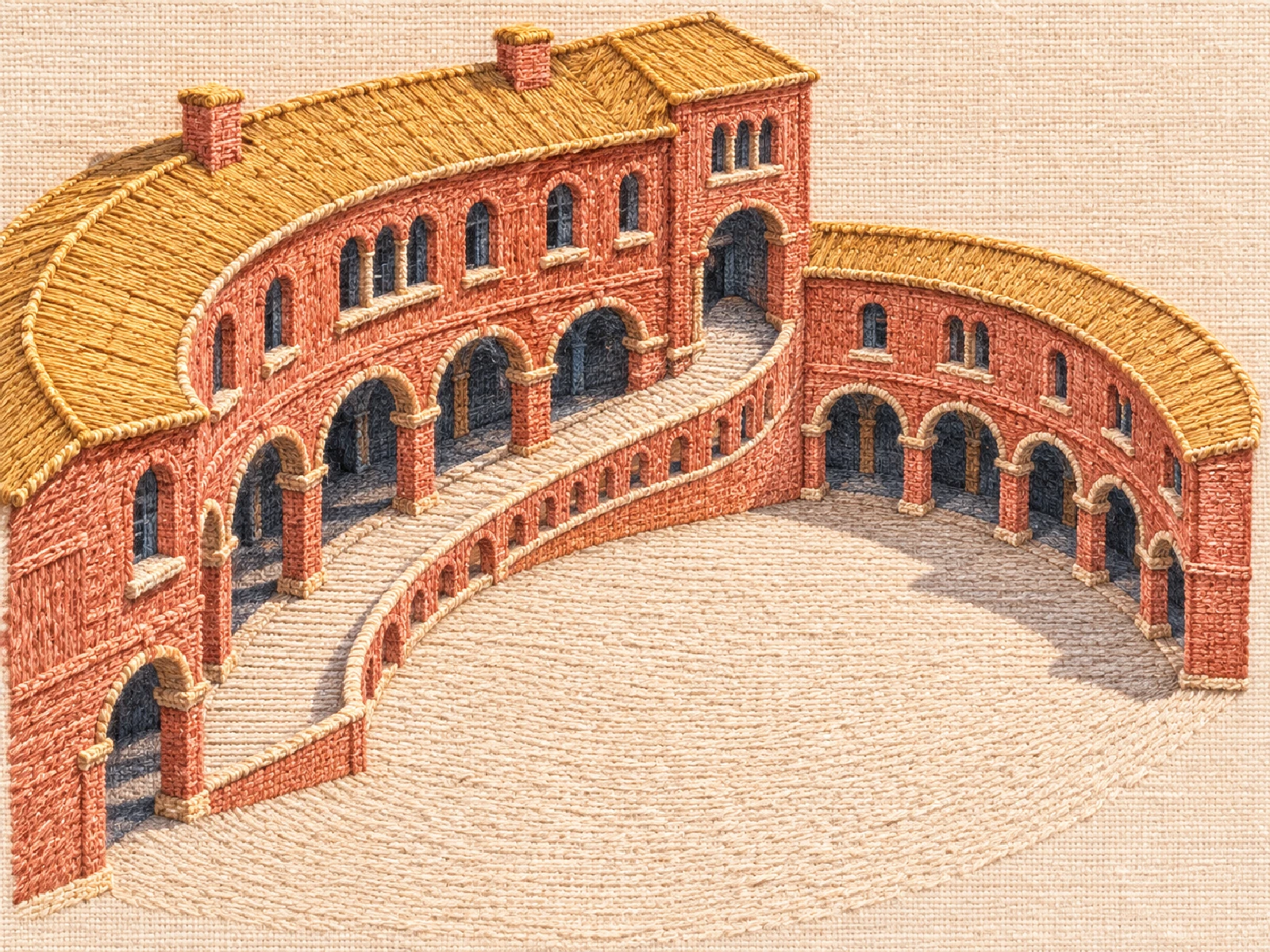
A Sunken Courtyard Between Curved Galleries
Unequal curved galleries embrace a sunken public courtyard. Raised threads and exposed ground weave give the architecture depth while preserving generous empty space.
Remix this referenceA Sunken Courtyard Between Curved Galleries
- Form language
- Translate built volumes into broad interlocking stitched panels; let repeated openings vary slightly within a coherent rhythm.
- Contour
- Use slightly wandering couched cords for selected edges; let other borders end in exposed, uneven stitch tips.
- Mark-making
- Lay satin-stitch bundles along each plane, varying their length naturally and gathering denser knots in small recesses.
- Surface rendering
- Build shallow padded relief over visible ground weave; merge tonal steps with interleaved threads and occasional loose fibers.
Priority
The finished image must visibly read as embroidered textile illustration with tangible thread relief.
What to avoid & what to check
Exact prompt for this example
MODULE OWNERSHIP
subject: Subject count, type, stable proportions and landmarks, resting face geometry, hair shape, physical materials, garment construction and permanent marks. No emotion, movement, color assignment or rendering recipe.
expression: Facial soft-tissue displacement and pupil direction, muscle coordination, regional intensity, asymmetry and onset/peak/release. No head/body pose, stable appearance, skin color or rendering.
gesture: Head/neck/body/limb orientation, joint movement, support, contact and pose-caused occlusion using existing anatomy. No eye/pupil movement, emotion, identity, props inventory or camera.
props: Prop count, type, construction, physical material and scale relative to the subject. Holding/contact belongs to gesture, position to composition, color to palette.
scene: Environment elements, terrain, backdrop/floor presence and structural detail. No canvas positions, camera, lighting, assigned colors or render texture.
camera: Projection, focal-length impression, camera elevation/yaw/roll, viewing distance and crop. No actor pose, world placement, lighting or canvas aspect ratio.
composition: Normalized 0-100% canvas positions, scale in frame, depth/overlap, focal hierarchy and margins. No joint pose, camera projection, rendering, subject/prop inventory or emotion.
palette: Color anchors, hue/saturation/value ranges, colors assigned to parts and approximate color coverage. No illumination direction, shading algorithm, physical material or layout.
lighting: Light-source direction/softness/intensity, ambient illumination, physical shadow direction/length and highlight position. Absence of directional illumination is allowed. No shading technique, palette or material changes.
style: Reusable form abstraction, contour weight/taper/edge quality, medium and mark scale/density/direction, surface rendering and tonal transition technique. No fixed subject proportions, anatomy, identity, expression, pose, palette, light-source direction, camera or layout.
output: Image count, aspect ratio, size, file/alpha requirements and global lettering/logo/watermark restrictions. No background scenery, crop, style, identity or pose.

SUBJECT
inventory: No separate subjects.
geometry: No separate subject geometry applies; architectural construction belongs to scene.
resting-face: No faces are present.
appearance: No character appearance or garments apply.

PRIORITY


AVOID


CHECK


PROPS
inventory: No separate props.
construction: No prop construction applies.

PRIORITY


AVOID


CHECK


SCENE
inventory: A sunken public courtyard has two unequal crescent galleries, arcaded passages, deep window reveals and a broad access ramp.
structure: Masonry galleries partly enclose an open paved court; the ramp joins its lower floor to a street-level entrance.

PRIORITY


AVOID


CHECK


CAMERA
projection: Use an oblique orthographic projection with parallel architectural edges and no wide-angle distortion.
viewpoint: View from a moderately elevated three-quarter angle, with a level camera roll.
crop: Include the complete courtyard opening and most roof edges, allowing the street approach to leave the crop.

PRIORITY


AVOID


CHECK


COMPOSITION
placement: Gather one gallery mass toward the upper left; open the courtyard bowl toward the lower right.
depth: Let the nearer gallery overlap part of the ramp while leaving the connection between levels legible.
spacing: Make the empty court the focal shape, framed by denser galleries; leave a generous margin beyond its open side.

PRIORITY


AVOID


CHECK


PALETTE
colors: Use chalk cream, ink blue, faded coral and muted mustard, keeping saturation restrained.
assignment: Assign cream to the court and surrounding field, coral to walls, mustard to roofs, and ink blue to recesses.
balance: Let pale cream remain expansive; concentrate the stronger hues within the architectural masses.

PRIORITY


AVOID


CHECK


LIGHTING
sources: Soft daylight comes from the upper right, with enough ambient illumination to reveal the recessed passages.
shadows: Architectural shadows fall softly toward the lower left; thread relief casts small local contact shadows.
highlights: Gentle highlights catch upper-right roof edges and the exposed crowns of raised threads.

PRIORITY


AVOID


CHECK


STYLE GUIDE
form-language: Translate built volumes into broad interlocking stitched panels; let repeated openings vary slightly within a coherent rhythm.
contour: Use slightly wandering couched cords for selected edges; let other borders end in exposed, uneven stitch tips.
mark-making: Lay satin-stitch bundles along each plane, varying their length naturally and gathering denser knots in small recesses.
surface-rendering: Build shallow padded relief over visible ground weave; merge tonal steps with interleaved threads and occasional loose fibers.

PRIORITY
The finished image must visibly read as embroidered textile illustration with tangible thread relief.

AVOID


CHECK


OUTPUT
format: Deliver one opaque PNG image, landscape 4:3, 1600 × 1200 pixels, without lettering, logos or watermarks.
restrictions: One opaque PNG image, landscape 4:3, 1600 × 1200 pixels; no lettering, logos or watermarks.

PRIORITY


AVOID


CHECK
Model information comes from image provenance. The same prompt may produce a different result.