Text to imageCharacterStyle guide
Little Bat Friend · Taut Wing Membranes
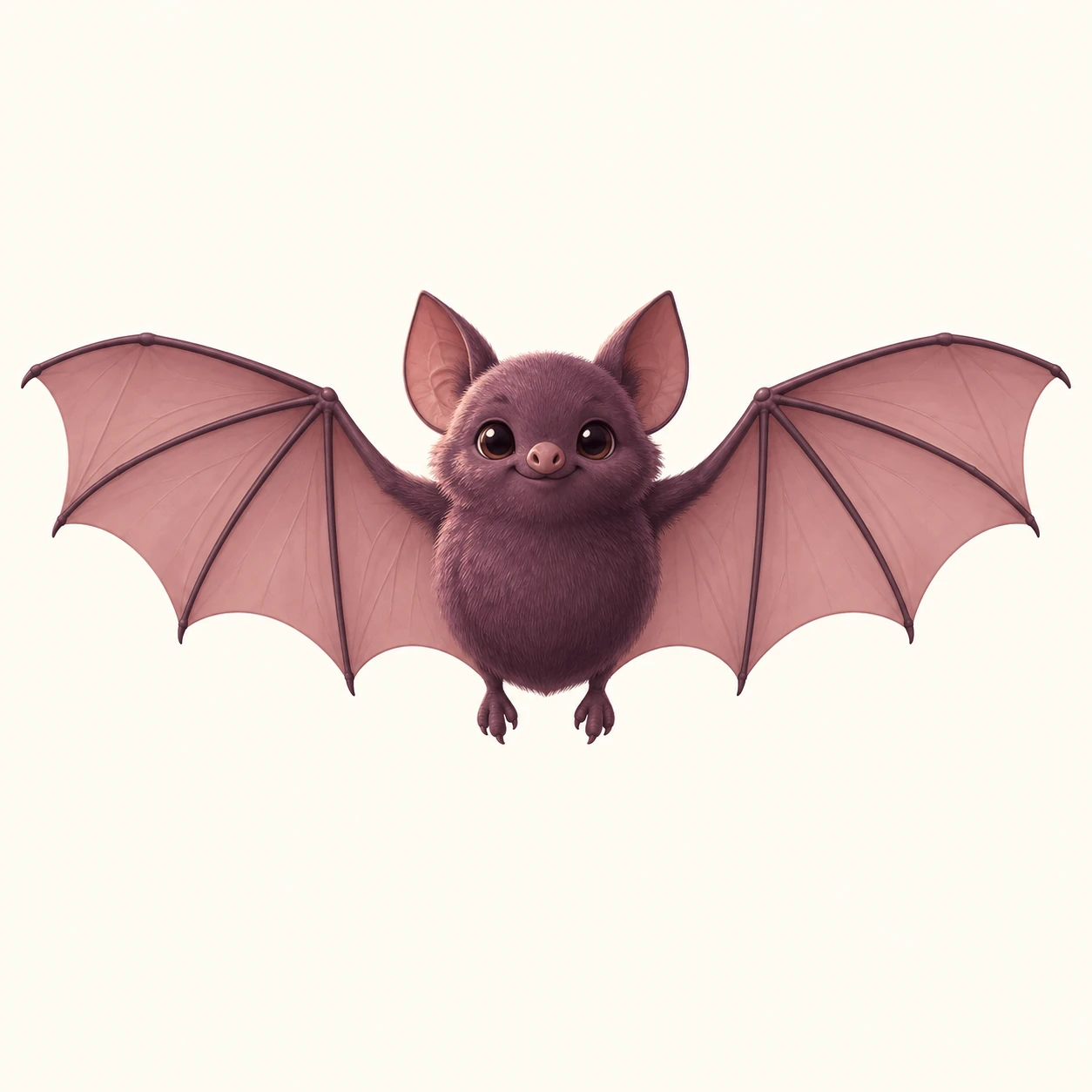
A character brief that reveals a bat’s spread-wing structure through membranes pulled into concave spans between elongated wing fingers.
Little Bat Friend · Taut Wing Membranes
- Shape & line
- Draw each wing with a gently convex upper outline and several long, slender finger supports radiating from its wrist toward the outer and lower edges. Between neighboring finger tips, pull the lower membrane edge inward toward the wrist in a shallow concave arc, creating a connected scalloped silhouette rather than rounded feather lobes.
- Color & light
- Use muted plum for the body and dusty rose for the membranes, keeping the finger supports slightly darker so their paths remain readable. Place soft light at image-upper-left, with restrained highlights on the upper-left body curve and wing supports and a broad, gentle shadow along the lower-right belly.
- Texture & material
- Render the body as short velvety fur with only a few soft tufts at the cheeks and belly. Keep the wing membranes smooth and thin-looking, adding sparse faint tension creases that fan inward from finger tips; let the broad membrane panels stay mostly flat and uninterrupted.
- Composition
- Arrange the spread wings as the widest part of the image, with their wrists level beside the shoulders and their lower scallops clearly separated from the hanging feet. Use a plain warm ivory background and place no props across the membranes, so the finger-to-membrane connections and inward-curving edges can be read at a glance.
Priority
Prioritize visible finger supports and taut concave membrane spans.
What to avoid & what to check
Avoid feathered wings, inflated membrane panels, and loose hanging fabric folds.
Check that each lower-edge concavity joins two visible finger tips and that both wings connect clearly to the body.
Exact prompt for this example
SUBJECT
One original little bat character with a round plum-colored body, small pointed ears, a gentle smile, and two fully spread wings. Elongated wing fingers support continuous membranes attached to the sides of its body; two small feet hang beneath its belly.

COMPOSITION
Use a straight-on full-body view with the bat centered, its left wing extending toward image-left and its right wing toward image-right. Keep both wing tips and the entire lower wing edges visible, with generous pale background around the silhouette.

STYLE GUIDE
1. Shape & line
Draw each wing with a gently convex upper outline and several long, slender finger supports radiating from its wrist toward the outer and lower edges. Between neighboring finger tips, pull the lower membrane edge inward toward the wrist in a shallow concave arc, creating a connected scalloped silhouette rather than rounded feather lobes.

2. Color & light
Use muted plum for the body and dusty rose for the membranes, keeping the finger supports slightly darker so their paths remain readable. Place soft light at image-upper-left, with restrained highlights on the upper-left body curve and wing supports and a broad, gentle shadow along the lower-right belly.

3. Texture & material
Render the body as short velvety fur with only a few soft tufts at the cheeks and belly. Keep the wing membranes smooth and thin-looking, adding sparse faint tension creases that fan inward from finger tips; let the broad membrane panels stay mostly flat and uninterrupted.

4. Composition
Arrange the spread wings as the widest part of the image, with their wrists level beside the shoulders and their lower scallops clearly separated from the hanging feet. Use a plain warm ivory background and place no props across the membranes, so the finger-to-membrane connections and inward-curving edges can be read at a glance.

PRIORITY
Preserve the requested identity, count, action, composition and output settings. Apply the style rules within those constraints; a style reference must not replace the subject or layout. Within the style: Prioritize visible finger supports and taut concave membrane spans.

AVOID
Avoid feathered wings, inflated membrane panels, and loose hanging fabric folds.

OUTPUT
Create one square character illustration with no lettering, captions, logos, or watermark.

SELF-CHECK
Check that each lower-edge concavity joins two visible finger tips and that both wings connect clearly to the body.
Model information comes from image provenance. The same prompt may produce a different result.