Text to imageProductStyle guide
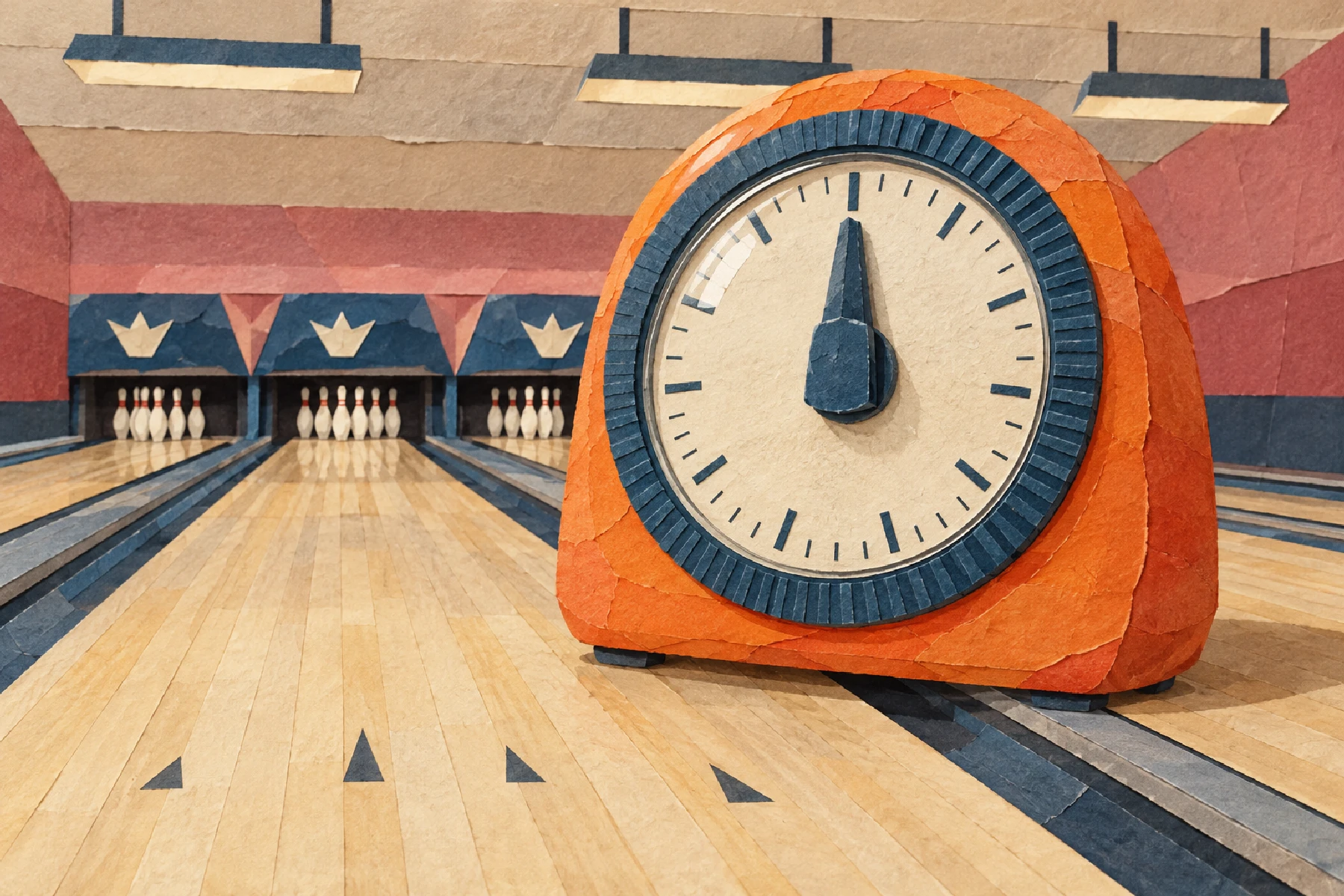
Giant Kitchen Timer in a Bowling Alley
A compact kitchen timer becomes large enough to interrupt a bowling lane. Hand-cut paper layers and exposed overlaps connect its rotary ring with the long depth of the alley.
Remix this referenceGiant Kitchen Timer in a Bowling Alley
- Form language
- Translate volumes into nested cut shapes and broad folded planes; slight asymmetry keeps the construction visibly handmade.
- Contour
- Use exposed scissor-cut edges with gentle wavering and occasional clipped corners; let overlaps create most interior boundaries.
- Mark-making
- Assemble layered cut-paper collage with sparse rubbed-pencil accents and irregular pasted fragments; vary cuts within one coherent craft.
- Surface rendering
- Keep paper fibers and slight buckling visible; build tonal changes with overlapping translucent scraps and rubbed patches.
Priority
The finished image must read as tactile layered cut-paper collage with exposed overlaps.
What to avoid & what to check
Exact prompt for this example
MODULE OWNERSHIP
subject: Subject count, type, stable proportions and landmarks, resting face geometry, hair shape, physical materials, garment construction and permanent marks. No emotion, movement, color assignment or rendering recipe.
expression: Facial soft-tissue displacement and pupil direction, muscle coordination, regional intensity, asymmetry and onset/peak/release. No head/body pose, stable appearance, skin color or rendering.
gesture: Head/neck/body/limb orientation, joint movement, support, contact and pose-caused occlusion using existing anatomy. No eye/pupil movement, emotion, identity, props inventory or camera.
props: Prop count, type, construction, physical material and scale relative to the subject. Holding/contact belongs to gesture, position to composition, color to palette.
scene: Environment elements, terrain, backdrop/floor presence and structural detail. No canvas positions, camera, lighting, assigned colors or render texture.
camera: Projection, focal-length impression, camera elevation/yaw/roll, viewing distance and crop. No actor pose, world placement, lighting or canvas aspect ratio.
composition: Normalized 0-100% canvas positions, scale in frame, depth/overlap, focal hierarchy and margins. No joint pose, camera projection, rendering, subject/prop inventory or emotion.
palette: Color anchors, hue/saturation/value ranges, colors assigned to parts and approximate color coverage. No illumination direction, shading algorithm, physical material or layout.
lighting: Light-source direction/softness/intensity, ambient illumination, physical shadow direction/length and highlight position. Absence of directional illumination is allowed. No shading technique, palette or material changes.
style: Reusable form abstraction, contour weight/taper/edge quality, medium and mark scale/density/direction, surface rendering and tonal transition technique. No fixed subject proportions, anatomy, identity, expression, pose, palette, light-source direction, camera or layout.
output: Image count, aspect ratio, size, file/alpha requirements and global lettering/logo/watermark restrictions. No background scenery, crop, style, identity or pose.

SUBJECT
inventory: One original mechanical kitchen timer; no people or animals.
geometry: A squat rounded housing has a flat foot, circular dial, thick rotary bezel, single pointer and unnumbered radial ticks.
resting-face: No readable face or anthropomorphic facial features.
appearance: A molded polymer shell surrounds a knurled aluminum bezel and a dial protected by a shallow glass cover.

PRIORITY


AVOID


CHECK


PROPS
inventory: No separate props.
construction: No prop construction applies.

PRIORITY


AVOID


CHECK


SCENE
inventory: A neighborhood bowling alley with wooden lanes, recessed gutters, pin decks and overhead light fixtures.
structure: Parallel lane boards and approach arrows establish the venue; low side walls and a plain ceiling enclose the hall.

PRIORITY


AVOID


CHECK


CAMERA
projection: Moderately wide perspective emphasizes receding lanes while preserving the timer's circular dial without extreme distortion.
viewpoint: View from just above lane height, slightly to the timer's left, with a gentle upward pitch and level roll.
crop: Include the complete timer and enough of the hall to establish its scale; adjacent lanes and ceiling extend beyond the crop.

PRIORITY


AVOID


CHECK


COMPOSITION
placement: The timer dominates the right-middle field; an open lane sweeps in from the lower left toward the distant pin deck.
depth: The giant timer spans a lane and overlaps its gutters; small distant lane fixtures establish the surprising scale change.
spacing: Keep the dial as the primary focus, with clear space around its upper rim and a broad secondary opening along the left lane.

PRIORITY


AVOID


CHECK


PALETTE
colors: Use mandarin orange, deep petrol blue, warm cream and muted rose; reserve strong saturation for the product.
assignment: Orange defines the shell, petrol blue the bezel and pointer, cream the dial and lanes, and rose the surrounding walls.
balance: Cream and subdued rose form the broad supporting field; orange is the concentrated accent and petrol blue provides depth.

PRIORITY


AVOID


CHECK


LIGHTING
sources: Soft overhead illumination is strongest toward the front left, with gentle ambient light throughout the hall.
shadows: A broad soft shadow falls behind and right of the timer.
highlights: Broad highlights sit on the shell's upper-left curve and the upper bezel; the dial cover catches one quiet reflection.

PRIORITY


AVOID


CHECK


STYLE GUIDE
form-language: Translate volumes into nested cut shapes and broad folded planes; slight asymmetry keeps the construction visibly handmade.
contour: Use exposed scissor-cut edges with gentle wavering and occasional clipped corners; let overlaps create most interior boundaries.
mark-making: Assemble layered cut-paper collage with sparse rubbed-pencil accents and irregular pasted fragments; vary cuts within one coherent craft.
surface-rendering: Keep paper fibers and slight buckling visible; build tonal changes with overlapping translucent scraps and rubbed patches.

PRIORITY
The finished image must read as tactile layered cut-paper collage with exposed overlaps.

AVOID


CHECK


OUTPUT
format: One finished image, landscape 3:2, 1800 × 1200 pixels, opaque PNG.
restrictions: No lettering, numerals, logos or watermarks; nonlinguistic dial ticks and lane arrows are permitted.

PRIORITY


AVOID


CHECK


FINAL INTEGRATION
subject + scene + composition: Recognizable product construction and familiar environmental cues let the arrangement communicate the scale reversal.
lighting + style: Soft illumination creates small shadows at exposed paper overlaps, making the collage's physical layers legible alongside its handmade surface treatment.
Model information comes from image provenance. The same prompt may produce a different result.