Text to imageArt stylesStyle guide
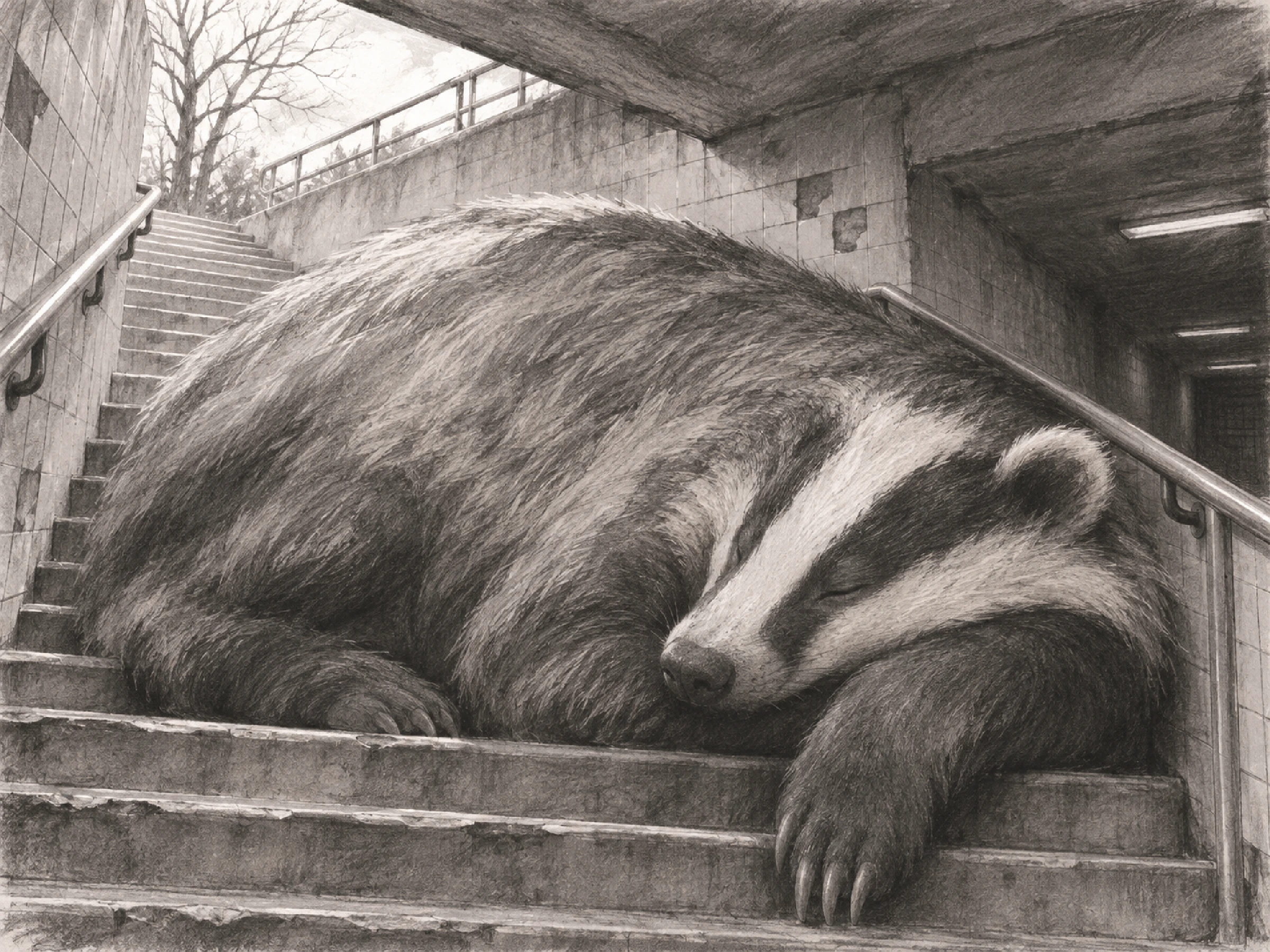
A Badger Filling the Underpass
An enormous badger sleeps curled across an underpass staircase. Smudged charcoal and erased light bring its bulky fur and the worn architecture into tactile conversation.
Remix this referenceA Badger Filling the Underpass
- Form language
- Build observed forms from broad, weighty masses; simplify minor detail while allowing irregularities to preserve specificity.
- Contour
- Alternate compressed charcoal edges with broken, rubbed-away boundaries; use brief sharp accents at structural turns.
- Mark-making
- Use the charcoal stick's side for broad sweeps and its tip for irregular directional strokes; vary pressure and spacing naturally.
- Surface rendering
- Smudge deposits into open half-tones, then lift light with kneaded eraser strokes; retain visible revisions and exposed paper tooth.
Priority
Make deposited, rubbed and erased charcoal visibly distinct within one observational drawing.
What to avoid & what to check
Exact prompt for this example
MODULE OWNERSHIP
subject: Subject count, type, stable proportions and landmarks, resting face geometry, hair shape, physical materials, garment construction and permanent marks. No emotion, movement, color assignment or rendering recipe.
expression: Facial soft-tissue displacement and pupil direction, muscle coordination, regional intensity, asymmetry and onset/peak/release. No head/body pose, stable appearance, skin color or rendering.
gesture: Head/neck/body/limb orientation, joint movement, support, contact and pose-caused occlusion using existing anatomy. No eye/pupil movement, emotion, identity, props inventory or camera.
props: Prop count, type, construction, physical material and scale relative to the subject. Holding/contact belongs to gesture, position to composition, color to palette.
scene: Environment elements, terrain, backdrop/floor presence and structural detail. No canvas positions, camera, lighting, assigned colors or render texture.
camera: Projection, focal-length impression, camera elevation/yaw/roll, viewing distance and crop. No actor pose, world placement, lighting or canvas aspect ratio.
composition: Normalized 0-100% canvas positions, scale in frame, depth/overlap, focal hierarchy and margins. No joint pose, camera projection, rendering, subject/prop inventory or emotion.
palette: Color anchors, hue/saturation/value ranges, colors assigned to parts and approximate color coverage. No illumination direction, shading algorithm, physical material or layout.
lighting: Light-source direction/softness/intensity, ambient illumination, physical shadow direction/length and highlight position. Absence of directional illumination is allowed. No shading technique, palette or material changes.
style: Reusable form abstraction, contour weight/taper/edge quality, medium and mark scale/density/direction, surface rendering and tonal transition technique. No fixed subject proportions, anatomy, identity, expression, pose, palette, light-source direction, camera or layout.
output: Image count, aspect ratio, size, file/alpha requirements and global lettering/logo/watermark restrictions. No background scenery, crop, style, identity or pose.

SUBJECT
inventory: One enormous European badger, large enough to fill an ordinary pedestrian underpass.
geometry: A wedge-shaped muzzle, rounded ears, heavy shoulders, low barrel-shaped body and short sturdy legs.
resting-face: Small eyes, a broad nose pad and a short mouth line beneath the muzzle define the natural face.
appearance: Coarse guard hairs cover dense underfur; paired facial bands extend from the muzzle toward the ears.

PRIORITY


AVOID


CHECK


EXPRESSION — ACTOR A
brows: The visible brow area rests smooth, without inward bunching.
lids: The visible eyelids meet softly in sleep, without squeezing.
cheeks: The visible cheek remains slack, without lifting or tightening.
nose: The nostrils remain unflared, with no wrinkling above the nose.
mouth: The visible mouth line stays softly closed, with neither corner pulled.
jaw: The jaw rests closed without clenching or dropping.
gaze: Closed lids conceal the pupils; no pupil direction is prescribed.
coordination: Soft lid closure accompanies an otherwise released face, without a smile or wince.
timing: Show settled release after the eyelids have closed into sustained sleep.

PRIORITY


AVOID


CHECK


GESTURE
head: A nestles its muzzle against the near foreleg, leaving one side of the face and one ear visible.
torso: A lies on its side in a loose crescent, its back forming a broad arch.
limbs: One forepaw hangs loosely over a stair edge; the remaining legs rest within the curl.
contact: The flank rests across several steps, and the hanging paw touches the next riser.

PRIORITY


AVOID


CHECK


PROPS
inventory: No separate props.
construction: No prop construction applies.

PRIORITY


AVOID


CHECK


SCENE
inventory: A municipal pedestrian underpass with concrete stairs, tiled retaining walls, tubular handrails and a tunnel opening.
structure: Stairs descend into a low rectangular passage; chipped nosings and occasional missing tiles suggest ordinary wear.

PRIORITY


AVOID


CHECK


CAMERA
projection: Natural rectilinear perspective with a moderately wide focal-length impression.
viewpoint: Look upward from the lower landing, slightly oblique to the stair run, without camera roll.
crop: Include the whole animal and enough surrounding architecture to establish the everyday setting.

PRIORITY


AVOID


CHECK


COMPOSITION
placement: The broad animal mass occupies the lower right, balanced by an open wedge of stairs at upper left.
depth: Foreground steps lead toward the paw; the body overlaps the far railing, with the tunnel receding beyond.
spacing: Read the paw against the adjacent handrail first, then the broad back and face; leave breathing room above.

PRIORITY


AVOID


CHECK


PALETTE
colors: A restrained range of charcoal black, warm ash gray and creamy paper white.
assignment: Mixed ash grays for the coat, charcoal black for facial bands, and pale warm grays for concrete and tiles.
balance: Middle grays dominate, with sparse deep blacks and generous paper-white passages.

PRIORITY


AVOID


CHECK


LIGHTING
sources: Broad overcast daylight enters from the stair opening above left; weak ambient light fills the passage.
shadows: Soft shadows extend down the stairs toward the tunnel, deepening beneath the animal.
highlights: Light catches the upper back, exposed ear rim, stair nosings and upper surfaces of the rails.

PRIORITY


AVOID


CHECK


STYLE GUIDE
form-language: Build observed forms from broad, weighty masses; simplify minor detail while allowing irregularities to preserve specificity.
contour: Alternate compressed charcoal edges with broken, rubbed-away boundaries; use brief sharp accents at structural turns.
mark-making: Use the charcoal stick's side for broad sweeps and its tip for irregular directional strokes; vary pressure and spacing naturally.
surface-rendering: Smudge deposits into open half-tones, then lift light with kneaded eraser strokes; retain visible revisions and exposed paper tooth.

PRIORITY
Make deposited, rubbed and erased charcoal visibly distinct within one observational drawing.

AVOID


CHECK


OUTPUT
format: One finished image, landscape 4:3, 2400 × 1800 pixels, opaque PNG.
restrictions: No lettering, logos or watermarks.

PRIORITY


AVOID


CHECK


FINAL INTEGRATION
subject + scene + composition: Familiar architectural references let the composition communicate the animal's extraordinary scale.
expression + gesture: The visible facial release and supported pose cooperate to make sustained sleep readable.
lighting + style: Erasure follows the established illumination, connecting the drawing process to the observed volumes.
Model information comes from image provenance. The same prompt may produce a different result.