Text to imageCharacterStyle guide
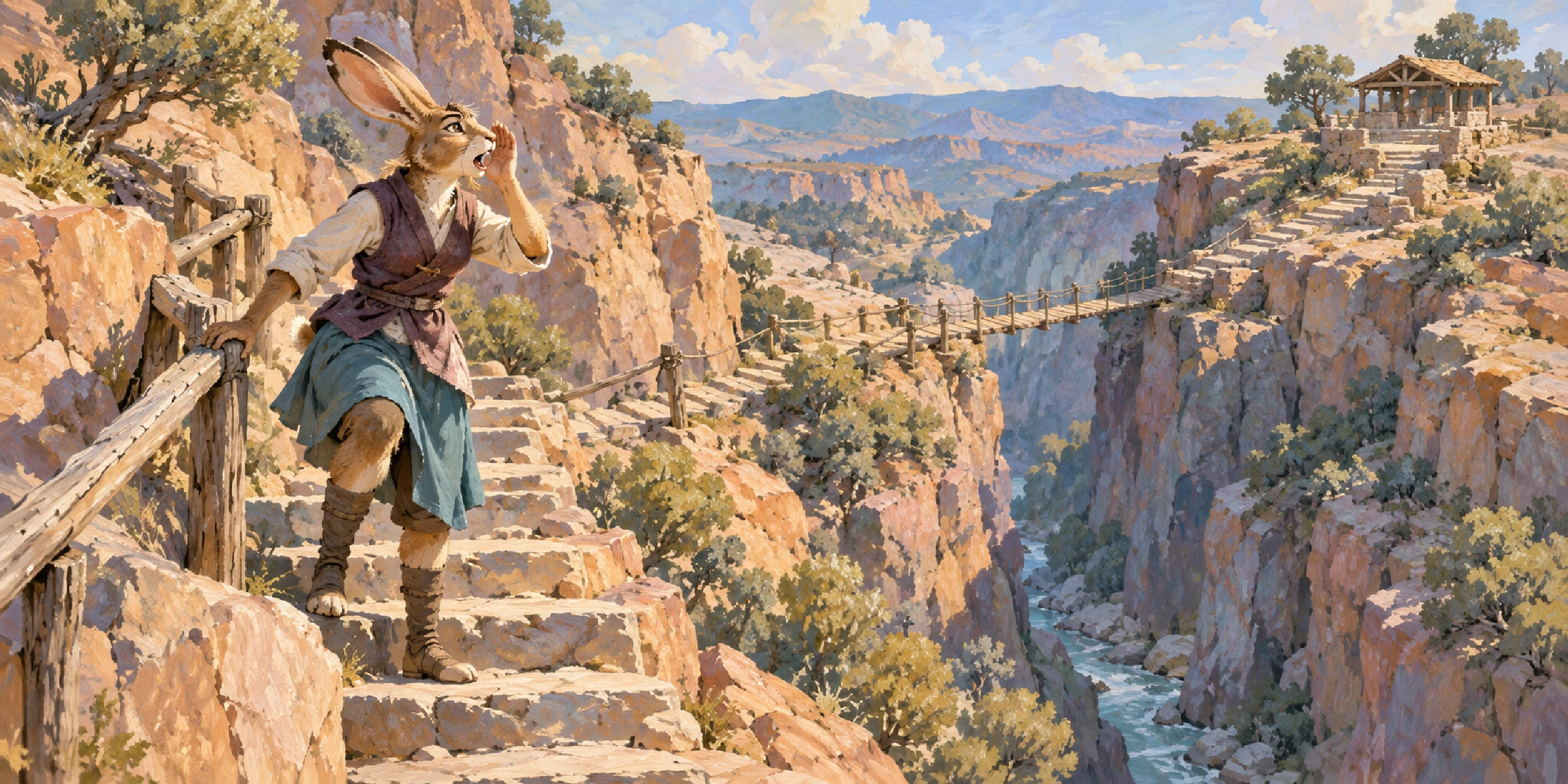
Hare Woman Calling Across the Ravine
A long-eared traveler calls across a ravine from its winding stairway. Opaque gouache brushwork carries a panoramic journey from her figure toward a distant shelter.
Remix this referenceHare Woman Calling Across the Ravine
- Form language
- Simplify forms into interlocking broad masses, using selective small notches to interrupt otherwise generous shapes.
- Contour
- Build broken contours from brush edges; alternate blunt opaque boundaries with lost edges and occasional tapered corrections.
- Mark-making
- Use loose gouache strokes with visible bristle splits, broad dragged swipes, and sparse smaller dabs; vary marks naturally with the form.
- Surface rendering
- Stack opaque patches over glimpses of earlier paint, shifting tone through adjacent strokes and occasional scumbled overlaps rather than uniform blending.
Priority
Preserve the visible opaque brushwork and spontaneous revisions of loose gouache.
What to avoid & what to check
Exact prompt for this example
MODULE OWNERSHIP
subject: Subject count, type, stable proportions and landmarks, resting face geometry, hair shape, physical materials, garment construction and permanent marks. No emotion, movement, color assignment or rendering recipe.
expression: Facial soft-tissue displacement and pupil direction, muscle coordination, regional intensity, asymmetry and onset/peak/release. No head/body pose, stable appearance, skin color or rendering.
gesture: Head/neck/body/limb orientation, joint movement, support, contact and pose-caused occlusion using existing anatomy. No eye/pupil movement, emotion, identity, props inventory or camera.
props: Prop count, type, construction, physical material and scale relative to the subject. Holding/contact belongs to gesture, position to composition, color to palette.
scene: Environment elements, terrain, backdrop/floor presence and structural detail. No canvas positions, camera, lighting, assigned colors or render texture.
camera: Projection, focal-length impression, camera elevation/yaw/roll, viewing distance and crop. No actor pose, world placement, lighting or canvas aspect ratio.
composition: Normalized 0-100% canvas positions, scale in frame, depth/overlap, focal hierarchy and margins. No joint pose, camera projection, rendering, subject/prop inventory or emotion.
palette: Color anchors, hue/saturation/value ranges, colors assigned to parts and approximate color coverage. No illumination direction, shading algorithm, physical material or layout.
lighting: Light-source direction/softness/intensity, ambient illumination, physical shadow direction/length and highlight position. Absence of directional illumination is allowed. No shading technique, palette or material changes.
style: Reusable form abstraction, contour weight/taper/edge quality, medium and mark scale/density/direction, surface rendering and tonal transition technique. No fixed subject proportions, anatomy, identity, expression, pose, palette, light-source direction, camera or layout.
output: Image count, aspect ratio, size, file/alpha requirements and global lettering/logo/watermark restrictions. No background scenery, crop, style, identity or pose.

SUBJECT
inventory: One adult anthropomorphic hare woman, an original traveling character; no other figures.
geometry: Lean torso, substantial haunches, long shins, compact muzzle, and elongated leaf-shaped ears with one notched tip.
resting-face: Wide-set eyes beneath shallow brow ridges, rounded cheek pads, a small triangular nose, and a split upper lip.
appearance: Short fur and a blunt forelock; a wool wrap vest over a linen tunic, divided walking skirt, and felt gaiters.

PRIORITY


AVOID


CHECK


EXPRESSION — ACTOR A
brows: Brows lift slightly toward their outer ends without a deep central furrow.
lids: Upper lids remain open; lower lids tighten lightly beneath the eyes.
cheeks: Cheek pads draw gently inward around the rounded calling mouth.
nose: Nostrils widen subtly while the bridge stays unwrinkled.
mouth: Lips form a broad open oval, with relaxed corners sustaining a clear call.
jaw: Jaw drops enough to open the call without stretching the mouth to a shout.
gaze: Pupils settle on the shelter across the ravine.
coordination: Steady eyes and restrained brow activity balance the stronger mouth action.
timing: Capture the sustained apex of one call, before the lips close for breath.

PRIORITY


AVOID


CHECK


GESTURE
head: Turn the head across the gap and lift the chin slightly; let the ears follow the turn naturally.
torso: Twist the upper torso away from the onward stair while keeping the pelvis balanced over the planted leg.
limbs: Cup one hand beside the mouth; extend the other to the railing, with the trailing foot on a higher step.
contact: The supporting palm rests on the rail and both feet meet their steps; keep the calling hand clear of the lips.

PRIORITY


AVOID


CHECK


PROPS
inventory: No separate props.
construction: No prop construction applies.

PRIORITY


AVOID


CHECK


SCENE
inventory: An open ravine with a cliff stair, sparse scrub, a narrow footbridge, and a small roofed shelter.
structure: The stair follows eroded rock shelves, crosses the cleft by the bridge, and continues to the shelter; timber rails mark exposed stretches.

PRIORITY


AVOID


CHECK


CAMERA
projection: Use a natural moderate-wide perspective, with gentle distance recession and little edge stretching.
viewpoint: Look slightly downward from near the traveler's chest height, with a three-quarter facial view and level roll.
crop: Show the complete figure within a broad environmental view; let the nearest rock shelf continue beyond the crop.

PRIORITY


AVOID


CHECK


COMPOSITION
placement: Place A in the left third at roughly half the image height; the shelter is a small destination near the upper right.
depth: Make the face and cupped hand the first read, then lead along the descending stair, overlapping bridge, and distant return path.
spacing: Leave a generous open interval across the ravine; stagger rock masses so the route unfolds rather than forming a continuous wall.

PRIORITY


AVOID


CHECK


PALETTE
colors: Use chalk apricot, muted aubergine, dusty turquoise, and warm cream, with restrained saturation overall.
assignment: Apricot belongs to rock, aubergine to the vest and deep clefts, turquoise to the tunic and distant air, cream to fur and sky.
balance: Let pale warm fields dominate, supported by broad cool passages and a few concentrated dark accents.

PRIORITY


AVOID


CHECK


LIGHTING
sources: Broad soft daylight enters from the upper left, with generous ambient light throughout the ravine.
shadows: Short softened shadows fall down and right; recesses remain legible rather than becoming black cavities.
highlights: Gentle highlights touch the upper ear rims, muzzle ridge, supporting knuckles, and exposed ledge tops.

PRIORITY


AVOID


CHECK


STYLE GUIDE
form-language: Simplify forms into interlocking broad masses, using selective small notches to interrupt otherwise generous shapes.
contour: Build broken contours from brush edges; alternate blunt opaque boundaries with lost edges and occasional tapered corrections.
mark-making: Use loose gouache strokes with visible bristle splits, broad dragged swipes, and sparse smaller dabs; vary marks naturally with the form.
surface-rendering: Stack opaque patches over glimpses of earlier paint, shifting tone through adjacent strokes and occasional scumbled overlaps rather than uniform blending.

PRIORITY
Preserve the visible opaque brushwork and spontaneous revisions of loose gouache.

AVOID


CHECK


OUTPUT
format: One finished image, 2:1 aspect ratio, 2400 × 1200 pixels, opaque PNG.
restrictions: No lettering, logos, signatures, or watermarks.

PRIORITY


AVOID


CHECK


FINAL INTEGRATION
expression + gesture + camera: Coordinate the facial view and hand clearance so the calling action remains readable.
scene + composition + style: Let environmental connections guide the visual journey while brush simplification preserves breathing room.
Model information comes from image provenance. The same prompt may produce a different result.