Text to imageProductStyle guide
Crescent Watering Can at the Nursery
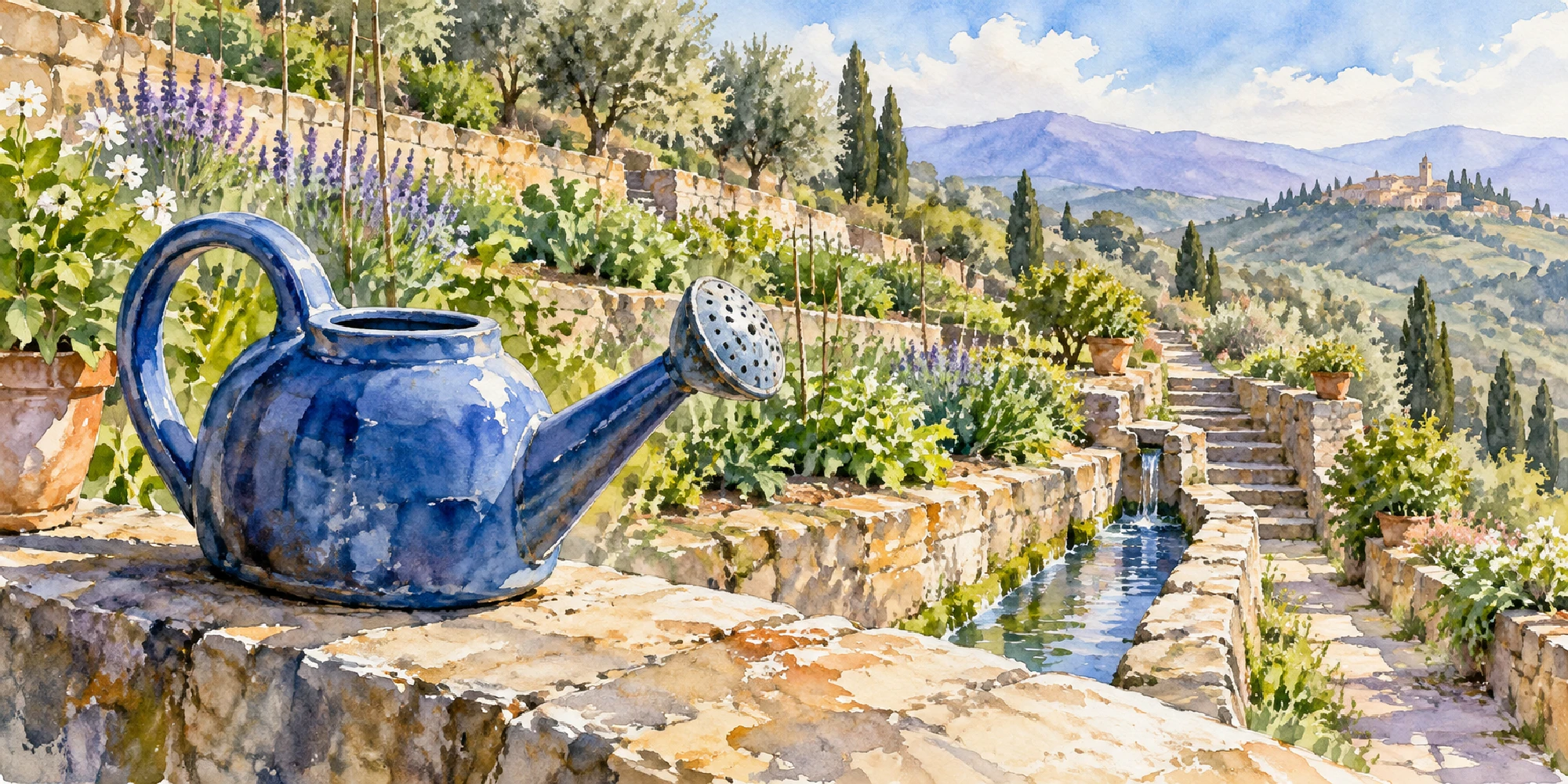
A crescent-shaped ceramic watering can overlooks a terraced nursery and its winding irrigation channel. Blooming watercolor and broken edges carry the eye from the product toward distant hills.
Remix this referenceCrescent Watering Can at the Nursery
- Form language
- Build recognizable volumes from generous connected brush shapes; simplify secondary detail into suggestive clustered strokes.
- Contour
- Use mostly unoutlined edges, alternating crisp wet-on-dry accents with feathered boundaries and deliberate paper breaks.
- Mark-making
- Lay broad wet washes, then add quick dry-brush skips and a few fluid strokes; allow spontaneous blooms to interrupt the brushwork.
- Surface rendering
- Model surfaces through transparent wash overlaps, pooled pigment and lifted passages; let tonal transitions breathe unevenly.
Priority
Keep expressive watercolor blooms and broken edges clearly visible.
What to avoid & what to check
Exact prompt for this example
MODULE OWNERSHIP
subject: Subject count, type, stable proportions and landmarks, resting face geometry, hair shape, physical materials, garment construction and permanent marks. No emotion, movement, color assignment or rendering recipe.
expression: Facial soft-tissue displacement and pupil direction, muscle coordination, regional intensity, asymmetry and onset/peak/release. No head/body pose, stable appearance, skin color or rendering.
gesture: Head/neck/body/limb orientation, joint movement, support, contact and pose-caused occlusion using existing anatomy. No eye/pupil movement, emotion, identity, props inventory or camera.
props: Prop count, type, construction, physical material and scale relative to the subject. Holding/contact belongs to gesture, position to composition, color to palette.
scene: Environment elements, terrain, backdrop/floor presence and structural detail. No canvas positions, camera, lighting, assigned colors or render texture.
camera: Projection, focal-length impression, camera elevation/yaw/roll, viewing distance and crop. No actor pose, world placement, lighting or canvas aspect ratio.
composition: Normalized 0-100% canvas positions, scale in frame, depth/overlap, focal hierarchy and margins. No joint pose, camera projection, rendering, subject/prop inventory or emotion.
palette: Color anchors, hue/saturation/value ranges, colors assigned to parts and approximate color coverage. No illumination direction, shading algorithm, physical material or layout.
lighting: Light-source direction/softness/intensity, ambient illumination, physical shadow direction/length and highlight position. Absence of directional illumination is allowed. No shading technique, palette or material changes.
style: Reusable form abstraction, contour weight/taper/edge quality, medium and mark scale/density/direction, surface rendering and tonal transition technique. No fixed subject proportions, anatomy, identity, expression, pose, palette, light-source direction, camera or layout.
output: Image count, aspect ratio, size, file/alpha requirements and global lettering/logo/watermark restrictions. No background scenery, crop, style, identity or pose.

SUBJECT
inventory: One original ceramic watering can; no human or animal subjects.
geometry: A squat crescent reservoir, high loop handle, oval filling mouth and tapered spout with a broad rose.
resting-face: No face or facial landmarks apply.
appearance: Glazed stoneware body and handle with a removable perforated metal rose; small handmade irregularities may vary.

PRIORITY


AVOID


CHECK


GESTURE
head: Head and neck channels have no control targets.
torso: Keep the can upright, with its filling mouth facing upward.
limbs: Limb and joint channels have no control targets.
contact: The can rests with its base supported by the stone work ledge.

PRIORITY


AVOID


CHECK


PROPS
inventory: No separate props.
construction: No prop construction applies.

PRIORITY


AVOID


CHECK


SCENE
inventory: A hillside nursery with a stone work ledge, planted terraces, an irrigation channel, steps and distant hills.
structure: Retaining walls support the beds; the channel bends beside a stair that connects the nursery levels.

PRIORITY


AVOID


CHECK


CAMERA
projection: Natural perspective with a moderate wide-angle impression and gentle depth expansion.
viewpoint: View across the ledge from just above its height, looking obliquely along the hillside with a level roll.
crop: Show the complete watering can within a broad environmental view; let the nearest ledge continue beyond the crop.

PRIORITY


AVOID


CHECK


COMPOSITION
placement: Set the can prominently in the left third; the channel and steps sweep across the middle toward the far right.
depth: The can overlaps the nearest beds; successive terrace walls lead into the open distance without obscuring its silhouette.
spacing: Read the can first, the winding route second, and the hills last; leave breathing room around the handle opening.

PRIORITY


AVOID


CHECK


PALETTE
colors: Ultramarine blue, sap green, raw sienna, pale lavender and creamy paper white.
assignment: Use ultramarine for the can, diluted blue-gray for its rose, sienna for masonry, green for planting and lavender for distance.
balance: Reserve the deepest saturation for the can; let the surrounding greens and earth hues stay airy and varied.

PRIORITY


AVOID


CHECK


LIGHTING
sources: Soft morning light enters from the upper right, with open-sky ambient illumination.
shadows: Broad, soft shadows fall to the lower left; where the can's base contacts the ledge, the shadow deepens.
highlights: A loose bright band follows the upper-right body curve, with a small glint on the rose rim.

PRIORITY


AVOID


CHECK


STYLE GUIDE
form-language: Build recognizable volumes from generous connected brush shapes; simplify secondary detail into suggestive clustered strokes.
contour: Use mostly unoutlined edges, alternating crisp wet-on-dry accents with feathered boundaries and deliberate paper breaks.
mark-making: Lay broad wet washes, then add quick dry-brush skips and a few fluid strokes; allow spontaneous blooms to interrupt the brushwork.
surface-rendering: Model surfaces through transparent wash overlaps, pooled pigment and lifted passages; let tonal transitions breathe unevenly.

PRIORITY
Keep expressive watercolor blooms and broken edges clearly visible.

AVOID


CHECK


OUTPUT
format: One finished image, 2:1 panoramic landscape, 2000 × 1000 pixels, opaque PNG.
restrictions: No lettering, logos, signatures or watermarks.

PRIORITY


AVOID


CHECK


FINAL INTEGRATION
subject + composition + style: Keep the product recognizable while allowing the watercolor language to remain as spontaneous as the surrounding landscape.
scene + camera + composition: Let the working environment provide a continuous visual journey beyond the featured product.
Model information comes from image provenance. The same prompt may produce a different result.