Text to imageCharacterStyle guide
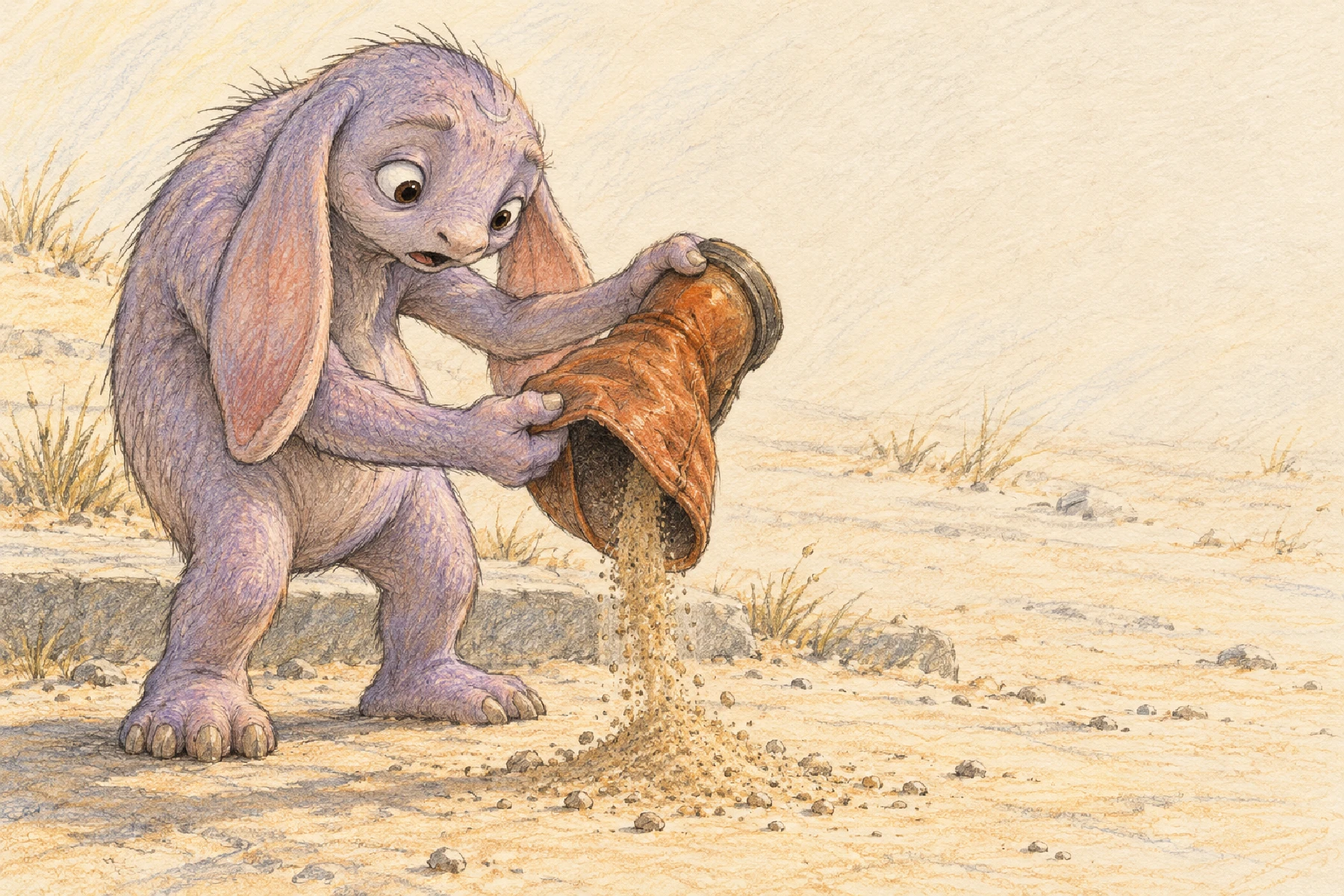
Long-Eared Creature Emptying a Boot
A long-eared creature watches an unexpectedly generous stream of sand pour from a boot. Rough pencil and loosely layered colored pencil give the spacious sketchbook scene a wry, tactile charm.
Remix this referenceLong-Eared Creature Emptying a Boot
- Form language
- Build volumes from loose rounded blocks interrupted by a few angular wedges; simplify small details into suggestive fragments.
- Contour
- Use rough pencil contours with pressure changes, occasional doubled searches, and open breaks; keep the drawing decisively resolved.
- Mark-making
- Layer colored-pencil strokes in loose directional bundles; let stray graphite ticks and irregular overlaps retain sketchbook immediacy.
- Surface rendering
- Let paper tooth interrupt pigment; use rubbed half-tones beside exposed paper and denser scribbled darks, with natural local variation.
Priority
Keep rough pencil and colored pencil visibly distinct throughout the finished drawing.
What to avoid & what to check
Exact prompt for this example
MODULE OWNERSHIP
subject: Subject count, type, stable proportions and landmarks, resting face geometry, hair shape, physical materials, garment construction and permanent marks. No emotion, movement, color assignment or rendering recipe.
expression: Facial soft-tissue displacement and pupil direction, muscle coordination, regional intensity, asymmetry and onset/peak/release. No head/body pose, stable appearance, skin color or rendering.
gesture: Head/neck/body/limb orientation, joint movement, support, contact and pose-caused occlusion using existing anatomy. No eye/pupil movement, emotion, identity, props inventory or camera.
props: Prop count, type, construction, physical material and scale relative to the subject. Holding/contact belongs to gesture, position to composition, color to palette.
scene: Environment elements, terrain, backdrop/floor presence and structural detail. No canvas positions, camera, lighting, assigned colors or render texture.
camera: Projection, focal-length impression, camera elevation/yaw/roll, viewing distance and crop. No actor pose, world placement, lighting or canvas aspect ratio.
composition: Normalized 0-100% canvas positions, scale in frame, depth/overlap, focal hierarchy and margins. No joint pose, camera projection, rendering, subject/prop inventory or emotion.
palette: Color anchors, hue/saturation/value ranges, colors assigned to parts and approximate color coverage. No illumination direction, shading algorithm, physical material or layout.
lighting: Light-source direction/softness/intensity, ambient illumination, physical shadow direction/length and highlight position. Absence of directional illumination is allowed. No shading technique, palette or material changes.
style: Reusable form abstraction, contour weight/taper/edge quality, medium and mark scale/density/direction, surface rendering and tonal transition technique. No fixed subject proportions, anatomy, identity, expression, pose, palette, light-source direction, camera or layout.
output: Image count, aspect ratio, size, file/alpha requirements and global lettering/logo/watermark restrictions. No background scenery, crop, style, identity or pose.

SUBJECT
inventory: One original, unclothed creature, actor A, with supple skin and sparse bristles.
geometry: A bean-shaped trunk, short sturdy legs, long forearms, and broad ribbon ears reaching the shoulders.
resting-face: A low wedge-shaped muzzle, widely spaced eyes, shallow brow pads, and a wide, thin-lipped mouth.
appearance: A small crescent scar crosses the forehead; ear rims are folded and the broad feet have blunt nails.

PRIORITY


AVOID


CHECK


EXPRESSION — ACTOR A
brows: Both brow pads rise, with the inner ends lifting slightly more.
lids: Upper lids lift while lower lids remain soft.
cheeks: Cheek pads remain loose without a smile lift.
nose: Nostril wings remain relaxed.
mouth: Lips separate into a small, uneven opening.
jaw: The jaw drops only slightly.
gaze: Both pupils turn down toward the sand.
coordination: The lifted upper face leads the quieter mouth response.
timing: Catch the first recognition of how much sand remains inside.

PRIORITY


AVOID


CHECK


GESTURE
head: The neck extends forward and the head tips down beside the boot.
torso: The torso bends forward slightly, supported by a broad, uneven stance.
limbs: One arm raises the boot heel while the other steadies its shaft; knees remain softly bent.
contact: Both hands grip the boot with its opening downward; both feet bear weight on the ground.

PRIORITY


AVOID


CHECK


PROPS
inventory: One ankle boot, long enough to span the creature's forearm.
construction: Supple leather shaft, rounded toe, thick sole, and an open cuff; minor wear may vary naturally.

PRIORITY


AVOID


CHECK


SCENE
inventory: A dry doorstep with one low stone step, loose sand, and a few wiry grass tufts.
structure: Sand streams from the boot opening onto a small heap on the shallow ground surface; the background has no further architecture.

PRIORITY


AVOID


CHECK


CAMERA
projection: A gentle perspective with the restrained depth of a normal lens.
viewpoint: View from waist height at a shallow three-quarter angle, with no roll.
crop: Show the entire creature, boot, and ground contact in a medium-wide view.

PRIORITY


AVOID


CHECK


COMPOSITION
placement: Group the creature in the left third; let the boot project inward and leave generous space to the right.
depth: The boot overlaps the torso, while the step sits behind the feet and the sand remains unobstructed.
spacing: Lead from the face to the boot opening and sand; separate these accents with airy intervals and loose margins.

PRIORITY


AVOID


CHECK


PALETTE
colors: Warm ivory, dusty lilac, burnt orange, and graphite gray form a muted palette.
assignment: Give the creature lilac skin, the boot burnt orange, and the step gray; keep sand and backdrop near ivory.
balance: Ivory dominates; lilac supplies the largest colored mass and orange forms a small, warmer accent.

PRIORITY


AVOID


CHECK


LIGHTING
sources: Broad, soft daylight arrives from the upper left with gentle ambient fill.
shadows: Short, soft shadows fall toward the lower right, with darker contact beneath the feet.
highlights: Subtle highlights touch the upper ear folds and the boot toe.

PRIORITY


AVOID


CHECK


STYLE GUIDE
form-language: Build volumes from loose rounded blocks interrupted by a few angular wedges; simplify small details into suggestive fragments.
contour: Use rough pencil contours with pressure changes, occasional doubled searches, and open breaks; keep the drawing decisively resolved.
mark-making: Layer colored-pencil strokes in loose directional bundles; let stray graphite ticks and irregular overlaps retain sketchbook immediacy.
surface-rendering: Let paper tooth interrupt pigment; use rubbed half-tones beside exposed paper and denser scribbled darks, with natural local variation.

PRIORITY
Keep rough pencil and colored pencil visibly distinct throughout the finished drawing.

AVOID


CHECK


OUTPUT
format: One finished image, landscape 3:2, 1800 × 1200 pixels, opaque PNG.
restrictions: No lettering, logos, signatures, or watermarks.

PRIORITY


AVOID


CHECK


FINAL INTEGRATION
expression + gesture + composition: Let facial acting and the supported action cooperate within the composition's open visual rhythm.
style + palette + lighting: Translate the palette and illumination through the chosen drawing marks without smoothing away their irregularity.
Model information comes from image provenance. The same prompt may produce a different result.