Text to imageAnimationStyle guide
Launching a Paper Cicada
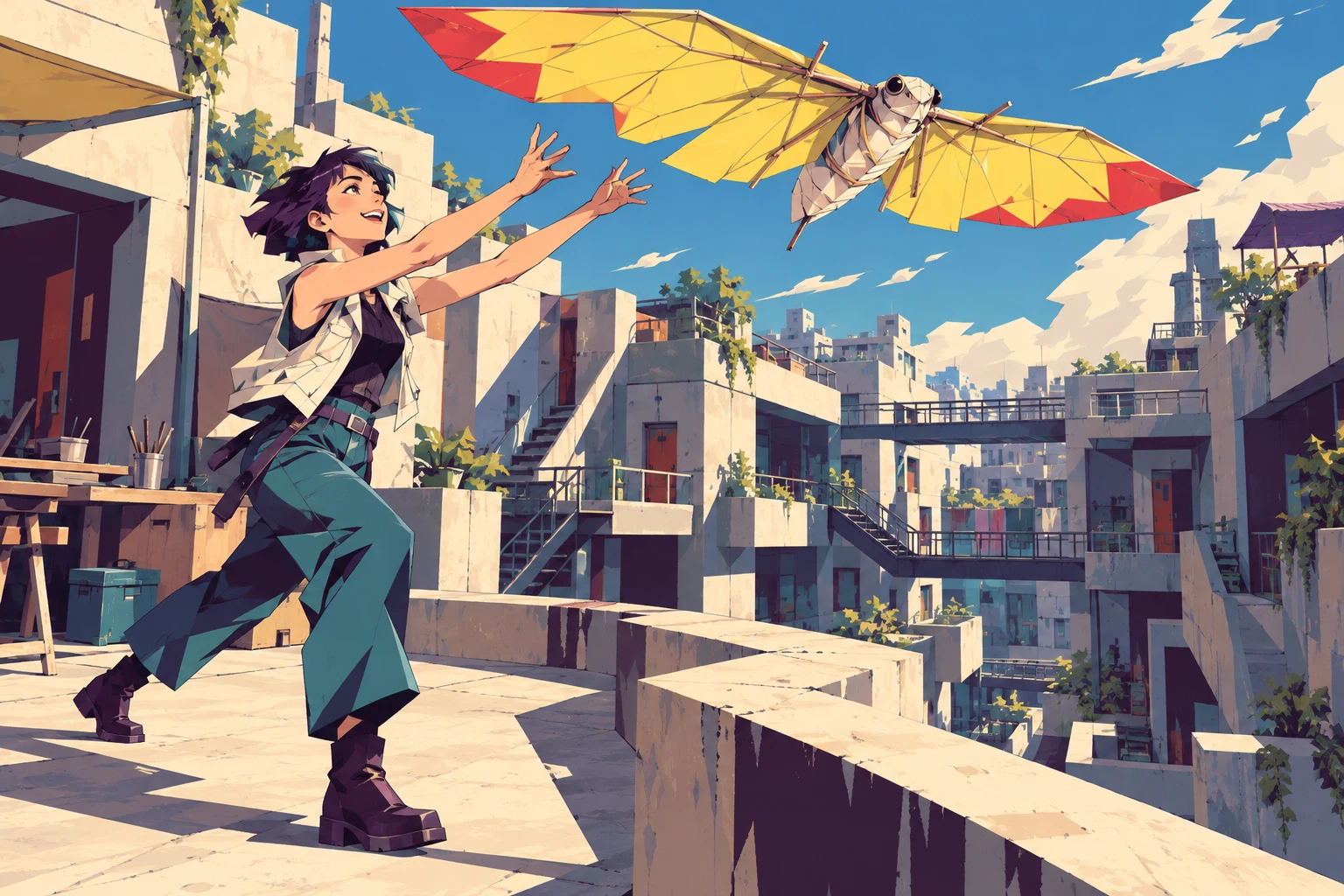
On a terrace surrounded by layered rooftops, a maker launches an enormous paper cicada. Newly opened hands, a bright expression and a bold wing silhouette hold the instant of departure.
Remix this referenceLaunching a Paper Cicada
- Form language
- Abstract forms into interlocking wedges, triangles and angular facets; let broad planes alternate with abrupt notches.
- Contour
- Use strong exterior line-weight contrast, tapering into sharp points; keep interior cuts short, crisp and selectively broken.
- Mark-making
- Cluster small angular facets and sharp strokes at transitions, leaving clean planes unmarked; vary stroke length and spacing naturally.
- Surface rendering
- Build surfaces from a small set of sharply separated tonal planes instead of gradients, allowing occasional abrupt value jumps.
Priority
Rendering medium: 2D angular Japanese anime graphic illustration; formal rendering reference: TRIGGER · 2010s · Promare (2019)
What to avoid & what to check
Exact prompt for this example
MODULE OWNERSHIP
subject: Subject count, type, stable proportions and landmarks, resting face geometry, hair shape, physical materials, garment construction and permanent marks. No emotion, movement, color assignment or rendering recipe.
expression: Facial soft-tissue displacement and pupil direction, muscle coordination, regional intensity, asymmetry and onset/peak/release. No head/body pose, stable appearance, skin color or rendering.
gesture: Head/neck/body/limb orientation, joint movement, support, contact and pose-caused occlusion using existing anatomy. No eye/pupil movement, emotion, identity, props inventory or camera.
props: Prop count, type, construction, physical material and scale relative to the subject. Holding/contact belongs to gesture, position to composition, color to palette.
scene: Environment elements, terrain, backdrop/floor presence and structural detail. No canvas positions, camera, lighting, assigned colors or render texture.
camera: Projection, focal-length impression, camera elevation/yaw/roll, viewing distance and crop. No actor pose, world placement, lighting or canvas aspect ratio.
composition: Normalized 0-100% canvas positions, scale in frame, depth/overlap, focal hierarchy and margins. No joint pose, camera projection, rendering, subject/prop inventory or emotion.
palette: Color anchors, hue/saturation/value ranges, colors assigned to parts and approximate color coverage. No illumination direction, shading algorithm, physical material or layout.
lighting: Light-source direction/softness/intensity, ambient illumination, physical shadow direction/length and highlight position. Absence of directional illumination is allowed. No shading technique, palette or material changes.
style: Reusable form abstraction, contour weight/taper/edge quality, medium and mark scale/density/direction, surface rendering and tonal transition technique. No fixed subject proportions, anatomy, identity, expression, pose, palette, light-source direction, camera or layout.
output: Image count, aspect ratio, size, file/alpha requirements and global lettering/logo/watermark restrictions. No background scenery, crop, style, identity or pose.

SUBJECT
inventory: One adult woman, an original rooftop model maker; no other people or living creatures.
geometry: Compact, wiry build with long forearms, broad cheekbones and a short squared chin.
resting-face: Straight resting brows, almond-shaped eye openings, a short nose bridge and a broad upper-lip bow.
appearance: Cropped hair forms stepped locks behind the ears; a sleeveless canvas work jacket covers a knit top, with roomy trousers and ankle boots.

PRIORITY


AVOID


CHECK


EXPRESSION — ACTOR A
brows: Outer brow ends rise gently while the inner ends remain relaxed.
lids: Upper lids open; lower lids tighten slightly beneath the lifted cheeks.
cheeks: Both cheeks lift, with the right cheek slightly higher.
nose: Keep the nose relaxed without wrinkling or nostril flare.
mouth: An open smile shows a narrow strip of upper teeth; the right corner rises higher.
jaw: The jaw releases into a small, easy opening.
gaze: Pupils turn upward and to her right toward the paper cicada.
coordination: Cheek lift and mouth-corner lift work together while the brows stay unknitted.
timing: Hold the bright apex just before the smile begins to settle.

PRIORITY


AVOID


CHECK


GESTURE
head: A extends her neck and tips her chin upward, with her head turned slightly to her right.
torso: Her torso reaches forward over a bent front knee, continuing the upward launch through her shoulders.
limbs: Both arms extend upward and outward; fingers uncurl, the front foot stays planted and the rear heel lifts.
contact: Her palms have just cleared the glider's underside; both hands remain visibly separate from it.

PRIORITY


AVOID


CHECK


PROPS
inventory: One handmade cicada-shaped glider, with a wingspan about twice the woman's outstretched arm span.
construction: Stiff folded paper wings attach to a slender bamboo keel; pleated wing roots and a tapered paper abdomen establish the insect shape.

PRIORITY


AVOID


CHECK


SCENE
inventory: A rooftop launch terrace opens into a deep residential atrium with stepped roofs, exterior stairs and connecting footbridges.
structure: A low parapet has a broad opening; recessed doors and projecting landings give the surrounding blocks an inhabited, irregular rhythm.

PRIORITY


AVOID


CHECK


CAMERA
projection: Perspective with a mild wide-angle, roughly 35 mm impression and clear recession without extreme stretching.
viewpoint: View from waist height, looking obliquely across the terrace with a slight upward pitch and no roll.
crop: A medium-wide full-body view includes the complete hands, feet and wing tips, with surrounding architecture still visible.

PRIORITY


AVOID


CHECK


COMPOSITION
placement: The woman fills the left third at substantial scale; the glider extends across the upper middle toward open space on the right.
depth: A near parapet overlaps a lower corner; roof edges form successive layers, with small bridges visible through their gaps.
spacing: Face and hands lead attention into the wing silhouette; generous space beyond the wing tips keeps its outline distinct.

PRIORITY


AVOID


CHECK


PALETTE
colors: Use ink plum, acid yellow, vermilion, warm ivory and muted teal, with the highest saturation reserved for yellow and vermilion.
assignment: Yellow wings have vermilion tips; skin and masonry are warm ivory, workwear is teal, and hair, trousers and deep recesses are plum.
balance: Broad ivory and teal areas support a concentrated yellow accent, sparse vermilion and a smaller share of deep plum.

PRIORITY


AVOID


CHECK


LIGHTING
sources: Moderately hard sunlight enters from high left, supported by broad ambient light from the open sky.
shadows: Terrace shadows fall toward the right and rear; contact shadows stay compact beneath the planted boot and parapet.
highlights: Highlights sit on left-facing cheek and hand surfaces and along the glider's upper-left paper edges.

PRIORITY


AVOID


CHECK


STYLE GUIDE
form-language: Abstract forms into interlocking wedges, triangles and angular facets; let broad planes alternate with abrupt notches.
contour: Use strong exterior line-weight contrast, tapering into sharp points; keep interior cuts short, crisp and selectively broken.
mark-making: Cluster small angular facets and sharp strokes at transitions, leaving clean planes unmarked; vary stroke length and spacing naturally.
surface-rendering: Build surfaces from a small set of sharply separated tonal planes instead of gradients, allowing occasional abrupt value jumps.

PRIORITY
Rendering medium: 2D angular Japanese anime graphic illustration; formal rendering reference: TRIGGER · 2010s · Promare (2019)

AVOID


CHECK


OUTPUT
format: Produce one image at 1536 × 1024 pixels in a 3:2 aspect ratio.
restrictions: Deliver an opaque PNG without lettering, logos or watermarks.

PRIORITY


AVOID


CHECK
Art direction
트리거 / TRIGGER · 2010s · 프로메어(2019) / Promare (2019) ↗- Abstract form surfaces into wedges, triangles and angular facets
- Strong exterior weight contrast with short sharp interior cuts
- Small angular facets and sharp marks, with no marks in clean planes
- A small set of sharply separated tonal planes in place of gradients
Model information comes from image provenance. The same prompt may produce a different result.