Text to imageAnimationStyle guide
A Street Inside a Fallen Tower
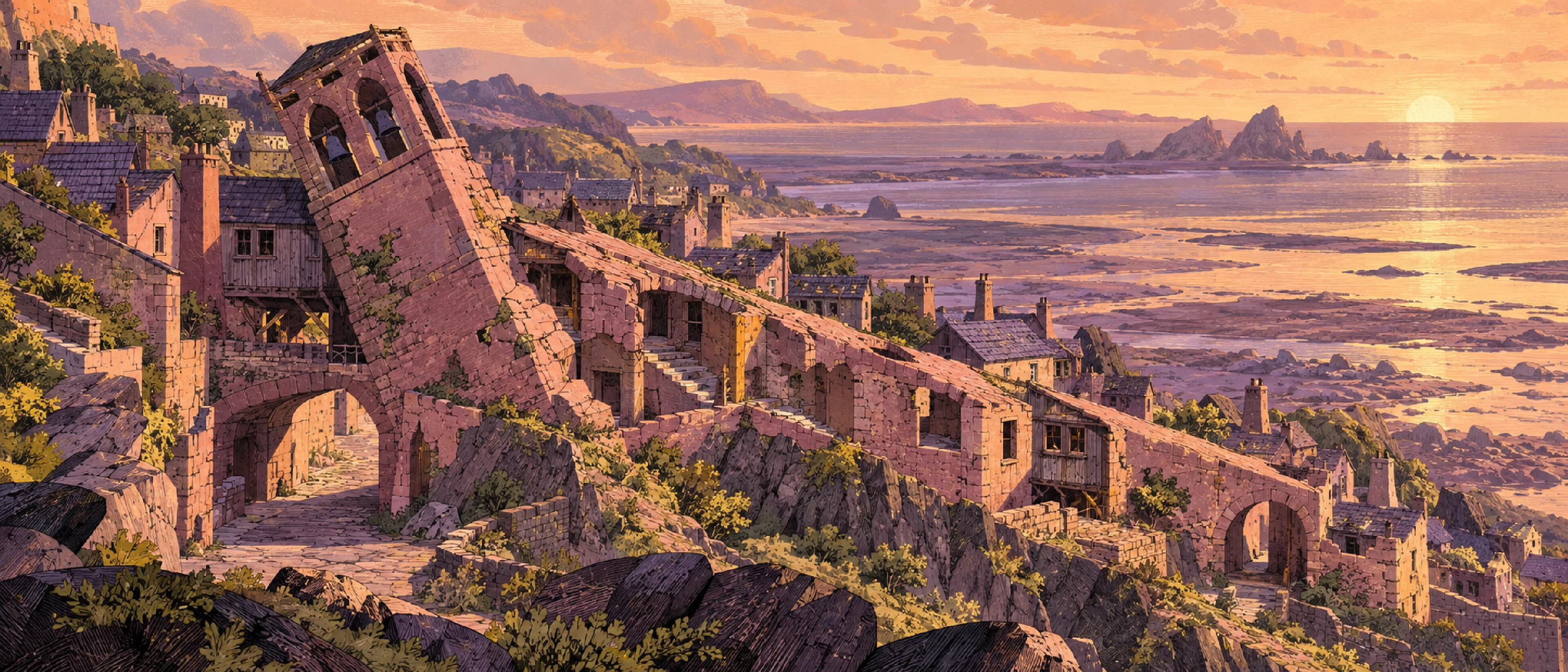
A fallen coastal bell tower has become a covered street. Steps and little houses glimpsed through its broken wall lead toward an apricot sea.
Remix this referenceA Street Inside a Fallen Tower
- Form language
- Abstract forms into interlocking angular planes with slightly skewed internal divisions; let minor shapes vary within this shared planar language.
- Contour
- Use irregular carved-looking straight segments and angular turns, with pressure changes and occasional broken edges instead of uniform outlines.
- Mark-making
- Gather short parallel hatches into loose directional groups; add a few dry scratches, allowing spacing and stroke length to vary naturally.
- Surface rendering
- Build flat printed planes with restrained paper tooth and hatched tonal regions; use stepped value changes rather than continuous volume modeling.
Priority
Rendering medium: 2D woodcut-print animated-film illustration; formal rendering reference: Cartoon Saloon · 2020s · Wolfwalkers (2020), town sequences
What to avoid & what to check
Exact prompt for this example
MODULE OWNERSHIP
subject: Subject count, type, stable proportions and landmarks, resting face geometry, hair shape, physical materials, garment construction and permanent marks. No emotion, movement, color assignment or rendering recipe.
expression: Facial soft-tissue displacement and pupil direction, muscle coordination, regional intensity, asymmetry and onset/peak/release. No head/body pose, stable appearance, skin color or rendering.
gesture: Head/neck/body/limb orientation, joint movement, support, contact and pose-caused occlusion using existing anatomy. No eye/pupil movement, emotion, identity, props inventory or camera.
props: Prop count, type, construction, physical material and scale relative to the subject. Holding/contact belongs to gesture, position to composition, color to palette.
scene: Environment elements, terrain, backdrop/floor presence and structural detail. No canvas positions, camera, lighting, assigned colors or render texture.
camera: Projection, focal-length impression, camera elevation/yaw/roll, viewing distance and crop. No actor pose, world placement, lighting or canvas aspect ratio.
composition: Normalized 0-100% canvas positions, scale in frame, depth/overlap, focal hierarchy and margins. No joint pose, camera projection, rendering, subject/prop inventory or emotion.
palette: Color anchors, hue/saturation/value ranges, colors assigned to parts and approximate color coverage. No illumination direction, shading algorithm, physical material or layout.
lighting: Light-source direction/softness/intensity, ambient illumination, physical shadow direction/length and highlight position. Absence of directional illumination is allowed. No shading technique, palette or material changes.
style: Reusable form abstraction, contour weight/taper/edge quality, medium and mark scale/density/direction, surface rendering and tonal transition technique. No fixed subject proportions, anatomy, identity, expression, pose, palette, light-source direction, camera or layout.
output: Image count, aspect ratio, size, file/alpha requirements and global lettering/logo/watermark restrictions. No background scenery, crop, style, identity or pose.

SUBJECT
inventory: No discrete character or object subjects.
geometry: No separate subject geometry applies.
resting-face: No faces are visible.
appearance: No separate character appearance applies.

PRIORITY


AVOID


CHECK


PROPS
inventory: No separate props.
construction: No prop construction applies.

PRIORITY


AVOID


CHECK


SCENE
inventory: A fallen masonry bell tower forms a covered street on a coastal hillside, among attached houses, scrub, tidal flats and open sea.
structure: The square shaft lies along the slope. Its broken side reveals steps through crosswall openings; former windows lead into timber homes, and the hollow belfry opens seaward.

PRIORITY


AVOID


CHECK


CAMERA
projection: Use gently expanded perspective with a moderate wide-lens impression and restrained convergence.
viewpoint: Look obliquely across the architecture from an elevated offshore viewpoint, with a level horizon.
crop: Use a distant panoramic view showing both passage ends and enough surrounding coast to explain the setting.

PRIORITY


AVOID


CHECK


COMPOSITION
placement: The passage spans roughly 70% of the canvas width, from the lower-left third toward a smaller outlet in the right third.
depth: Broken masonry overlaps the exposed steps; successive openings draw attention from the broad entry to the sea beyond the outlet.
spacing: Keep generous sky and tidal-flat intervals around the dense architecture; preserve clear gaps through the passage.

PRIORITY


AVOID


CHECK


PALETTE
colors: Use dusty rose, storm violet, pale apricot and muted yellow-green, with deep plum as the darkest anchor.
assignment: Give masonry dusty rose, roofs and tidal flats violet, sea and sky apricot, scrub yellow-green, and recesses deep plum.
balance: Let rose and apricot dominate; keep violet broad but subdued, with yellow-green appearing as sparse accents.

PRIORITY


AVOID


CHECK


LIGHTING
sources: Broad, soft late-afternoon sunlight enters from the upper left, supported by gentle open-sky ambient light.
shadows: Long shadows extend toward the lower right; sheltered passage sections remain readable in ambient light.
highlights: Keep highlights broad and quiet on upper-left-facing masonry edges and exposed stair lips.

PRIORITY


AVOID


CHECK


STYLE GUIDE
form-language: Abstract forms into interlocking angular planes with slightly skewed internal divisions; let minor shapes vary within this shared planar language.
contour: Use irregular carved-looking straight segments and angular turns, with pressure changes and occasional broken edges instead of uniform outlines.
mark-making: Gather short parallel hatches into loose directional groups; add a few dry scratches, allowing spacing and stroke length to vary naturally.
surface-rendering: Build flat printed planes with restrained paper tooth and hatched tonal regions; use stepped value changes rather than continuous volume modeling.

PRIORITY
Rendering medium: 2D woodcut-print animated-film illustration; formal rendering reference: Cartoon Saloon · 2020s · Wolfwalkers (2020), town sequences

AVOID


CHECK


OUTPUT
format: Create one finished 21:9 image, 3360 × 1440 pixels, as an opaque PNG.
restrictions: No lettering, logos, signatures or watermarks.

PRIORITY


AVOID


CHECK
Art direction
카툰 살롱 / Cartoon Saloon · 2020s · 울프워커스(2020)의 도시 장면 / Wolfwalkers (2020), town sequences ↗- Transfer the angular planar abstraction of the town sequences to generic form surfaces
- Slightly irregular straight and angular contours resembling carved lines
- Short parallel hatch groups and restrained scratched marks
- Flat planes with limited paper texture and hatched tonal regions, without continuous modeling
Model information comes from image provenance. The same prompt may produce a different result.