Text to imageIllustrationStyle guide
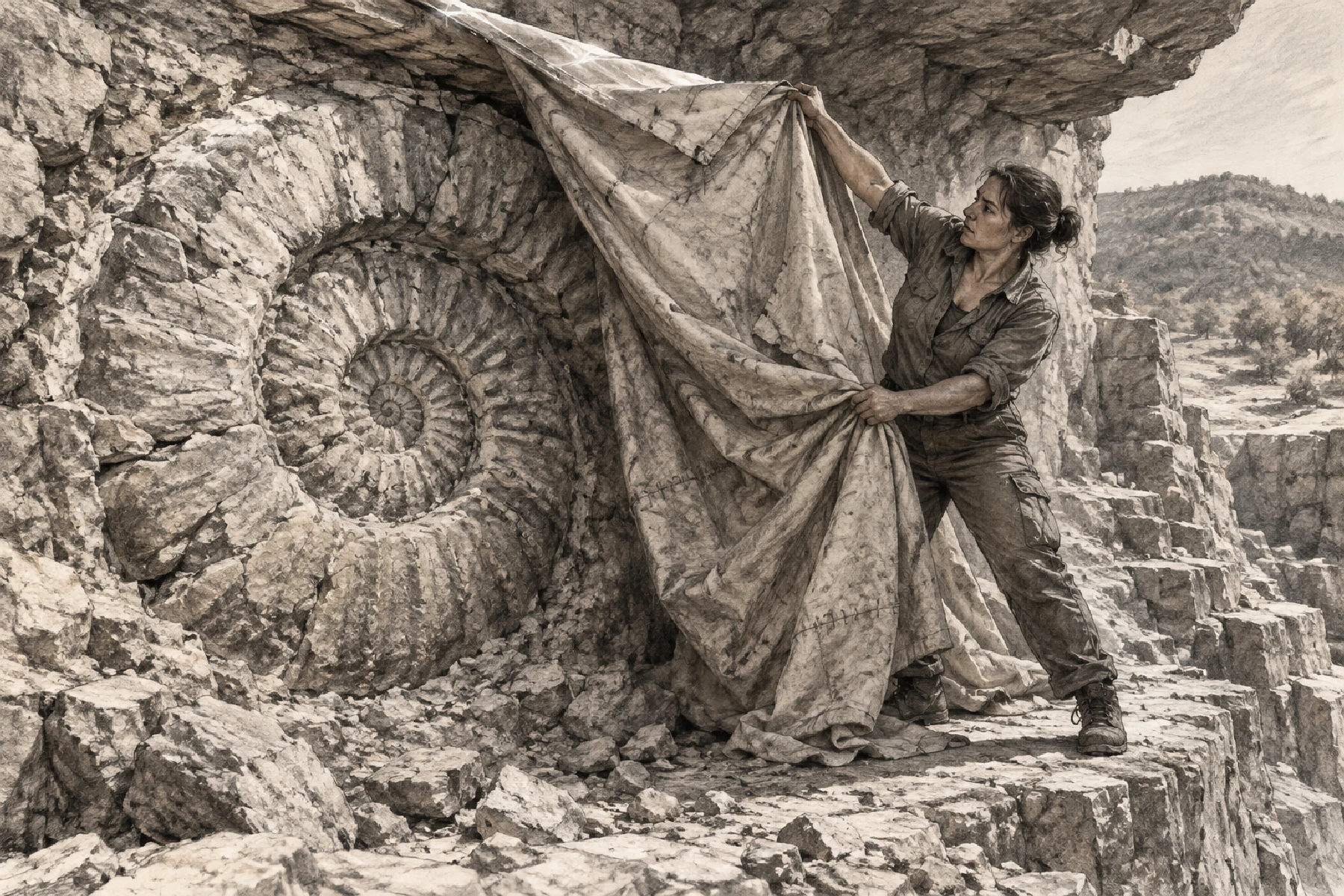
Woman Uncovering a Fossil Wall
A woman pulls a heavy covering from a quarry wall, revealing an enormous spiral fossil. Rubbed charcoal darkness and erased light convey the weight of the cloth and the age of the rock.
Remix this referenceWoman Uncovering a Fossil Wall
- Form language
- Build observed volumes from broad interlocking masses, allowing irregular silhouettes and selective detail; minor shapes may vary naturally.
- Contour
- Use broken, pressure-sensitive edges: compressed charcoal accents alternate with boundaries that dissolve into adjacent tone.
- Mark-making
- Lay charcoal on its side in broad sweeps, interrupting them with searching tip strokes and uneven finger-drag smudges.
- Surface rendering
- Rub tones into toothy paper, then lift light with a kneaded eraser; retain ghost marks and dusty transitions beside sharp recovered accents.
Priority
Keep observational charcoal visibly shaped by smudging and erased light.
What to avoid & what to check
Exact prompt for this example
MODULE OWNERSHIP
subject: Subject count, type, stable proportions and landmarks, resting face geometry, hair shape, physical materials, garment construction and permanent marks. No emotion, movement, color assignment or rendering recipe.
expression: Facial soft-tissue displacement and pupil direction, muscle coordination, regional intensity, asymmetry and onset/peak/release. No head/body pose, stable appearance, skin color or rendering.
gesture: Head/neck/body/limb orientation, joint movement, support, contact and pose-caused occlusion using existing anatomy. No eye/pupil movement, emotion, identity, props inventory or camera.
props: Prop count, type, construction, physical material and scale relative to the subject. Holding/contact belongs to gesture, position to composition, color to palette.
scene: Environment elements, terrain, backdrop/floor presence and structural detail. No canvas positions, camera, lighting, assigned colors or render texture.
camera: Projection, focal-length impression, camera elevation/yaw/roll, viewing distance and crop. No actor pose, world placement, lighting or canvas aspect ratio.
composition: Normalized 0-100% canvas positions, scale in frame, depth/overlap, focal hierarchy and margins. No joint pose, camera projection, rendering, subject/prop inventory or emotion.
palette: Color anchors, hue/saturation/value ranges, colors assigned to parts and approximate color coverage. No illumination direction, shading algorithm, physical material or layout.
lighting: Light-source direction/softness/intensity, ambient illumination, physical shadow direction/length and highlight position. Absence of directional illumination is allowed. No shading technique, palette or material changes.
style: Reusable form abstraction, contour weight/taper/edge quality, medium and mark scale/density/direction, surface rendering and tonal transition technique. No fixed subject proportions, anatomy, identity, expression, pose, palette, light-source direction, camera or layout.
output: Image count, aspect ratio, size, file/alpha requirements and global lettering/logo/watermark restrictions. No background scenery, crop, style, identity or pose.

SUBJECT
inventory: One adult woman working as a field conservator; no other living figures.
geometry: A compact, sturdy build with substantial forearms, a broad nose, and a rounded chin.
resting-face: Low, straight brows, deep-set eyes, and a broad mouth with a fuller lower lip establish her resting face.
appearance: Hair forms a small nape knot; she wears a cotton work shirt with rolled sleeves, loose trousers, and leather boots.

PRIORITY


AVOID


CHECK


EXPRESSION — ACTOR A
brows: The inner brows draw together slightly, with one sitting a little lower.
lids: Upper lids narrow modestly while lower lids stay gently firm.
cheeks: Cheeks tighten faintly without lifting into a smile.
nose: The nose remains relaxed, with no wrinkle or nostril flare.
mouth: Lips meet lightly, with one corner tucked inward a little.
jaw: The jaw settles firmly without a conspicuous clench.
gaze: Pupils track the canvas edge beside her hand.
coordination: Upper-face concentration leads; the mouth carries only a trace of effort.
timing: Hold the apex of sustained effort rather than a sudden reaction.

PRIORITY


AVOID


CHECK


GESTURE
head: A turns her head toward her raised hand, extending her neck slightly while keeping her face visible.
torso: Her torso twists away from the wall and settles backward over the rear leg against the cloth's resistance.
limbs: The left arm reaches high, the right elbow draws toward the waist, and bent knees support a staggered stance.
contact: Her left hand grips the upper canvas fold; her right gathers the lower cloth, with both boots planted on the ledge.

PRIORITY


AVOID


CHECK


PROPS
inventory: One heavy canvas covering, broad enough to conceal a wall area taller than the woman.
construction: Coarse woven fabric with a reinforced outer hem, a few old repairs, and enough weight to form deep folds.

PRIORITY


AVOID


CHECK


SCENE
inventory: An open quarry with an overhanging rock wall, a narrow working ledge, broken stone, and a distant scrub-covered ridge.
structure: A monumental ammonite fossil remains embedded in the layered wall; irregular quarry steps descend through a cleft.

PRIORITY


AVOID


CHECK


CAMERA
projection: Natural perspective with a moderate wide-angle impression and restrained edge distortion.
viewpoint: Observe from across the ledge at the woman's chest height, oblique to the wall, with a level horizon.
crop: A medium-wide, full-figure view includes the fossil and enough surrounding quarry to feel enclosed by rock.

PRIORITY


AVOID


CHECK


COMPOSITION
placement: The woman occupies the right third at roughly half the frame height; the uncovered spiral spreads across the left.
depth: Cropped foreground stone leads to the figure and wall, while a narrow opening reveals the distant ridge.
spacing: The hand-and-canvas junction leads the eye to the spiral; leave breathing space between the face and fossil.

PRIORITY


AVOID


CHECK


PALETTE
colors: Use paper ivory, warm ash gray, graphite gray, and near-black in a nearly achromatic range.
assignment: Ivory and ash belong to exposed rock and canvas; graphite groups the clothing, with near-black in the deepest recesses.
balance: Let middle grays dominate, preserving generous pale passages and a few concentrated dark anchors.

PRIORITY


AVOID


CHECK


LIGHTING
sources: Broad daylight enters from upper left, with weaker ambient light reaching beneath the overhang.
shadows: Soft-edged shadows fall down and right, becoming denser beneath the overhang and inside deep cloth folds.
highlights: Light catches the upper canvas ridge, the working knuckles, and the projecting rim of the fossil.

PRIORITY


AVOID


CHECK


STYLE GUIDE
form-language: Build observed volumes from broad interlocking masses, allowing irregular silhouettes and selective detail; minor shapes may vary naturally.
contour: Use broken, pressure-sensitive edges: compressed charcoal accents alternate with boundaries that dissolve into adjacent tone.
mark-making: Lay charcoal on its side in broad sweeps, interrupting them with searching tip strokes and uneven finger-drag smudges.
surface-rendering: Rub tones into toothy paper, then lift light with a kneaded eraser; retain ghost marks and dusty transitions beside sharp recovered accents.

PRIORITY
Keep observational charcoal visibly shaped by smudging and erased light.

AVOID


CHECK


OUTPUT
format: One finished illustration, landscape 3:2, 1800 × 1200 pixels, opaque PNG; no lettering, logos, or watermarks.
restrictions: One finished illustration, landscape 3:2, 1800 × 1200 pixels, opaque PNG; no lettering, logos, or watermarks.

PRIORITY


AVOID


CHECK


FINAL INTEGRATION
gesture + props + composition: Coordinate fabric construction, hand contact, and overlap so the pulling action remains immediately readable.
lighting + style: Let the lighting guide where charcoal accumulates and where erasure retrieves the paper.
Model information comes from image provenance. The same prompt may produce a different result.