Text to imageCharacterStyle guide
A Fold-Eared Porter and the Unrolling Carpet
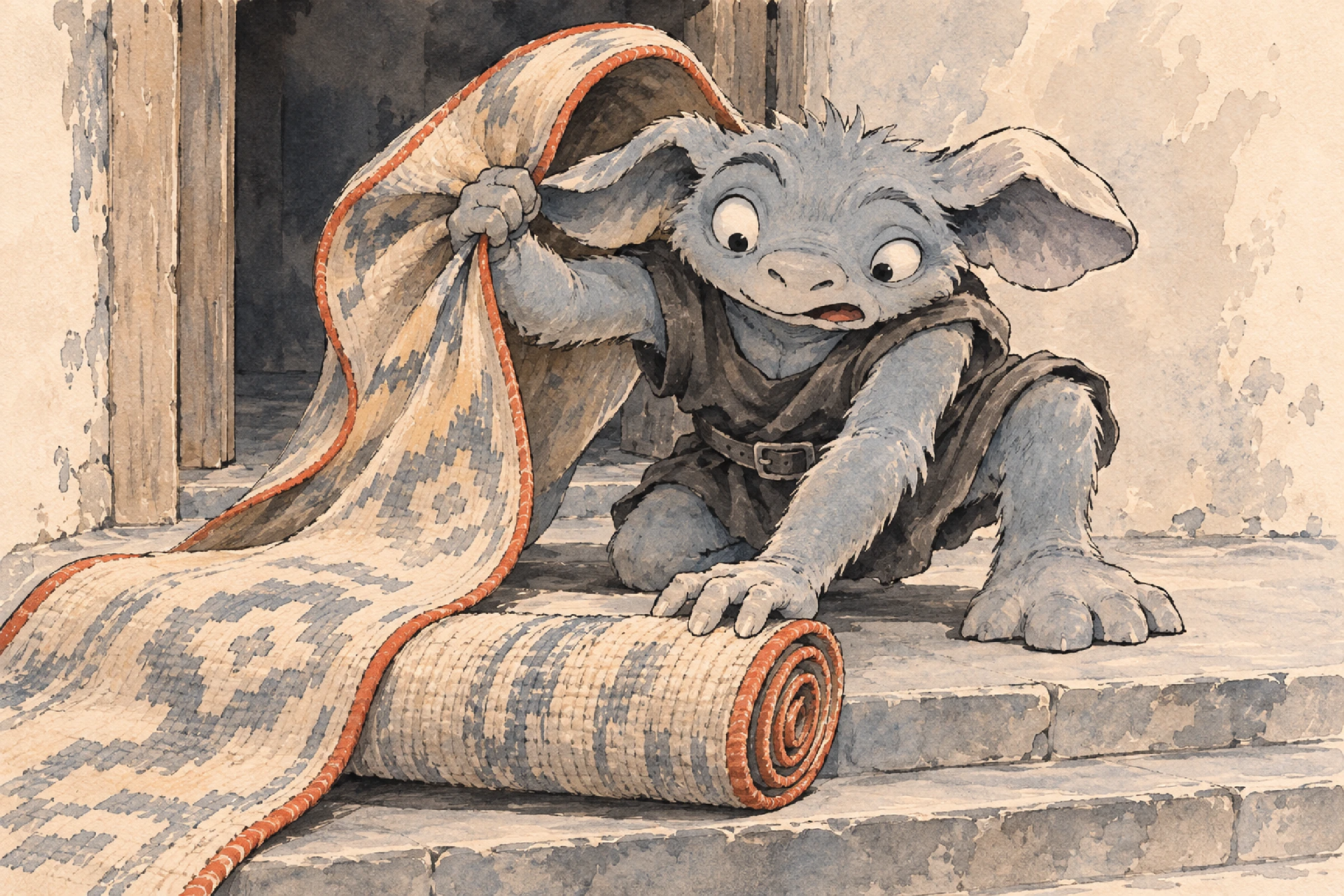
A small fold-eared porter grapples with a carpet unrolling across a threshold. Overlapping limbs and a great loop of cloth become a narrative character illustration in broken ink lines and spreading washes.
Remix this referenceA Fold-Eared Porter and the Unrolling Carpet
- Form language
- Simplify volumes into elastic silhouettes and folded wedges, letting minor shape irregularities vary within the same brisk drawing language.
- Contour
- Use springy dip-pen lines that swell under pressure and break at selected edges; retain occasional exploratory double strokes.
- Mark-making
- Combine quick hooked pen marks with sweeping brush washes; reserve scratchy dry strokes for a few compressed folds.
- Surface rendering
- Let dilute ink pool at wet boundaries and leave paper interruptions inside broad washes; use denser ink in a few abrupt tonal blocks.
Priority
Editorial ink wash should read through the exchange between responsive pen lines, pooled washes, and untouched paper.
What to avoid & what to check
Exact prompt for this example
MODULE OWNERSHIP
subject: Subject count, type, stable proportions and landmarks, resting face geometry, hair shape, physical materials, garment construction and permanent marks. No emotion, movement, color assignment or rendering recipe.
expression: Facial soft-tissue displacement and pupil direction, muscle coordination, regional intensity, asymmetry and onset/peak/release. No head/body pose, stable appearance, skin color or rendering.
gesture: Head/neck/body/limb orientation, joint movement, support, contact and pose-caused occlusion using existing anatomy. No eye/pupil movement, emotion, identity, props inventory or camera.
props: Prop count, type, construction, physical material and scale relative to the subject. Holding/contact belongs to gesture, position to composition, color to palette.
scene: Environment elements, terrain, backdrop/floor presence and structural detail. No canvas positions, camera, lighting, assigned colors or render texture.
camera: Projection, focal-length impression, camera elevation/yaw/roll, viewing distance and crop. No actor pose, world placement, lighting or canvas aspect ratio.
composition: Normalized 0-100% canvas positions, scale in frame, depth/overlap, focal hierarchy and margins. No joint pose, camera projection, rendering, subject/prop inventory or emotion.
palette: Color anchors, hue/saturation/value ranges, colors assigned to parts and approximate color coverage. No illumination direction, shading algorithm, physical material or layout.
lighting: Light-source direction/softness/intensity, ambient illumination, physical shadow direction/length and highlight position. Absence of directional illumination is allowed. No shading technique, palette or material changes.
style: Reusable form abstraction, contour weight/taper/edge quality, medium and mark scale/density/direction, surface rendering and tonal transition technique. No fixed subject proportions, anatomy, identity, expression, pose, palette, light-source direction, camera or layout.
output: Image count, aspect ratio, size, file/alpha requirements and global lettering/logo/watermark restrictions. No background scenery, crop, style, identity or pose.

SUBJECT
inventory: A is one original fold-eared porter creature.
geometry: A horizontal bean-shaped head sits above a compact torso, with long forearms, broad spade-shaped feet, and no tail.
resting-face: Widely separated eyes, short brow ridges, a flat nasal pad, and a broad mouth define the resting face.
appearance: Each broad ear folds outward once; short fleece covers the body, and a sleeveless belted canvas tunic leaves the forearms bare.

PRIORITY


AVOID


CHECK


EXPRESSION — ACTOR A
brows: Both brow ridges rise, with the right one lifted more sharply.
lids: The eyes open unevenly wide, leaving the right upper lid more arched.
cheeks: The cheek pads loosen without lifting into a smile.
nose: The nasal pad stays smooth, with only a slight opening of the nostrils.
mouth: The lips open into a crooked small oval, with one corner drawn sideways.
jaw: The jaw drops modestly rather than stretching into a shout.
gaze: Both pupils turn down toward the carpet cylinder.
coordination: Raised brows and widened lids carry the surprise while the mouth remains briefly caught open.
timing: Catch the apex just after the roll escapes control, before the face tightens into effort.

PRIORITY


AVOID


CHECK


GESTURE
head: The neck reaches forward and the head dips toward the work beneath it.
torso: The torso pitches forward with a slight sideways twist, countering the pull of the unfolding cloth.
limbs: One knee rests on the landing while the opposite foot plants firmly; the left forearm hooks upward and the right arm reaches down.
contact: The left forearm catches a lifted carpet fold while the right palm presses the rolling cylinder; the fold partly hides the left elbow.

PRIORITY


AVOID


CHECK


PROPS
inventory: One long carpet, approximately twice the porter's standing height when fully extended.
construction: Thick woven wool has a plain bound edge and enough body to form a substantial rolled cylinder and broad folds.

PRIORITY


AVOID


CHECK


SCENE
inventory: A rug shop threshold includes a small stone landing, two shallow steps, and a plain wall segment.
structure: An open doorway and worn step noses establish the shop entrance without additional shop furnishings.

PRIORITY


AVOID


CHECK


CAMERA
projection: Use lightly compressed natural perspective with an editorial illustration's restrained depth.
viewpoint: Look slightly downward from a three-quarter front viewpoint, with no camera roll.
crop: Use a full-figure view that includes the carpet loop and both visible supports beneath the porter.

PRIORITY


AVOID


CHECK


COMPOSITION
placement: Set the porter just right of center and let the carpet sweep from the lower left into a tall loop beside the head.
depth: Overlap cloth, forearm, and torso in a readable chain; keep the threshold behind them and the cylinder in front.
spacing: Lead attention from the face to the pressing hand and rolling edge; preserve a wide open interval above the lower steps.

PRIORITY


AVOID


CHECK


PALETTE
colors: Build the image from paper ivory, soot black, diluted blue-gray, and a restrained vermilion accent.
assignment: Use blue-gray for the fleece and stone, soot black for the tunic, and vermilion along the carpet's bound edge.
balance: Ivory remains dominant; concentrate the deepest values in the tunic and roll, with vermilion as a sparse continuous accent.

PRIORITY


AVOID


CHECK


LIGHTING
sources: Soft exterior daylight comes from the upper right, with ample ambient fill at the doorway.
shadows: Short diffuse shadows fall leftward beneath the planted foot, knee, and rolled carpet.
highlights: Broad weak highlights touch the upper right ear fold and the highest carpet bend.

PRIORITY


AVOID


CHECK


STYLE GUIDE
form-language: Simplify volumes into elastic silhouettes and folded wedges, letting minor shape irregularities vary within the same brisk drawing language.
contour: Use springy dip-pen lines that swell under pressure and break at selected edges; retain occasional exploratory double strokes.
mark-making: Combine quick hooked pen marks with sweeping brush washes; reserve scratchy dry strokes for a few compressed folds.
surface-rendering: Let dilute ink pool at wet boundaries and leave paper interruptions inside broad washes; use denser ink in a few abrupt tonal blocks.

PRIORITY
Editorial ink wash should read through the exchange between responsive pen lines, pooled washes, and untouched paper.

AVOID


CHECK


OUTPUT
format: One finished image, 3:2 aspect ratio, 2400 × 1600 pixels, PNG with an opaque background.
restrictions: No lettering, logos, signatures, or watermarks.

PRIORITY


AVOID


CHECK
Model information comes from image provenance. The same prompt may produce a different result.