Text to imageProductStyle guide
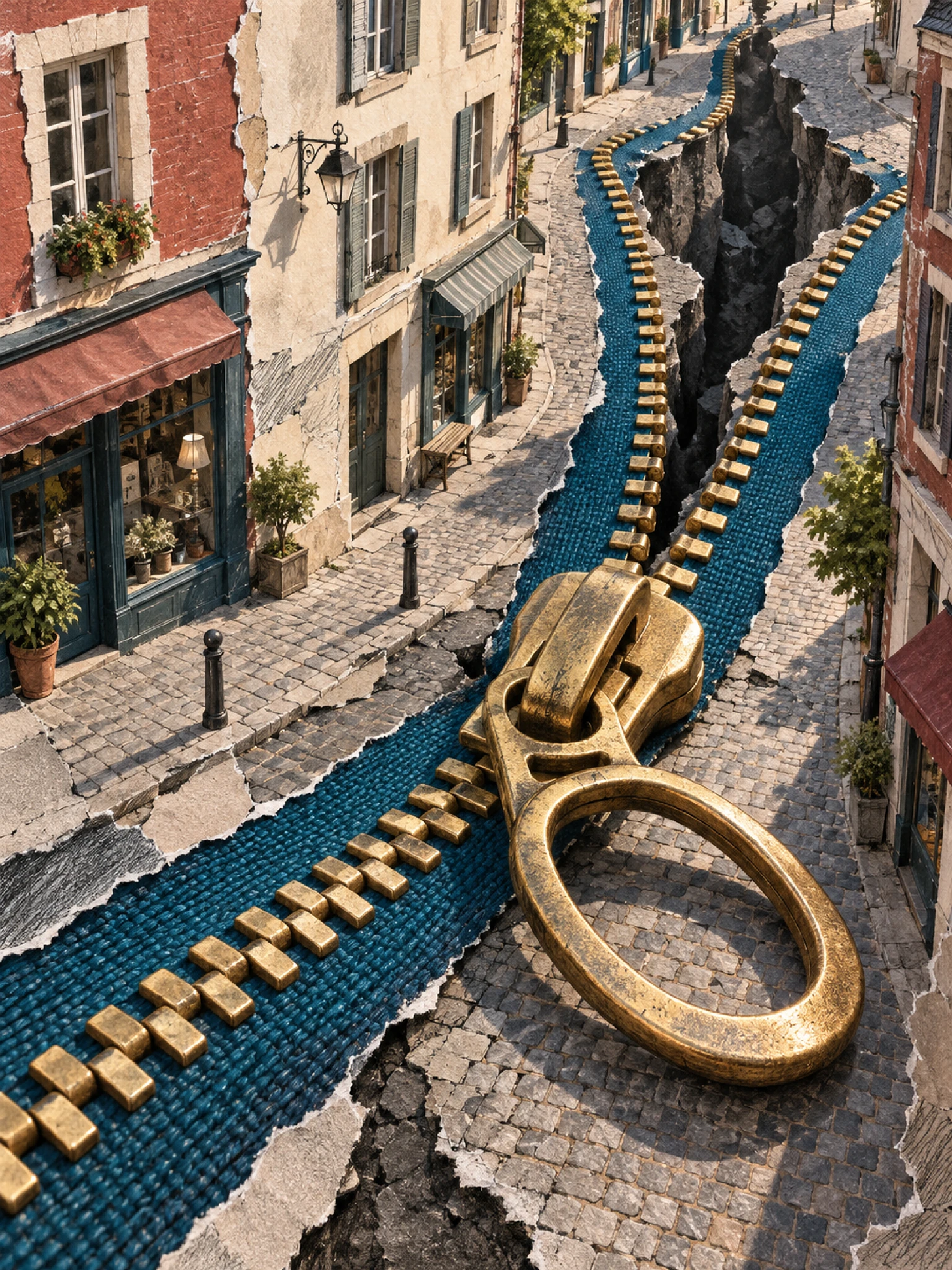
A Zipper Joining Two Streets
An enormous zipper fastens two separated strips of a small-town street. Photographic fragments, torn paper, and drawn connections expand its construction into a surreal urban scene.
Remix this referenceA Zipper Joining Two Streets
- Form language
- Combine recognizable photographic fragments with simplified paper silhouettes; allow small shape mismatches at joins.
- Contour
- Alternate crisp scissor edges, fibrous torn borders, and sparse hand-drawn bridges between fragments.
- Mark-making
- Use mixed-media collage with pencil hatching and dry painted swipes that sometimes cross pasted seams.
- Surface rendering
- Retain photographic tonal detail inside selected cutouts; use rubbed paper fields and abrupt pasted tonal transitions elsewhere.
Priority
Keep photographic, torn-paper, and drawn contributions visibly distinct yet coherent.
What to avoid & what to check
Exact prompt for this example
MODULE OWNERSHIP
subject: Subject count, type, stable proportions and landmarks, resting face geometry, hair shape, physical materials, garment construction and permanent marks. No emotion, movement, color assignment or rendering recipe.
expression: Facial soft-tissue displacement and pupil direction, muscle coordination, regional intensity, asymmetry and onset/peak/release. No head/body pose, stable appearance, skin color or rendering.
gesture: Head/neck/body/limb orientation, joint movement, support, contact and pose-caused occlusion using existing anatomy. No eye/pupil movement, emotion, identity, props inventory or camera.
props: Prop count, type, construction, physical material and scale relative to the subject. Holding/contact belongs to gesture, position to composition, color to palette.
scene: Environment elements, terrain, backdrop/floor presence and structural detail. No canvas positions, camera, lighting, assigned colors or render texture.
camera: Projection, focal-length impression, camera elevation/yaw/roll, viewing distance and crop. No actor pose, world placement, lighting or canvas aspect ratio.
composition: Normalized 0-100% canvas positions, scale in frame, depth/overlap, focal hierarchy and margins. No joint pose, camera projection, rendering, subject/prop inventory or emotion.
palette: Color anchors, hue/saturation/value ranges, colors assigned to parts and approximate color coverage. No illumination direction, shading algorithm, physical material or layout.
lighting: Light-source direction/softness/intensity, ambient illumination, physical shadow direction/length and highlight position. Absence of directional illumination is allowed. No shading technique, palette or material changes.
style: Reusable form abstraction, contour weight/taper/edge quality, medium and mark scale/density/direction, surface rendering and tonal transition technique. No fixed subject proportions, anatomy, identity, expression, pose, palette, light-source direction, camera or layout.
output: Image count, aspect ratio, size, file/alpha requirements and global lettering/logo/watermark restrictions. No background scenery, crop, style, identity or pose.

SUBJECT
inventory: One original zipper product, monumental in scale relative to the street; no people or animals.
geometry: Paired tape bands carry partly interlocked teeth; a broad slider has an oversized oval ring pull.
resting-face: No face or facial geometry applies.
appearance: Woven textile tapes, solid metal teeth, and a cast-metal slider form the zipper.

PRIORITY


AVOID


CHECK


PROPS
inventory: No separate props.
construction: No prop construction applies.

PRIORITY


AVOID


CHECK


SCENE
inventory: A small-town street with cobbles, sidewalks, shopfronts, upper windows, and an open ground fissure.
structure: The street divides into two intact strips beside the fissure and rejoins as a continuous paved passage.

PRIORITY


AVOID


CHECK


CAMERA
projection: Use perspective with a moderately wide-lens impression and clear recession.
viewpoint: Look obliquely down the street from an upper-story height, with no camera roll.
crop: Include the complete slider and pull; let the long zipper and nearest façades extend beyond the frame.

PRIORITY


AVOID


CHECK


COMPOSITION
placement: Set the slider just right of center; the joined section runs toward the lower-left edge.
depth: The pull overlaps the street; separated tapes recede between staggered façade layers toward the upper right.
spacing: Give the slider first attention, the street junction second; leave an open wedge between distant branches.

PRIORITY


AVOID


CHECK


PALETTE
colors: Use petrol blue, tarnished gold, warm ivory, brick red, and charcoal.
assignment: Make tapes petrol blue, teeth and slider gold, façades ivory and brick red, and the fissure charcoal.
balance: Muted architectural colors occupy most of the image; stronger blue and gold distinguish the product.

PRIORITY


AVOID


CHECK


LIGHTING
sources: Soft daylight comes from the upper right, supported by broad ambient light.
shadows: The slider and façades cast broad, moderately short shadows toward the lower left.
highlights: Bright catches sit on the pull's upper-right rim and exposed upper edges of the teeth.

PRIORITY


AVOID


CHECK


STYLE GUIDE
form-language: Combine recognizable photographic fragments with simplified paper silhouettes; allow small shape mismatches at joins.
contour: Alternate crisp scissor edges, fibrous torn borders, and sparse hand-drawn bridges between fragments.
mark-making: Use mixed-media collage with pencil hatching and dry painted swipes that sometimes cross pasted seams.
surface-rendering: Retain photographic tonal detail inside selected cutouts; use rubbed paper fields and abrupt pasted tonal transitions elsewhere.

PRIORITY
Keep photographic, torn-paper, and drawn contributions visibly distinct yet coherent.

AVOID


CHECK


OUTPUT
format: One finished image, portrait 3:4, 1536 × 2048 pixels, opaque PNG.
restrictions: No lettering, logos, or watermarks.

PRIORITY


AVOID


CHECK


FINAL INTEGRATION
subject + scene + composition: The product and street should form one readable visual event while retaining their separate constructions.
lighting + style: Shared illumination connects collage fragments without erasing their differing edge and surface treatments.
Model information comes from image provenance. The same prompt may produce a different result.